
A food grade conveyor belt replacement should be approved against the original machine specification, the actual food-contact duty and product-specific compliance evidence—not by colour or an “FDA” suffix. Before ordering, verify the belt’s carrying face, underside, reinforcement, edges, splice, attachments and pulley route; then confirm that the cleaning procedure and any required documentation apply to the proposed finished assembly.
A white belt can match the original width and length yet introduce an unapproved coating, a different seam or exposed textile reinforcement. For maintenance engineers, QA teams and purchasing managers, the goal is a documented, repeatable replacement decision—not a general catalogue of belts for food factories.
This guide addresses replacement approval and supplier documentation. For selecting belt families across produce, bakery, meat and packaged-food operations, use LKBELT’s food-processing application overview instead.
What Makes a Conveyor Belt Suitable for Food Contact?
“Food grade” is a convenient purchasing term, not a complete regulatory determination. The appropriate question is whether the specific material and finished article can be used with the food, time, temperature and conditions involved in a defined operation. The surrounding machine and its cleaning procedure need their own assessment.
For US applications, the FDA’s explanation of food-contact material components describes how the authorization status of constituent substances and their intended uses affect an article’s regulatory position. A supplier may be able to provide applicable declarations, a letter of guaranty or other supporting evidence, but the wording and scope of that evidence must match the selected construction and use.
For the EU, the European Commission’s food-contact materials guidance explains the framework of Regulation (EC) No 1935/2004, good manufacturing practice under Regulation (EC) No 2023/2006 and material-specific rules where applicable. The Commission also describes the additional framework for plastic materials and articles under Regulation (EU) No 10/2011. Do not assume a coating name establishes which provisions apply to a multilayer finished belt; obtain the relevant compliance evidence for the proposed article.
A white or blue belt is not automatically approved for food contact. Nor is every operation inside a food factory a direct-contact application. A sealed carton conveyor and a line carrying unpackaged sliced food can require different evidence even if they use belts of the same size.
Replacement Gate 1: Confirm Food Contact and the Existing Approval
Before comparing belt catalogues, map the position of the belt in the process. Record whether the food is unpackaged, whether it may be oily or sticky, and what can realistically touch the belt during production and sanitation. Include ambient and product temperature, exposure time, washdown frequency and any potential cross-contact between raw and ready-to-eat areas.
In produce sorting, water, plant debris and frequent cleaning may dominate the inspection requirements. A dough transfer needs attention to release behaviour, residue at the edge and the geometry of the transfer point. A raw protein line may have different hygiene controls and cleaning chemicals from a line transporting closed food packs. These are application descriptions, not claims that one universal belt material is approved for any of those uses.
The application overview identifies the relevant operating position; here the task is different: decide whether the proposed replacement assembly is equivalent to, or an approved change from, the installed belt.
Obtain the facility’s actual sanitation and quality requirements before selecting a belt. If the process changes from protected packs to direct food contact, do not treat the earlier belt approval as automatically transferable.
Replacement Gate 2: Compare the Offered Construction With the Original
Food-processing equipment can use different belt constructions. They are not interchangeable merely because each appears smooth or is described as food grade.
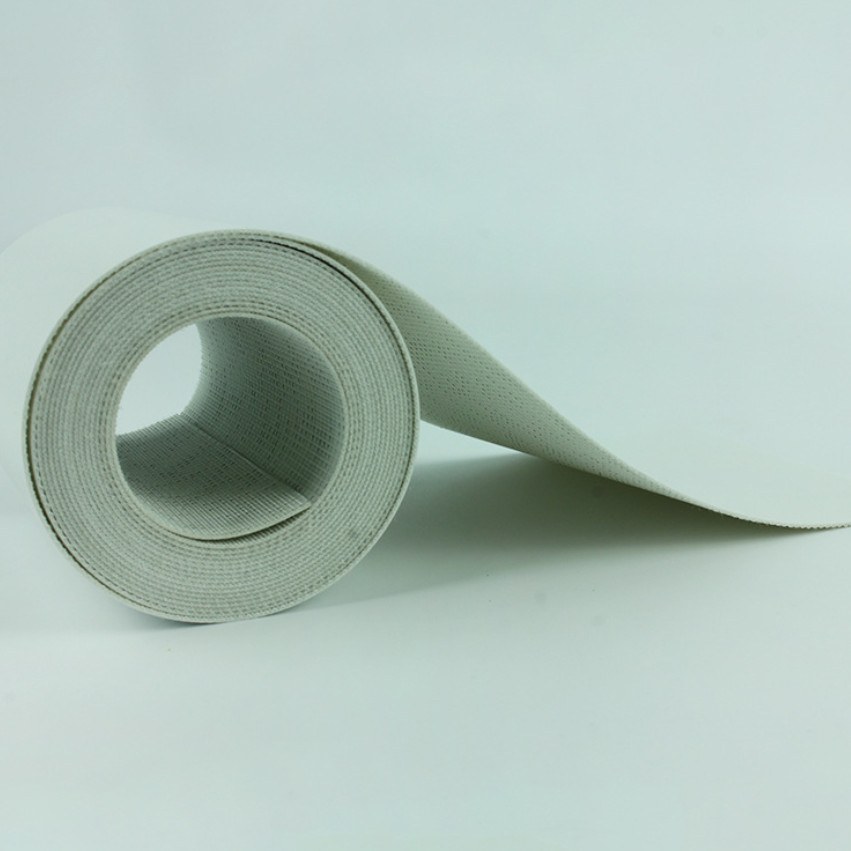
Fabric-reinforced PVC and PU belts
A coated-fabric belt contains a polymer carrying face combined with a reinforcement and a defined underside. Its construction can support common conveying arrangements, but its fabric, edge and joint must be considered during cleaning and wear inspection. Damage that exposes reinforcement needs assessment under the site’s hygiene and maintenance procedure; a clean-looking top surface does not resolve an inaccessible underside or damaged seam.
The LKBELT PB10W-FDA white PVC belt is a concrete example: the public product page shows a white PVC carrying face and a fabric underside, and requests finished dimensions and joint information. Its model name is an identification reference. The suffix does not itself verify food-contact compliance for a specified food or market.
The LKBELT transparent PU conveyor belt is shown as pale translucent roll material. Its page requests belt grade, finished size, joint, pulley/support details and food-contact documentation where relevant. A model-range table on that page must not be treated as the exact specification of the photographed roll. Ask for the offered model’s drawing and data.
Similarly, the R-1M0910-N-FDA PU belt has a blue surface and visible woven underside in LKBELT’s public photographs. The page requests temperature and operating details for heated duty. Do not infer a temperature rating, heat resistance for a different process or food-contact authorization from the page title or model suffix alone.
Homogeneous, modular and open-structure belting
A homogeneous or monolithic belt may avoid exposed textile layers within its main body, but welds, attachments, damage and machine access still require inspection. Modular plastic belts have hinges and connecting rods; cleaning access and material suitability depend on the specific design. Open metal or mesh structures can be relevant where drainage or airflow is required, but the joint, mesh geometry, temperature and machine drive are different selection problems.
These are construction families for comparison, not an assertion that LKBELT supplies or certifies every family or every sanitary conveyor system. A supplier proposing a different type must verify drive engagement, take-up, support, cleaning access and the machine manufacturer’s requirements. Dynamic Conveyor’s food-grade belting selection discussion illustrates how tensioning and access can differ between conveyor systems; it should not be read as evidence that all food belts must be tensionless or self-tracking.
Replacement Gate 3: Compare the Evidence Before Ordering
The following checklist ties a purchasing choice to a particular verification task rather than ranking PVC, PU or another material as a universal winner.
| Selection question | Evidence to collect | Why the answer changes the belt specification |
|---|---|---|
| Does food directly touch the belt? | Food category, contact surface, time, temperature and market | Determines the relevant food-contact evidence and accepted use conditions |
| What is the complete belt construction? | Model/drawing, coating, backing, reinforcement, edges and joint | Identifies what can contact food, retain soil, flex or wear |
| What does cleaning expose? | Chemical names, concentrations, contact time, water pressure and drying | Tests compatibility of the cover, underside, seam and attachments with the approved cycle |
| Where can residue collect? | Access to underside, return path, guides, seam, edges and hardware | Determines inspection access and any machine-level hygiene limitations |
| Will the belt fit the machine? | Finished width and loop length, pulleys, bed, reverse bends and take-up | Prevents a material substitution that changes traction, bending or joint clearance |
| What documents are required? | Market-specific declaration or supporting evidence, grade/lot identification, supplier approval | Makes the approved construction and permitted conditions traceable |
| How will the first belt be accepted? | Drawing revision, inspection and agreed trial criteria | Reduces the risk of repeating an unapproved substitute in subsequent orders |
For a packaged-food conveyor, the decisive information may be handling, underside friction and the cleaning performed on the machine. For an unpackaged-food conveyor, contact documentation and hygiene acceptance can become early decision gates. Neither case eliminates the need to verify the finished belt’s mechanical fit.
Replacement Gate 4: Inspect Cleanability and Conveyor Access
A belt surface and the conveyor system around it cannot be evaluated separately. Accessible cleaning on the carrying face does not prove that liquid, residue or damaged material is absent from the return run, seam or underside. Check the complete route with the plant’s quality and maintenance personnel.

Four areas deserve explicit attention:
- Carrying face and product release. Record tackiness, surface texture, debris and residue after production; verify that the surface and the chosen cleaning procedure are approved for the food and belt.
- Edges and reinforcement. Inspect cuts, fraying, lifting layers and places where fabric becomes exposed. Record whether the original edge finish is part of the accepted design.
- Joint and attachments. Review splice geometry, possible crevices, cleats and guides. Determine whether their material and placement are included in contact and cleaning documentation.
- Underside and conveyor access. Identify rollers, bed surfaces, scrapers and inaccessible pockets. Confirm the equipment’s approved method for reaching and inspecting them.
Do not recommend steam, soaking, high-pressure spraying or chemical concentrations without the machine OEM’s and belt supplier’s instructions. Powered equipment should be isolated for physical inspection under the site’s energy-control procedure. Cleaning-in-place claims and access to the conveyor frame are machine-specific, not implied by the word food grade on a belt.
The separate LKBELT food conveyor belt cleaning guide addresses cleaning-method selection and inspections in more detail. Here, the purpose is to make cleanability a documented part of buying and approving the replacement.
Replacement Gate 5: Verify US/EU Food-Contact Documents
First identify the destination market and the intended food-contact conditions. For direct-contact positions, ask the supplier to identify the offered belt construction and provide relevant documentary support. Documentation should be checked for applicable material, use restrictions, food type or simulant where specified, temperature and contact duration. Exact requirements vary by jurisdiction and product; do not claim a single certificate establishes all regulatory compliance.
A useful supplier response connects four things: a named product, the finished belt or assembly covered, the intended use, and the supporting evidence. Request revision identifiers and available traceability information so future replacement orders can be matched to the approved design. If a different coating, textile reinforcement, joint or attachment is offered, document whether the prior evidence still applies or new confirmation is required.
For EU plastic food-contact articles, the European Commission’s legislation summary explains Regulation (EU) No 10/2011 and its amendments, including changes introduced by Regulation (EU) 2025/351, where applicable. Refer to the current legislation and the relevant transition provisions; do not rely solely on an old declaration or a generic statement about plastic migration. A purchaser should ask the responsible technical and quality teams to determine which declarations and supporting tests are applicable to the specific construction; this article is not a compliance certification or a substitute for regulatory review.
For US orders, FDA food-contact substance notifications and other authorizations can be specific to the manufacturer, substance and intended use; ask the supplier to identify the basis relevant to the offered material rather than requesting an imaginary universal ‘FDA certificate.’ Food safety is not established by a model designation, photograph, surface colour or a claim that the supplier uses “FDA material.” If compliance evidence is missing, keep the proposed substitute in a pending technical/QA approval status rather than describing it as suitable.
Replacement Gate 6: Verify Fit With the Existing Conveyor
A replacement can satisfy a material-level request and still fail installation. Record the original belt reference, finished endless circumference, width, thickness and measurement basis. Photograph both faces, the edge, joint and any guides or cleats. If the used belt is worn or elongated, reconcile dimensions with the machine drawing and accepted supplier reference instead of assuming the used loop represents the original specification.

Show the drive and return path: smallest contacted pulley, reverse bends, support bed, belt face at each contact, take-up travel, installation access and any required joint clearance. A coated-fabric belt is not necessarily compatible with a positive-drive system; a belt approved for a rotating pulley is not automatically approved over a fixed nosebar.
The LKBELT PU dumpling-machine belt demonstrates why finished processing details matter. Its public page shows a white PU face, shaped openings and rows of edge holes, and requests a dimensioned opening layout, hole pitch, edge offsets and joint position. That product should not be treated as a universal food-grade replacement or an approved match for every dumpling machine. The original pattern, equipment and food-contact evidence require verification.
When the proposed material differs from the original, compare the underside, reinforcement, finished joint and bending requirements—not merely the nominal width and polymer. LKBELT’s PVC vs PU conveyor belts guide deals with the material-substitution question separately; the present article addresses the broader food-contact and sanitary purchasing decision.
Two Practical Food-Line Replacement Scenarios
Scenario A: Ready-to-eat slicing line with an incomplete declaration
Hypothetical engineering example. A maintenance buyer needs a replacement belt for a line transferring unpackaged ready-to-eat portions. The offered white PVC belt matches the old belt’s width and loop length, but the supplier has not identified the exact finished construction covered by its food-contact documents.
The buyer should not approve the substitute solely from the colour, code or matching dimensions. Procurement requests the grade/drawing and intended-use evidence, while QA reviews the food, time, temperature and sanitation requirements. Engineering checks the underside, splice, pulley route and accessibility. If the new joint or material differs, all parties agree which approval and trial steps are required. The outcome remains pending until the specific product and conditions are supported.
Scenario B: Wet produce line with a changed cleaning cycle
Hypothetical engineering example. A produce conveyor originally used a fabric-reinforced belt. The site changes its washdown procedure, and a different PU construction is proposed during routine replacement. The new sample looks smooth and has the correct width, but its underside and seam differ.
Maintenance documents where water reaches the return run and whether the belt can be inspected and dried. QA checks the cleaning media and food-contact conditions, while the supplier confirms the offered construction’s exposure limits. Engineering reviews the pulleys, supports and joint passage, then establishes a representative first-belt acceptance trial. A material change is justified only if the required evidence and machine fit support it—not because PU is assumed to be easier to clean.
Food Grade Conveyor Belt Replacement RFQ and First-Article Approval
Send each shortlisted supplier the same technical package so offers can be compared as finished belt assemblies:
- Food and process: direct or indirect contact, food type, product condition, exposure time, normal and peak product temperatures, destination market and line position.
- Equipment: conveyor manufacturer/model, drawing, drive arrangement, support bed, smallest pulley, reverse bends, take-up, fitting access and operating duty.
- Original belt: model and drawing revision if available, width, finished loop length and measurement basis, total thickness, carrying face, underside, reinforcement, joint and edge finish.
- Processed features: guides, cleats, holes, profiles, sidewalls, spacing and tolerances, with photographs and dimensioned drawings.
- Sanitation: approved detergents and sanitizers, concentrations, temperatures, frequency, rinse/dry steps and equipment access restrictions.
- Compliance and purchasing: applicable documentation for the exact grade and use, available traceability, quantity, proposed deviations, sample requirements and acceptance authority.
Before releasing repeat quantities, reconcile the belt label and supplier drawing with the approved specification. Inspect finished dimensions, both faces, edge quality, splice and attachments. Qualified site personnel should complete installation and any authorized running tests using OEM procedures. QA should confirm that the approved cleaning and hygiene verification requirements have been satisfied; engineering should document tracking, contact, joint passage and operating fit under representative conditions.
Keep the accepted drawing revision, product identification, lot or batch traceability when available, inspection and trial records, document versions and approved deviations with the purchasing record. An initial quotation is not the same as an approved replacement, especially when the plant’s contact or cleaning conditions have changed.
Frequently Asked Questions
Is a white or blue conveyor belt automatically food grade?
No. Colour helps visual identification, but the actual material, construction, intended use and applicable supporting documentation determine suitability.
Do food-grade PVC and PU belts need different approval checks?
Both require product-specific review. Compare the proposed complete assembly, its regulatory evidence for the intended market and the cleaning and machine conditions. Do not approve either solely by its polymer label.
Can I use a supplier’s general FDA statement to approve a finished belt?
A general claim is insufficient if it does not identify the relevant material, intended conditions and applicable basis. Obtain the evidence needed for the actual belt and use, then have the responsible quality team review it.
Is a homogeneous belt always more hygienic than a fabric belt?
Not universally. Construction affects possible damage and access points, but sanitation also depends on the joint, attachments, conveyor design, operating conditions and validated procedures.
What if a replacement belt fits but has a different underside or joint?
Treat those changes as deviations. Confirm support friction, drive and pulley compatibility, cleaning exposure, and any effect on the existing approval before accepting the replacement.
Should a replacement food conveyor belt be approved before buying a production quantity?
Where the site requires qualification or the proposed construction differs, agree on a first-belt review and acceptance process covering fit, relevant documentation and the facility’s hygiene requirements before repeat orders.
Conclusion
A reliable food grade conveyor belt replacement is a controlled change—or verified like-for-like purchase—of a specific finished assembly in a specific food-processing duty. Start with product contact and the destination market, then verify documentation, cleanability, underside and joint construction, and the equipment route. Record approvals and deviations so the next replacement is repeatable.
For an LKBELT technical quotation, send the food and cleaning conditions, equipment drawing, original belt code, both-face and seam photographs, finished dimensions and required documents. That gives the supplier and your engineering/QA teams a concrete basis for reviewing a proposed belt rather than relying on a generic food-grade label.