
Two belt samples can look suitable for the same conveyor while hiding different undersides, reinforcement and joining requirements. Replacing PVC with PU on appearance alone can leave the original handling problem unresolved and introduce a new fit problem.
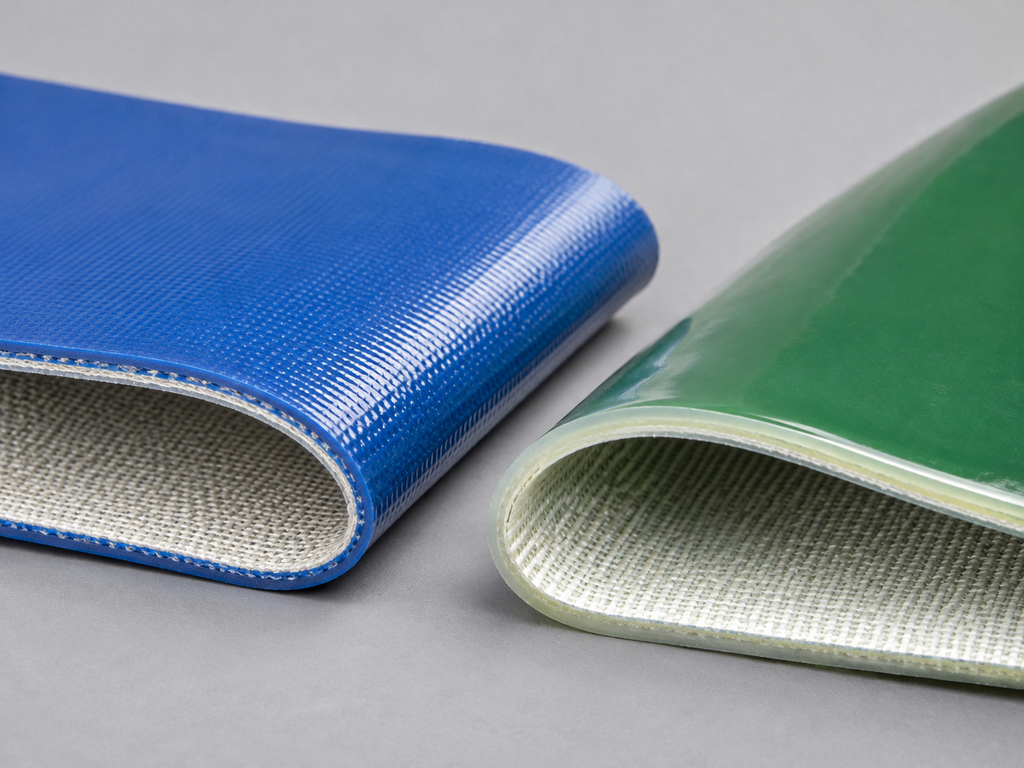
Choose between PVC and PU conveyor belts by matching the complete belt construction to the product, conveyor and operating conditions. Compare the carrying surface, underside, reinforcement, finished thickness, joint and pulley limits. Then confirm cleaning compatibility and any food-contact documentation. Neither material name establishes a universal performance or cost advantage.
A useful PVC vs PU conveyor belt comparison starts with the existing belt specification and the reason for considering a change.
PVC vs PU Conveyor Belts: What’s the Main Difference?
PVC means polyvinyl chloride; PU means polyurethane. In the fabric conveyor belts discussed here, these names identify the coating material within a finished construction. The textile reinforcement, running face, surface finish and joint complete the specification.
A PU-coated fabric belt differs from a homogeneous or monolithic PU construction. PVC-coated fabric also differs from modular plastic belting assembled from linked sections. PU timing belts and round transmission belts serve different drive functions and require separate selection criteria. The guide to types of conveyor belts explains these construction families in more detail.
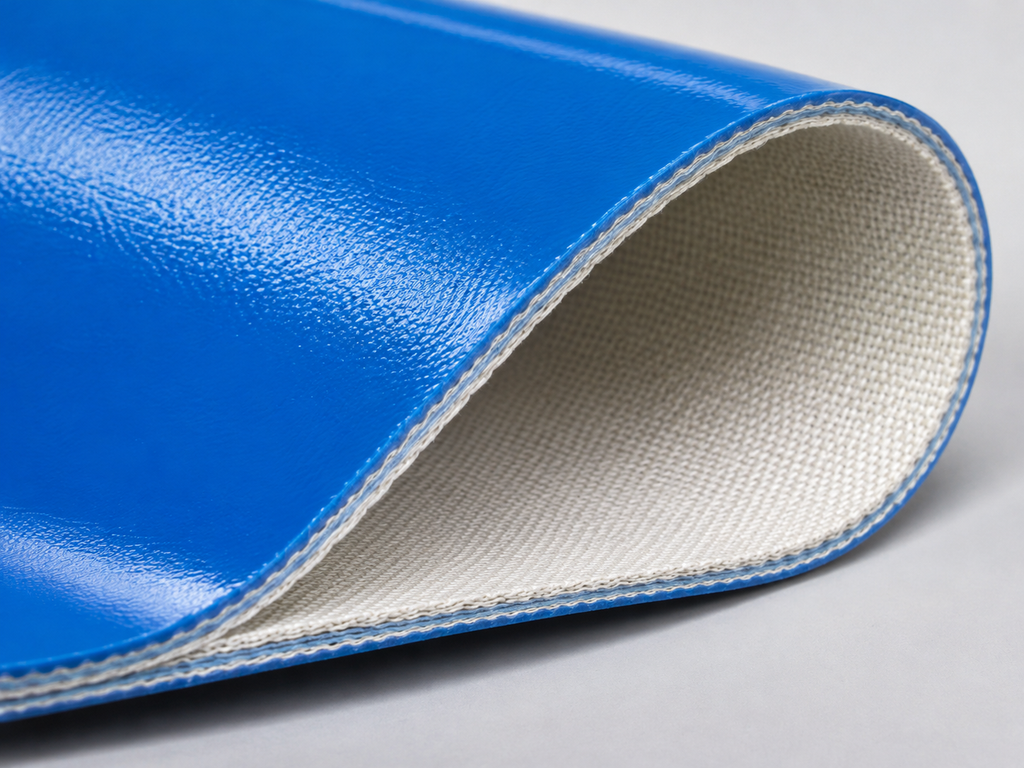
LKBELT’s blue PVC flat conveyor belt illustrates the distinction. Its published description identifies a blue glossy carrying surface and fabric underside. Ordering still requires finished length, width, total thickness and tolerances. The separate PVC range table does not establish the photographed sample’s ply count or operating limits.
Material identification narrows the candidates. The offered model and finished assembly determine what you are actually buying.
How PVC and PU Belts Differ in Industrial Applications
Carrying surface and underside perform different jobs
The carrying face must move the product as intended. A carton needs suitable grip during acceleration; a sticky product may need reliable release at discharge. Texture, product condition and contact pressure affect that interaction. A smooth appearance or a blue, white or green colour cannot establish actual friction.
The underside meets the support bed and drive pulley. Specify whether the conveyor uses sliding support, carrying rollers or a combination, and identify return-side contacts. A material change at the top does not automatically improve drag underneath. Habasit’s Fabric Conveyor Belts Engineering Guide explains the influence of support surfaces and pulley contact on fabric-belt operation.
Identify the exposure behind the wear
Before requesting a different polymer, describe where damage begins. Carrying-face abrasion, underside polishing, edge rubbing and joint separation are different findings. A PU alternative should address the identified exposure through supported construction data or an agreed trial. Changing cover material alone does not correct a misaligned support or unsuitable joint.
Oil resistance also requires a defined exposure. Identify animal fat, vegetable oil, lubricant or another medium, together with contact duration and temperature. Include moisture and mechanical abrasion. Evaluate PVC and PU formulations against those conditions rather than treating either material as universally resistant or unsuitable.
PVC vs PU Conveyor Belt Comparison Table
| Selection factor | PVC conveyor belt | PU conveyor belt | What buyers must verify |
|---|---|---|---|
| Dry packaging and product contact | An existing PVC belt can remain suitable for cartons when grip and release meet the duty | Assess a PU alternative against the same carton movement, stopping and release needs | Representative products, surface finish and any accumulation |
| Sliding-bed and underside contact | The blue PVC example has a fabric underside to match to the bed and drive | R-2M0845-AG is double-fabric PU; changing the cover does not establish lower underside drag | Running face, bed finish, pulley contact and actual wear location |
| Oil, grease and cleaning chemicals | Retain a PVC candidate when its documented formulation covers the actual exposure | Select a PU grade only with evidence for the specified media and cleaning cycle | Chemical identity, concentration, temperature and contact duration |
| Temperature and duty | Check the offered PVC model against product heat, cold operation and cleaning | Check the PU assembly under the same continuous and temporary exposures | Model limits, sliding heat and wet operating conditions |
| Thickness, reinforcement and pulleys | Match the complete PVC construction to every contacted pulley | R-2M1712-FDA lists 1.3 mm, two layers and a 20 mm minimum pulley; other PU models differ | Model-specific forward/reverse bending and finished-joint approval |
| Finished joint and replacement fit | Match the splice profile to scrapers, supports and installation access | Equal width and thickness do not make a PU assembly interchangeable | Joint thickness, local flexibility, attachments and complete belt route |
| Food contact and cleanability | PB10W-FDA identifies a white PVC fabric-backed belt; intended-use evidence is still needed | A PU label likewise requires documentation for the selected construction | Contact conditions, permitted cleaning and accessible edges/seams |
| Initial cost and application value | A conforming PVC offer remains valid without a material upgrade | Accept a different price only against specified benefits and acceptance criteria | Comparable finished quotations, installation and documented service evidence |
Food Contact, Cleaning and Chemical Compatibility
Direct food contact needs construction-specific evidence
A belt carrying unpackaged food has different contact requirements from one carrying sealed cartons. Record the food, contact time and temperature, destination market and surfaces exposed during use. LKBELT’s food-processing applications provide context for distinguishing those conveyor positions.
For U.S. applications, FDA guidance on food-contact material components explains that regulatory status depends on the constituent substances and intended use. Request the applicable declaration or supporting material documentation, permitted contact conditions and identification of the offered construction. Review joints and attachments where relevant to contact.
LKBELT’s PB10W-FDA white PVC conveyor belt has a documented white carrying face and fabric underside. The FDA suffix identifies the model; it does not independently demonstrate compliance for your process. Its separate PVC range table also does not define this model’s thickness or ply count. Obtain those finished specifications with the contact documentation.
Compare the actual cleaning cycle
Give suppliers the detergent and sanitizer identities, in-use concentrations, contact times, temperatures and frequency. Include rinsing, water exposure and drying. The relevant question is whether the offered cover, underside, edges, joint and profiles tolerate that cycle while remaining inspectable.
Forbo’s chemical resistance guide for Siegling Transilon coatings distinguishes coating types and recommends testing with the actual media under operating conditions. Its ratings describe Forbo materials and cannot establish resistance for an LKBELT belt.
Ask for applicable resistance evidence and agree any necessary testing. A visually clean surface does not establish that the assembly meets the plant’s sanitation acceptance requirements. The food conveyor belt cleaning guide covers procedure selection and inspection of the finished assembly.
Belt Thickness, Reinforcement and Pulley Compatibility
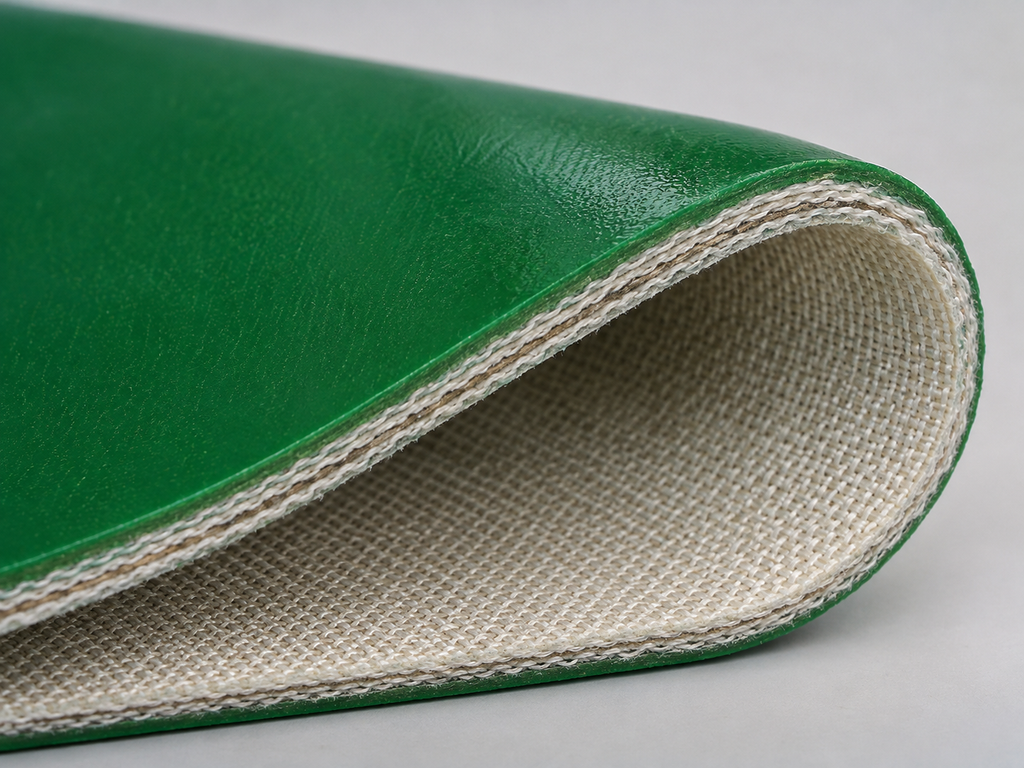
LKBELT’s R-2M0845-AG industrial PU conveyor belt is identified as a 4.5 mm double-fabric construction. Its product views show the carrying face, fabric underside and layered edge. That combination is more useful for replacement identification than a generic request for a green PU belt. It does not establish tensile capacity, chemical resistance or food-contact suitability.
The transparent PU conveyor belt is shown separately as pale translucent roll material. On that page, the range-table row for R-2M1712-FDA lists 1.3 mm thickness, two layers and a 20 mm minimum pulley. These values describe that named model, not automatically the photographed roll or R-2M0845-AG.
A published pulley value is a starting reference for the identified belt. Confirm its application to the finished joint, actual tension, contact arrangement and operating conditions. Reverse bending needs its own review. Approval around a rotating small pulley does not establish suitability over a stationary nosebar, where the underside also slides.
Specify the finished joint profile and local flexibility, especially where it passes scrapers, supports or transfers. Include cleats, guides and sidewalls in the bending and clearance review. A replacement with the same overall thickness can still have a different reinforcement arrangement or splice.
Temperature review belongs here too. Distinguish continuous duty from brief exposure, and product temperature from ambient, cleaning and sliding-contact conditions. Include cold and wet operation and any heated drum. An ordinary PVC or PU conveyor belt should not be selected for oven transport without specific approval.
When Should Buyers Choose PVC or PU?
For dry packaging, retain an existing PVC construction when carton handling, underside contact, pulley fit and operating limits meet the requirement. First establish whether a reported problem comes from the belt construction or the machine. A PU substitution needs a specific benefit and agreed acceptance criteria.
For frequently cleaned food conveyors, compare eligible PVC and PU options against the same food-contact documentation, cleaning chemistry, joint construction and installed route. Eliminate options that cannot support the intended use or approved cleaning cycle. Compare the remaining constructions through representative handling and inspection checks rather than favouring a polymer label.
For small pulleys or reverse bends, start with approved model-specific bending data and the finished joint. Reinforcement, total thickness, attached profiles and bend direction can decide suitability before coating preference does. A nominal minimum pulley value does not independently approve a reverse bend or fixed nosebar.
Compare purchase cost alongside installation, cleaning compatibility and credible service evidence. Without representative operating data, a promised lifetime saving remains an estimate.
Two Practical Industrial Selection Scenarios
Scenario A — Dry packaging conveyor
In this hypothetical example, sealed cartons travel on a flat slider-bed conveyor. Maintenance reports wear underneath the existing PVC belt, and purchasing receives a PU alternative quotation.
First identify the wear location and inspect the bed, contamination and belt route under the machine’s approved procedure. Confirm carton grip, release at discharge and whether packs accumulate. LKBELT’s logistics and material-handling applications distinguish straight conveying, transfers and other package-handling duties.
Compare the two offers using the same finished width, loop-length reference, thickness, underside, joint and pulley arrangement. Ask whether the proposed construction addresses the actual underside wear. PVC may remain appropriate if it meets those requirements. Any additional PU cost needs evidence tied to this conveyor’s duty.
Scenario B — Food-processing line with frequent cleaning
In this hypothetical example, unpackaged food contacts the belt and the conveyor undergoes frequent wet cleaning. Purchasing compares eligible PVC and PU constructions for an existing pulley route and joint arrangement.
Provide food-contact conditions and the full cleaning cycle. Check coating compatibility, underside access, edge condition and seam cleanability. If adhesion at discharge is a concern, include representative product in the assessment. Obtain documentation for the offered construction and review forward and reverse bends with the supplier.
Agree first-belt acceptance with engineering, maintenance and QA. It should cover fit, product movement, joint passage and inspection after the approved cleaning cycle, together with the site’s required hygiene verification. Neither a PU label nor a white PVC surface substitutes for that approval.
What Should Buyers Include in a PVC or PU Conveyor Belt RFQ?
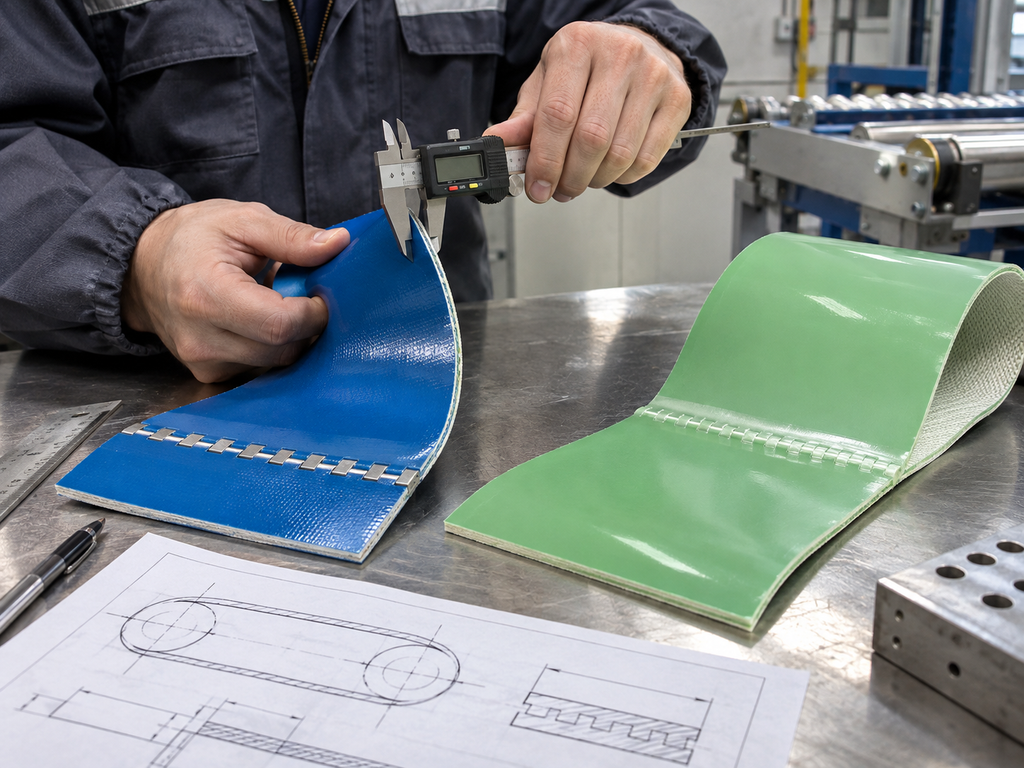
Send the same information to each supplier so quotations describe comparable assemblies:
- Machine and existing belt. Conveyor manufacturer, model, drawing, belt position, original product code and material reference. Add photographs of both faces, edges and the joint.
- Product and surface. Conveyed goods, direct or packaged contact, surface colour, texture, grip or release needs and any non-marking requirement.
- Finished construction. Underside, reinforcement, width, loop length with its measurement basis, total thickness and tolerances.
- Installed route. Drive and smallest contacted pulley, sliding or roller support, reverse bends, nosebars, take-up and relevant operating tension information.
- Joining and processing. Joint type, finished profile, installation access, and dimensions and positions of guides, cleats or sidewalls.
- Duty and exposure. Speed, load, operating cycle, temperatures, oil or grease, and cleaning chemistry, concentration, time and water exposure.
- Documentation and acceptance. Food-contact evidence where required, quantity, approved sample, proposed trial and how deviations will be reported and accepted.
A material-level inquiry asks what PVC or PU options exist. A replacement specification defines the installed belt. An approved alternative construction adds an explicit review of differences and acceptance against the machine and process requirements.
Width, colour and nominal polymer are insufficient to establish interchangeability. Keep the accepted construction and drawing revision with the repeat-order reference.
Frequently Asked Questions
Is PU always better than PVC for conveyor belts?
No. Compare identified constructions against the actual product, support arrangement, exposure and purchasing requirements. PU needs a supported application benefit to justify a change.
Can PVC conveyor belts be used in food processing?
Suitable constructions can be considered when their documentation covers the intended contact and use conditions. Neither PVC nor PU has blanket approval for every food application.
Do all PU conveyor belts resist oils and cleaning chemicals?
No. Confirm the exact formulation, media, concentration, contact time and temperature, including the finished joint and attachments.
Which material works with smaller pulleys?
Use model-specific bending data for the complete construction. Thickness, reinforcement, joint, profiles and bend direction prevent a reliable answer based on polymer alone.
Can equally sized PVC and PU belts replace each other?
Only after reviewing the remaining specifications and approving any differences. Include the underside, reinforcement, joint, installed route and required documentation.
Conclusion
Choose PVC or PU by matching the finished belt to the conveyed product, machine and exposure. Compare specific constructions, resolve documentation requirements and agree how a proposed alternative will be accepted.
For an LKBELT replacement quotation, send the original belt reference, both-face and joint photographs, finished dimensions, conveyor drawing and operating and cleaning conditions. Identify the problem the replacement needs to solve so the proposed PVC or PU construction can be reviewed against it.