
One supplier quotes an aramid-cord replacement. Another quotes a Kevlar-cord belt with the same nominal dimensions. Before approving either offer, find out where the reinforcement sits, what it does and which finished construction the supplier is quoting.
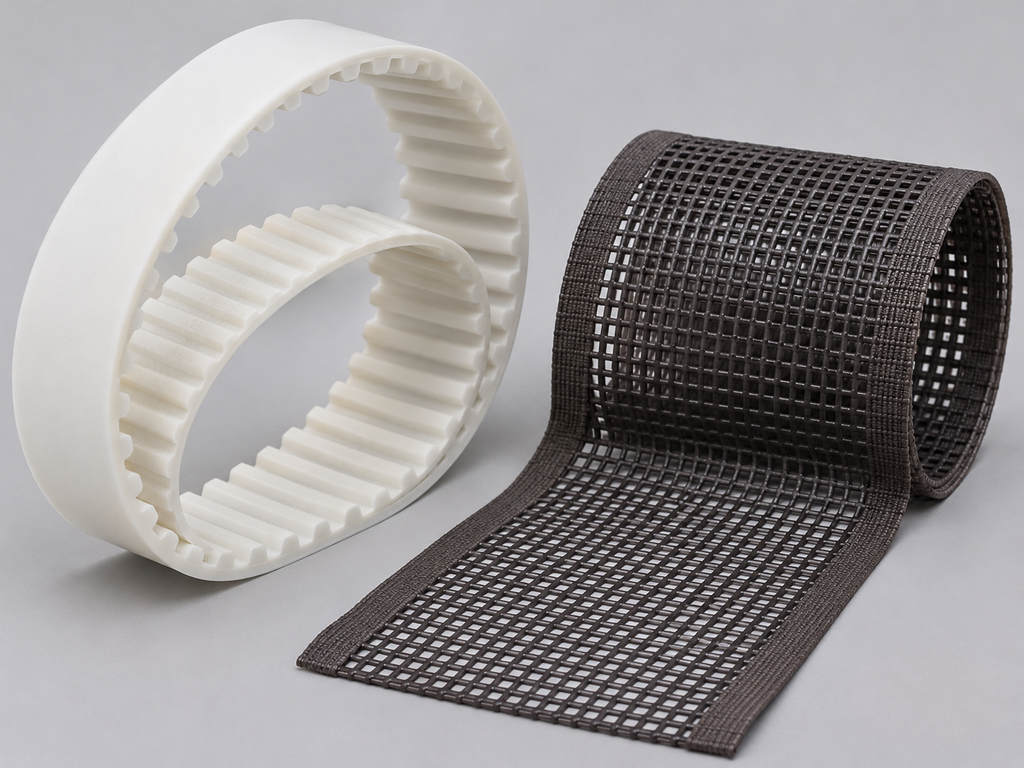
Kevlar® is a branded para-aramid fiber within the broader aramid family. For industrial belts, compare the actual cord, fabric or mesh construction and the ratings for the finished belt. Confirm working load, extension, pulley compatibility, supply form and operating environment before accepting a substitution. Request traceability when the fiber brand is part of the specification.
Is Kevlar Different From Aramid?
Aramid means aromatic polyamide. Para-aramid fibers are often selected for tensile strength or stiffness. Meta-aramids often serve thermal protection and other specialized textile applications. The two categories have different property profiles. Teijin identifies Twaron® and Technora® as distinct para-aramid products and Teijinconex® as a meta-aramid. Compare the exact grade for the intended role. Teijin Aramid material classification
Arclin identifies Kevlar® as a para-aramid fiber. Arclin acquired the Kevlar® business from DuPont on April 1, 2026. Arclin acquisition announcement In a quote, “aramid” identifies a family and “Kevlar” names a brand. A cord specification goes further by identifying the converted reinforcement. Depending on the design, it may describe the cord construction, diameter, arrangement and treatment for bonding to the belt body. Ask how the supplier identifies the cord and how it verifies branded fiber if the purchase requires it. Arclin Kevlar® fiber information
What Does Aramid Reinforcement Actually Do in a Belt?
In a synchronous belt, longitudinal cords carry tensile load and influence how much the belt changes length under load. The teeth transmit force at the pulley. Cord stiffness and tooth capacity describe different limits. In a V-belt, the cords carry tensile load while the sidewalls contact the sheave grooves. In a fabric carcass or open mesh, yarn arrangement can affect behavior along and across the belt. The same fiber name can therefore refer to different load paths and different purchasing checks. Conveyor belt reinforcement guide
Where Is Aramid Used in Industrial Belts?
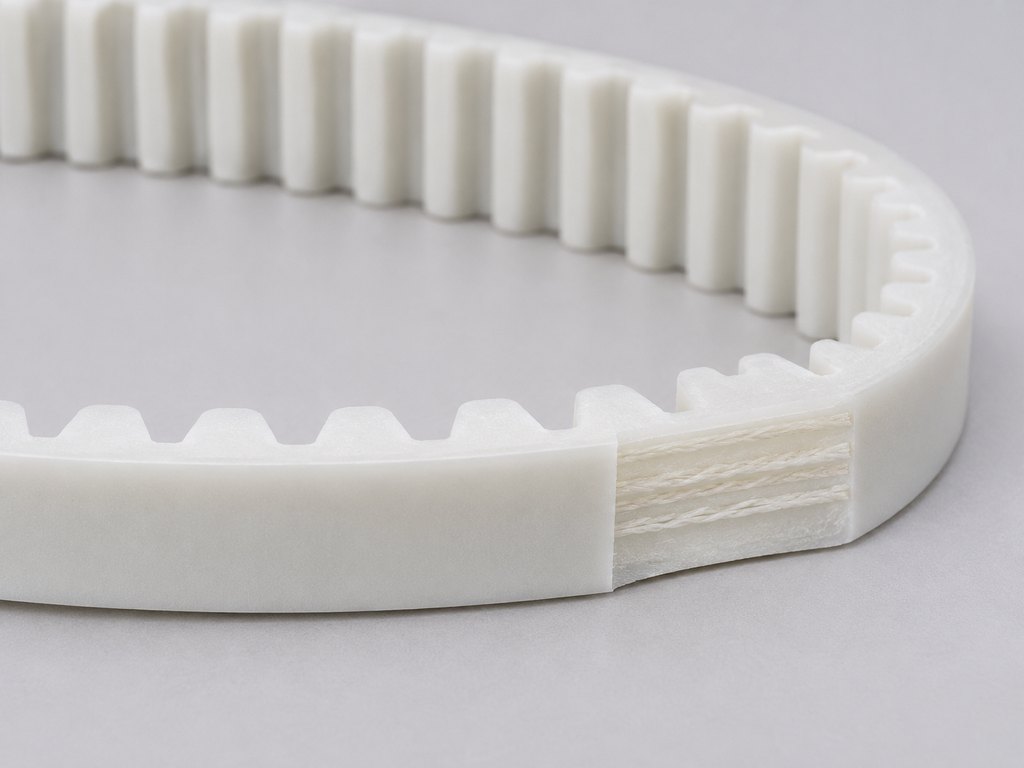
T10 polyurethane timing belt
LKBELT’s published T10 PU timing belt listing names a Kevlar-cord construction. Its profile table includes a T10 row with a 10 mm pitch and lists other tooth profiles. Use the T10 row as a profile reference. Ask for the exact drawing and technical sheet for the offered variant, including the cord specification, finished width and tooth count or pitch length. Confirm the mating pulley geometry and whether the belt arrives open-ended, joined or manufactured endless. If branded fiber is mandatory, request documentation covering the offered variant.
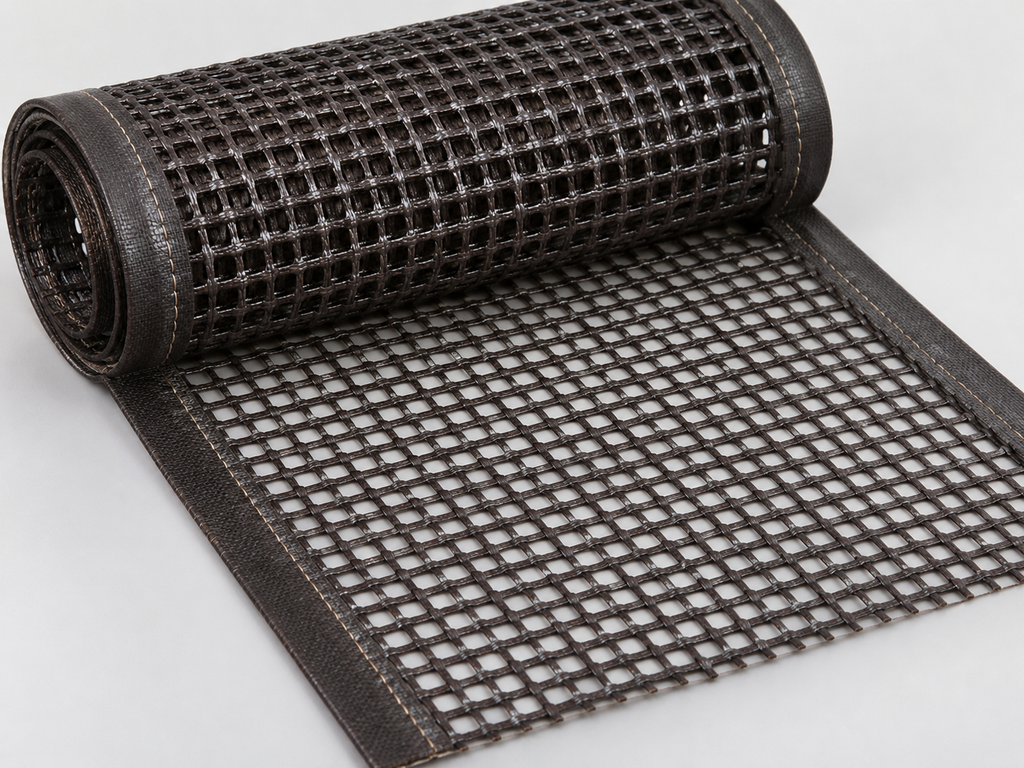
PTFE-coated mesh conveyor belt
LKBELT’s PTFE-coated mesh conveyor belt range lists item 6007 with a 4 × 4 mm mesh opening, fiberglass + Kevlar reinforcement, 1.2 mm thickness and 600 g/m² weight per unit area. Those are catalogue entries for that item. Here the reinforcement is part of the open mesh. Confirm how the mesh is oriented in the finished belt and ask the supplier to identify the direction and test basis of any strength data used for selection. Specify edge treatment, seam, operating tension and thermal duty for the complete loop. A mesh opening shared by two items is only one part of the replacement specification.
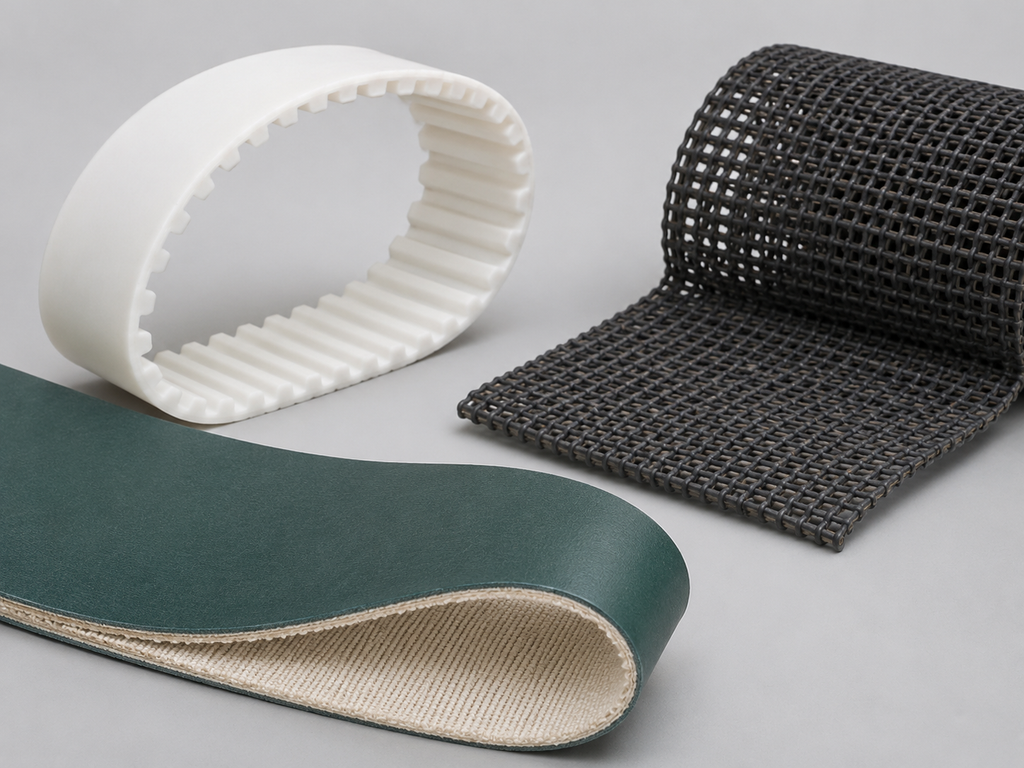
Industrial V-belts
Gates identifies aramid tensile cords in its Predator™ Single Belts. This is an example of aramid in a specific V-belt construction. For a V-belt replacement, confirm the section, length reference, sheave groove, pulley sizes, installation tension and drive rating for the actual product. Load still has to pass through the groove interface, so pulley condition and fit remain part of the review. Gates Predator Single Belts
How Should Buyers Compare Aramid, Polyester, Fiberglass and Steel?
Use the exact manufacturer data in the same belt family. Polyester, fiberglass, steel and aramid appear in different belt constructions. A comparison between a steel-cord synchronous belt and a polyester-reinforced conveyor belt tells little about substitution because the load path and duty differ. Even within one synchronous profile, available cord variants can have different stiffness and flex requirements. BRECOflex documents multiple tension-member choices and distinguishes tensile behavior from tooth strength in its own timing belts. BRECOflex tension-member materials
For a proposed alternative, ask what force the finished belt can carry at the required speed and how far it extends under the actual load. Compare data on the same basis, including belt width, test conditions and units. Give the supplier start-stop frequency and peak or shock loads. Ask which pulley, idler and environmental limits apply to the offered construction. If the machine controls position tightly, agree on the allowable movement under load before comparing the quotes.
Does Kevlar Reinforcement Mean Less Stretch or Longer Belt Life?
Breaking strength, allowable working tension and extension at a given load answer different questions. Breaking strength describes a failure test. Allowable working tension is the supplier’s service limit for the specified construction and conditions. Extension data describe how the belt changes length under load. For an indexing drive, ask for finished-belt load–elongation data near the actual operating load, and clarify whether a reported change is elastic extension, permanent change after cycling or another measurement.
If the original belt fails early, show the supplier where damage begins. Tooth wear, a separated joint or damage concentrated at a backside idler can point to different checks. Cord construction, its bond to the body and repeated bending all affect how the belt behaves. Reviewing only the reinforcement name leaves those checks open.
What Determines Heat Resistance and Small-Pulley Compatibility?
Map the route over every driven pulley and idler, including backside idlers, wrap and reverse bending. Ask for the minimum approved diameters for the exact finished belt, distinguishing forward and reverse bends where the supplier does so. Cord diameter and construction, belt thickness, load and joint all influence repeated flexing. Check the actual routing even when a proposed belt seats correctly on the teeth at rest. Conveyor belt splice types and bending compatibility
For thermal review, separate ambient air from actual product contact temperature. Record steady and peak exposure, duration, speed, tension and what happens during a stop. For a PU timing belt, request limits for the body, reinforcement interface and finished construction. For a PTFE mesh belt, include the mesh, coating, seam and edge treatment. Ask the supplier to state which limits apply under load and with the specified humidity, chemicals or cleaning exposure.
How Should Buyers Read Aramid and Kevlar Belt Specifications?
Start with the original marking, drawing revision and supplier designation. Treat colour and part-number suffixes as identification clues. Have the manufacturer decode any suffix, including “K,” before specifying a replacement. Ask for a technical sheet that identifies the exact variant and whether the reinforcement is longitudinal cord, fabric or part of a hybrid mesh.
Put brand and substitution rules on the RFQ. If the OEM mandates branded fiber, ask for evidence of provenance. If a generic para-aramid alternative is permitted, record the operating limits and acceptance criteria it must meet. Ask each supplier to list deviations in writing so the technical reviewer can compare the same features across offers.
Aramid-Reinforced Belt Selection Matrix
| Belt or specification case | What the source establishes | What buyers must verify | Purchasing implication |
|---|---|---|---|
| LKBELT T10 PU timing belt | Published Kevlar-cord designation and T10 profile reference | Cord specification, load and extension, pulley route and supply form | Compare the exact variant with the original drive |
| LKBELT PTFE mesh item 6007 | Listed opening, hybrid reinforcement, thickness and areal weight | Directional data, finished joint and edges, working tension and exposure | Approve the complete mesh assembly for the process |
| Gates Predator Single Belt | Aramid tensile cord in a named V-belt family | Exact section, sheave fit, length basis, drive rating and tension | Use the manufacturer’s selection data for that model |
| Generic aramid designation | Reinforcement family named | Role, exact grade and construction, provenance if required | Record the approved reinforcement in the order |
| Proposed cord substitution | Alternative submitted for review | Working load, extension, flexing, environment and machine approval | Resolve deviations before ordering |
Two Practical Industrial Scenarios
Replacing a T10 packaging drive belt
Suppose an indexing drive uses a PU timing belt marked T10 and the OEM drawing specifies aramid cords. Two suppliers match the width and tooth count, and one names Kevlar. Provide the pulley drawing, backside idler route, peak load and installation tension. Ask each supplier for its finished-belt extension at the relevant load, approved bend limits and supply form. Review whether the frame can accept the offered loop. If the OEM allows a generic para-aramid substitute, approve against the same operating and dimensional criteria as the branded offer.
Replacing a PTFE mesh process belt
Suppose the removed belt is identified as LKBELT item 6007. A proposed fiberglass-only replacement has the same aperture. Compare finished width, length, support, running direction, edges and joint, then ask for allowable tension and thermal limits for the supplied loop. Record the hottest contact and what happens if the line stops under load. If process airflow or product release is sensitive to the mesh, agree a representative trial before approval. The substitution decision covers both how the mesh handles the product and how the assembly runs through the machine.
What Should Buyers Specify Before Ordering?
Send the same baseline to each supplier.
- Machine and original belt. Manufacturer, model, position, original part number, belt family, marking photos and drawing revision. Describe the failure or performance concern.
- Finished construction. Length and measurement basis, width, thickness, cord or fabric specification, branded fiber requirement if applicable, and joint or endless supply form. Include tooth profile, pitch and tooth count for a timing belt, or mesh opening, direction and edge treatment for a mesh belt.
- Machine duty. Load, operating tension where known, speed, start-stop cycle, pulleys and idlers, reverse bends, support and installation access. State continuous and peak temperature, exposure duration, humidity, chemicals and cleaning conditions.
- Approval and order. Request the offered drawing, applicable load and extension data, permitted bends, environmental limits and evidence for any specified fiber brand. State allowed substitutions, sample or test requirements, quantity and delivery needs.
Compare the supplier’s stated limits with the machine duty and record the approved variant and deviations. Check the delivered marking, dimensions and construction against the purchase drawing. Agree separately on fit or operating trials where positioning, airflow or product behavior matters.
Frequently Asked Questions
Does every aramid belt contain Kevlar®?
Aramid is a material family. Request supplier documentation when the brand or grade is part of the purchase specification.
Is a Kevlar-cord timing belt stronger than a steel-cord belt?
Compare allowable working load, tooth capacity and extension for the exact belts. Include pulley bends, speed and shock loads.
Can aramid raise the belt’s temperature rating?
Use the supplier’s rating for the complete assembly under the stated exposure and load. Confirm the body, joint and edge limits where applicable.
Can I identify aramid from the belt colour or a “K” suffix?
Use the manufacturer’s marking guide, technical sheet or written confirmation for the exact part.
Can an aramid-cord belt replace a polyester-cord belt directly?
Check the permitted substitution against the machine specification. Confirm service load, extension, pulley path, dimensions and environment before approval.
Conclusion
Kevlar® identifies a para-aramid brand. A replacement order also needs the role and construction of the reinforcement, the finished belt dimensions and the supplier’s operating limits. Compare those details against the machine, its pulley or support path and the actual duty.
For a quotation, send LKBELT the original belt marking, drawing and operating requirements, including any mandatory cord or mesh specification.