
A packaging line can contain several belts that look similar but perform different jobs. One feeds flat carton blanks into a folder-gluer, another controls a package between opposed surfaces, and a wider conveyor carries sealed cases away. Replacing all three by matching only width and material can introduce feed errors, surface marks or an installation problem.
Choose a packaging conveyor belt by its exact machine position, the product surface it contacts and the finished belt path. Confirm the required grip or release, both belt faces, reinforcement, width, loop length, thickness, joint and smallest pulley. For replacement purchasing, retain the original belt or machine reference and verify any change against the actual package range rather than assuming that a general-purpose flat belt fits every packaging station.
The practical distinction is between a belt that merely transports a finished package and a belt that controls the position of paperboard, film or a pouch during an operation. A packaging conveyor belt for finished cartons is not automatically a suitable replacement for a narrow carton feeder or folder-gluer belt.
Which Belts Are Used at Different Packaging Stations?
The phrase packaging conveyor can describe an entire machine or only one of its belts. Dorner’s packaging conveyor applications cover pouches, cartons, boxes, product turning, merging and transfer through a range of conveyor-system designs. These are useful application categories, but the completed machine’s functions do not identify the construction of a replacement belt.
For a belt inquiry, start by labelling the machine position and the part that touches the material. LKBELT’s printing, paper and packaging application guide distinguishes sheet feeding, folding and gluing, synchronized machine positions and finished-pack transport. The following questions turn those broad process labels into usable belt specifications.
Carton-blank feeding and separation
A feeder advances flat sheets or carton blanks from a stack or upstream station. Its required contact depends on the board grade, surface coating, dust, printed face and the machine’s separator or pickup arrangement. Some machines use narrow belts, paired tracks or perforated belts in a dedicated feed mechanism; others have more conventional flat runs.
Feed reliability is not a coating-color decision. If a feeder double-feeds, slips or skews blanks, first establish when the problem occurs and whether the same result appears across light and heavy stock. A worn cover may reduce useful traction, but separator settings, dust, moisture, alignment or another component can create similar symptoms. Record the original belt face, position and machine settings before a substitute is approved.
Measure the finished belt and note whether several belts must run as a matched group. For narrow or multiple-track feeders, record each track position, belt count and the OEM matching requirement instead of treating visually similar loops as interchangeable. For machines with a synchronized feed or vacuum hold-down, keep the original drive and process references. Ordinary PVC or PU flat-belt photographs are not proof that the offered construction is approved for precision feeding or vacuum service.
Folder-gluer and opposed-belt positions
A folder-gluer may grip paperboard between upper and lower belts while the blank is folded and glued. The belts can experience pressure contact, repeated bending and a narrow installed route. In these positions, a change in cover thickness, compressibility, grip or joint profile can affect movement and contact with printed stock even if loop length is correct.
Habasit’s folder-gluer belt technical overview shows why specialized paperboard-processing belt constructions are treated separately from ordinary conveying belts. That is an engineering reference, not a specification or performance claim for an LKBELT model.
For replacement, identify whether the belt acts as a feeder, upper pressure belt, lower drive/control belt or discharge belt. Record the mating belt or pressure surface, setting range, direction, smallest pulley and original joining method. Do not assume that any fabric-backed PVC belt can replace a specified folder-gluer belt. Confirm LKBELT’s supply and processing suitability for the exact OEM reference before describing it as an alternative.
Flexible pouches and finished-package transport
Film bags, stand-up pouches, wrapped units and cartons behave differently on a conveying surface. A flexible pouch can present seams, gussets, folds or a shifting load. A rigid carton presents a more defined footprint but may have exposed tape, labels or printed surfaces that are sensitive to rubbing. A tote has its own feet or runners.
At the finished-package stage, check the actual package range: smallest footprint, heaviest item, lightest item, center of gravity, underside details and any accumulation or handover. LKBELT’s logistics and material-handling application page provides a related way to record cartons, parcels, bags and transport conditions. The same method is useful for secondary packaging, although a line’s handling functions must still be confirmed from its machine design.
An opposed-belt pouch gripper or bottomless conveyor is a distinct mechanism. It requires its own pressure, clearance, traction and machine approval. A general PVC or PU conveying belt listing does not establish approval for the opposed-belt position, or supply of the complete gripping system.
Packaging Belt Selection by Machine Position
A useful purchase comparison begins with the work done by the belt, not an assumed material ranking.
| Machine position | What the belt must control | Evidence to collect | Supplier / OEM approval focus |
|---|---|---|---|
| Carton blank feeder | Single-sheet advance, grip and release across stock grades | Board samples, contact face, separator condition, position reference | Correct working surface, thickness, joint and matched-belt geometry |
| Folder-gluer upper/lower position | Carton grip under pressure and repeated bends | Upper/lower identifiers, mating belt, pulley path, pressure/clearance | Specialist construction and permitted replacement deviations |
| Wrapped-product or pouch conveyor | Transport without unstable shifting or surface damage | Package sizes, gussets/seams, weight range, contact photographs | Surface behavior, support and release at the actual duty |
| Finished-case discharge | Carton movement through transfer and stopping points | Package footprint, gap, stops, belt speed and load | Surface, finished length, joint, pulley and support compatibility |
| Incline or guided conveying position | Product retention and controlled tracking | Incline, cleat/guide drawings, direction and return route | Attachment geometry, clearances and approved belt build |
| Machine drive or timing position | Motion transmission, rather than product carrying | Original toothed/flat drive code, mating pulleys, drive duty | Exact drive-belt family and profile; do not substitute a conveying belt |
The table is a scoping tool. It does not imply that LKBELT has a confirmed finished belt for every listed mechanism. A supplier quotation becomes meaningful only when the proposed construction matches the actual position and its acceptance criteria.
How Should Buyers Compare Belt Surfaces and Constructions?
Carrying-face grip, release and marking
For carton blanks and printed packs, collect the actual material and printed side used in production. A belt may move one plain kraft-board grade acceptably yet leave visible rubbing on a coated or printed grade. Paper dust, adhesive residue and humidity can change the contact conditions during the run. Distinguish a surface defect on the package from a mechanical feed or alignment issue.
A textured covering is not universally preferable: it may change the contact pattern, while a smoother face may offer different grip and release behavior. Ask for an approved sample and compare the result on the actual carton or pouch. Do not describe a belt as “non-marking” without a defined material and representative test.
Underside, reinforcement and pulley path
A belt’s visible top face says little about its underside or reinforcement. The underside can slide over a bed, travel across rollers or contact a drive pulley. Depending on the installed route, the other face can contact a backside roller. A narrow feeder loop may also pass over smaller or reverse-bend rollers than the larger finished-pack conveyor.
Record every contact that imposes a bend, including the smallest pulley, drive contact, reverse bends, tensioner and guides. Ask the supplier for the selected model’s permitted geometry, working limits and finished-joint requirements. Published dimensions or bend data for one grade should not be transferred to another model.
The existing conveyor belt transfer-point guide explains the separate geometry of end rollers, fixed nosebars and product handover. For this packaging article, the purchasing question is narrower: can the proposed finished belt pass the actual station’s path and release the specific package without unacceptable snagging or scuffing?
Joint condition and surface continuity
Joint construction is especially important where a product repeatedly contacts a narrow belt or travels through a pressure zone. Note the seam orientation, thickness transition and local flexibility, then inspect whether surface marking or feeding variation repeats at the same belt position. A visible repeated mark is evidence to investigate, not proof that the joint is necessarily the cause.
Review joining options against the selected belt and installed machine rather than selecting a splice by appearance. LKBELT’s conveyor belt splice guide explains general approaches; a packaging-machine joint still requires specific approval for its pressure, bending and contact duty.
Which LKBELT Belt Products Are Relevant Starting References?
LKBELT shows different belt families that can support an initial specification discussion. These are documented base-belt examples for a specification discussion, not universal replacements for specialist packaging-machine belts.

The blue PVC flat conveyor belt has a photographed glossy blue carrying surface and fabric underside. Its page asks for finished dimensions, the joint and conveyor arrangement. That makes it a candidate family to review for a packaging transport duty where the actual surface, friction and bending requirements have been established. The photographs alone do not verify a particular feeder, film-contact or folder-gluer performance rating.
The transparent PU conveyor belt range shows pale translucent material in roll form, with separate model entries on the page. Its appearance does not certify release behavior, food contact or suitability for a small pulley. Confirm the exact grade, finished construction and documented operating limits instead of carrying over figures from another model in the table.
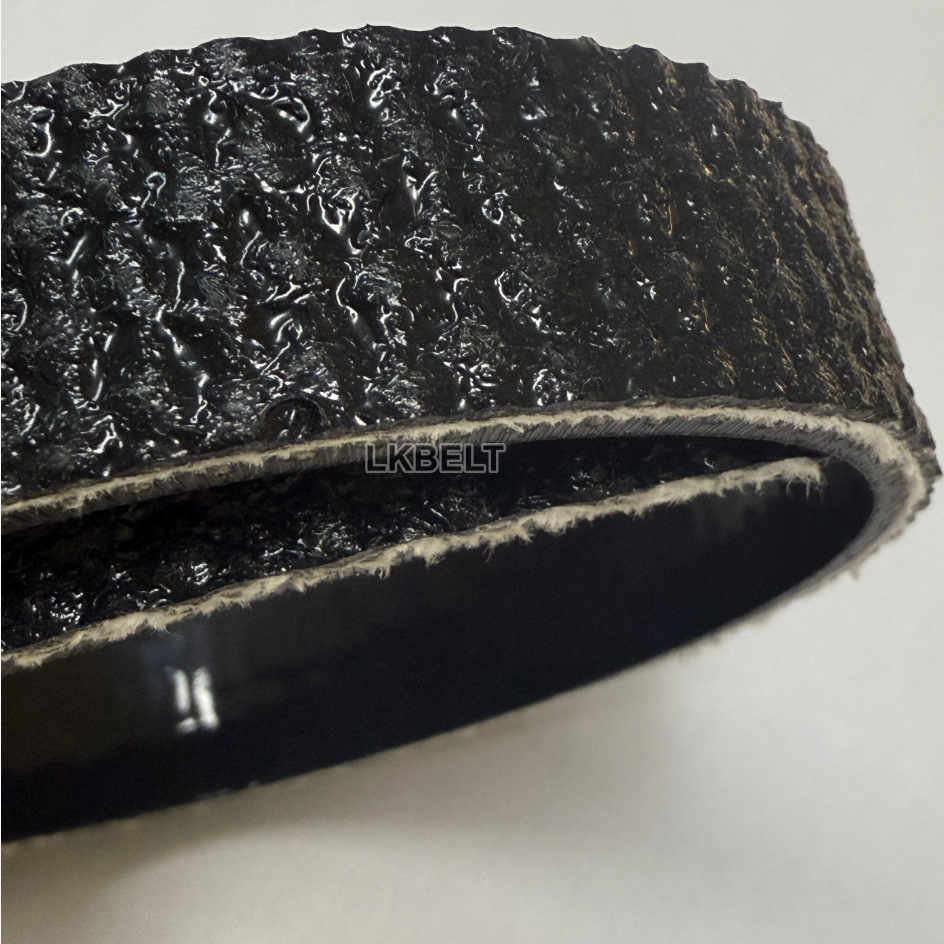
The PVK logistics conveyor belt is presented with a dark-grey textured carrying face and visible woven texture for logistics conveying. It may be relevant when studying parcel or case-handling duty, but a PVK label is not a specification. Confirm its actual offered grade, underside, dimensions, load duty and joint before considering it for a packaged-product line.
If the actual position requires opposed gripper belts, a narrow flat transmission belt, a toothed synchronization belt or specialized machine tape, record that distinction before quoting. A product-family resemblance is insufficient evidence of interchangeability.
Troubleshoot the Position Before Changing Belt Material
A replacement request often begins with a symptom rather than a drawing. The maintenance record should help separate belt condition from the rest of the machine.
Double feeding or inconsistent carton pickup. Identify stock grade and humidity, separator status, belt face wear and the time at which irregular feeding starts. Compare good and bad stock under the same authorized machine setup. Do not assume a higher-friction covering will correct a feeder setting problem.
Skew, side drift or edge wear. Photograph the belt position and any frame, guide or pulley contact. Compare the machine’s tracking, tension and alignment requirements with the actual belt dimensions and joint. A different belt cannot compensate reliably for an unresolved machine fault.
Scuffs on printed cartons or film. Record which face is damaged, the repeat interval and whether marks coincide with the belt seam, scraper, guide or a pressure point. Include actual samples in the trial. Do not claim a coating is safe for printed finishes until the result has been observed.
Pouches tipping or catching at discharge. Check package geometry, seam or gusset orientation, belt speed, support gap and the next conveyor’s contact conditions. The separate transfer mechanism may require equipment correction; the belt supplier should receive the drawing and observed defect, not an instruction to change material blindly.
Accumulation wear or heat. Confirm whether packages become stationary while the belt continues moving beneath them. That changes the contact duty. LKBELT’s accumulation conveyor belt guide addresses this specialized subject in more detail; here, record whether it occurs at the packaging position and whether the replacement construction is approved for it.
For physical inspection or repair, isolate the machine according to its OEM and site energy-control procedures. Any powered diagnosis or production trial must be performed by qualified personnel with approved safeguards.
Two Practical Packaging-Belt Selection Scenarios
Scenario A — A carton feeder marks printed stock
In this hypothetical case, a packaging plant changes from plain board to a coated carton blank. Some finished blanks show a repeated mark, while a supplier offers a smooth PVC belt with the same width as the current feeder belt.
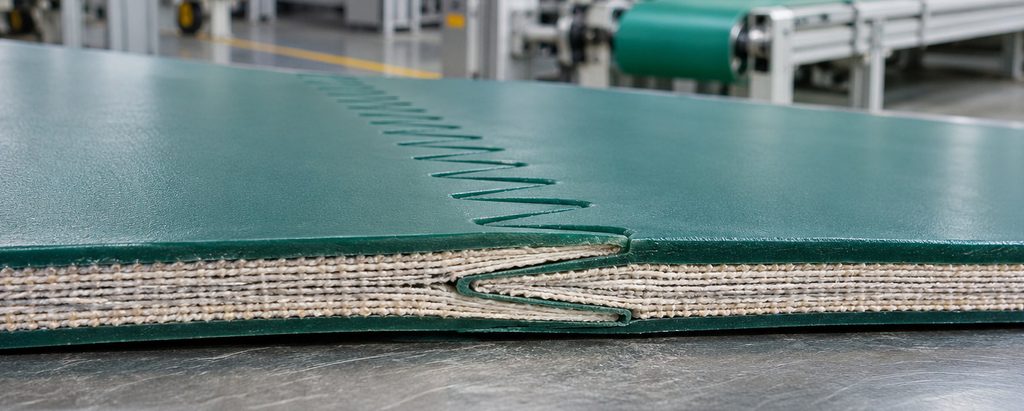
Before ordering, maintenance identifies the exact upper or lower contact position, compares clean and marked sheets, checks residue and photographs the existing belt joint and working face. The team records pulley diameters, the installation’s pressure arrangement and the original belt reference. If the mark correlates with a seam or nearby component, simply choosing a smoother top surface may not resolve it.
The buyer sends the original construction and several representative board samples for evaluation. A candidate is accepted only after the responsible team approves feeding consistency, surface appearance, fit and joint passage over the specified material range. This is a hypothetical decision process, not an LKBELT customer outcome.
Scenario B — Flexible pouches fail at a discharge handover
In this hypothetical example, a line conveys sealed pouches toward case packing. Lightweight pouches sometimes wrinkle or turn as they pass to the next conveyor. Purchasing has quotations for a blue PVC belt and a textured PVK belt.
First document pouch size, fill distribution, gusset and seal locations, orientation, speed and the actual transfer gap. The team checks whether the issue begins on the carrying belt or at the downstream support. Both suppliers must quote a finished assembly against the same belt route, joint, pulley and underside requirements.
A textured face is not automatically the winner. The plant approves a sample using the lightest and most difficult pouches, including checks for release, marks and repeatable positioning. If the true fault is an unsupported gap or incorrect handover timing, the conveyor engineering team addresses that separately. No invented line-speed, cost saving or trial result is required to reach a sound specification decision.
What Should a Packaging Conveyor Belt RFQ Include?
An RFQ should identify the actual belt position rather than request “one packaging belt.” For each position, include:
- Machine identity and function: OEM, model, position label, drawing revision, feeder/folder-gluer/finished-pack/drive role and whether a matched set is involved.
- Product being handled: board or film grade, package size and mass range, printed or coated contact face, orientation and known failure samples.
- Current belt evidence: original part code, photographs of carrying face and underside, edge, joint, marks and any installed attachments.
- Finished dimensions: requested new width, loop circumference or pitch length as applicable, thickness, tolerances and the basis of measurement. Separate worn-belt measurements from an approved original dimension.
- Machine route: smallest pulleys, reverse bends, support bed, drive surface, tensioner travel, guides and installation access.
- Functional detail: grip/release expectation, pressure or opposed-belt interface, accumulation, marking acceptance and any synchronized drive/profile information.
- Working conditions: speed range, starts/stops, dust, adhesives, ink, humidity, cleaning chemicals and relevant product-contact documentation if required.
- Commercial and approval terms: quantities by belt position, required drawings, disclosed deviations, sample review, approval authority and repeat-order reference.
For a belt set spanning several positions, give each position its own code. A single generic sample photograph or nominal material description cannot establish that all replacements are interchangeable.
How Should a Replacement Belt Be Approved?
Separate the evaluation into three decisions. First, check that the delivered item matches the agreed finished specification: dimensions, construction, working face, underside, joint and any guides or attachments. Second, have qualified maintenance personnel confirm that it can be installed and tensioned under the OEM procedure without unexpected contact or clearance problems. Third, perform the approved process trial with the real range of packaging materials.
Use the difficult cases, not only the easiest product: thin and thick carton board, coated and uncoated samples, light and heavy pouches, bags with prominent seals and any planned accumulation condition. Record feeding accuracy, unwanted surface marks, release at transfers, joint passage and belt condition after a representative run. The customer, OEM or responsible engineering team—not the appearance of the belt sample—must decide whether the trial meets the application’s acceptance criteria.
Retain the approved drawing, belt model, lot or order reference, deviations and trial record for repeat purchases. That record reduces the risk of a future reorder drifting into a different construction that happens to have the same width or color.
Frequently Asked Questions
Is a carton feeder belt the same as a finished-package conveyor belt?
Not necessarily. Feeder positions may require specialized grip, pressure contact, narrow geometry or synchronized movement; finished-pack transport has different load, release and handover demands. Verify the actual machine position and original belt specification.
Can PVC or PU be selected from the package material alone?
No. Package contact is one input. Confirm the offered grade, underside, reinforcement, joint, pulley path, exposure and the OEM requirements. A material name does not approve a particular feed or transfer duty.
What should I check if a new belt leaves marks on cartons?
Record the affected stock, contact side and repeat pattern. Inspect the belt face, joint, guides, pressure points and nearby equipment under the approved service procedure before selecting another covering.
Are textured logistics belts suitable for every pouch or carton?
No. Test the actual weight, footprint, seams and printed surfaces; confirm the finished belt and transfer geometry. The published PVK logistics example does not establish compatibility with every packaging line.
Can I replace a folder-gluer belt with an ordinary flat PVC conveyor belt?
Not without validating the specialist machine position, original construction, pressure arrangement, joint and bending duty. Ask the OEM and proposed supplier to approve any changed construction.
What information should I send for several belts on one packaging machine?
Provide a labelled position schedule, original codes, finished dimensions, photographs of both faces and joints, pulley-route drawings, package conditions and required quantities. Keep matched positions and their approval records together.
Conclusion
Packaging conveyor belts should be specified by the job they perform: feeding and controlling carton blanks, guiding flexible packages or carrying finished cases. Match the actual product contact with the belt’s two faces, construction, joint and complete installed route. Confirm specialist machine positions instead of treating every flat belt as interchangeable.
For LKBELT to review a replacement-belt inquiry, send the machine and position references, original belt codes, both-face and joint photographs, finished dimensions, pulley drawings and representative cartons or pouches. Include the observed problem and the acceptance criteria that a proposed replacement must meet.