
A conveyor belt develops a lifted edge near the return side. Maintenance can see the separation but not the reason it began. Ordering another belt with the same width and nominal thickness may reproduce the failure if the machine’s smallest pulley, reverse-bend route, chemical exposure or belt-edge construction remains unchanged.
Conveyor belt delamination is the separation of layers within a multi-layer belt construction. The immediate task is to distinguish an actual bond failure from a damaged joint, lifted coating, torn edge or external debris; the next task is to identify the operating condition that initiated it. A replacement should match the support and bending route, exposure and finished joint—not merely the original colour and dimensions.
What Does Delamination Look Like in a Conveyor Belt?
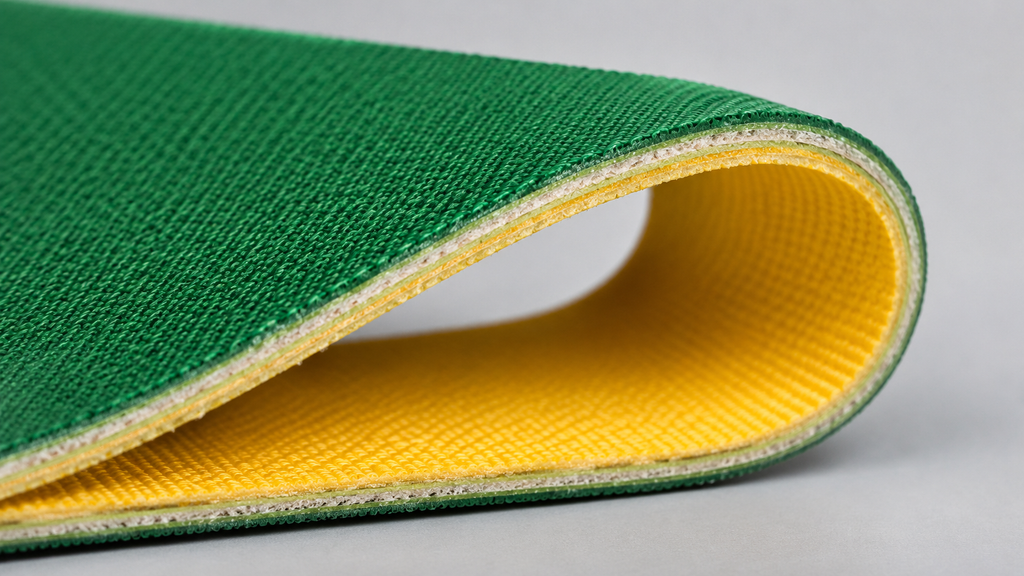
Fabric-reinforced PVC and PU belts can have a polymer cover, one or more textile plies, adhesive or bonding interfaces and a specifically constructed underside. A delamination complaint can describe separation between the cover and fabric, between fabric layers, or around an existing joint. Those failures require different investigations.
Inspect the belt while the machine is safely isolated and access is authorized. Look for where the lifted layer starts, which interface has separated and how the defect travels across the width or along the loop. Record both faces, the belt edge, the splice and a scale reference. A photograph showing a loose flap without the neighbouring structure cannot reliably establish which layer failed.
An exposed textile edge that has been cut or abraded can appear frayed without bond separation farther inside the belt. A visibly raised splice can be a local joint problem. Conversely, a coating that lifts repeatedly away from the fabric at positions distant from the splice may indicate a wider construction or environmental issue.
Do not diagnose bonding chemistry solely from appearance. Confirmation may require the supplier’s manufacturing data, material testing or a controlled examination of a removed sample.
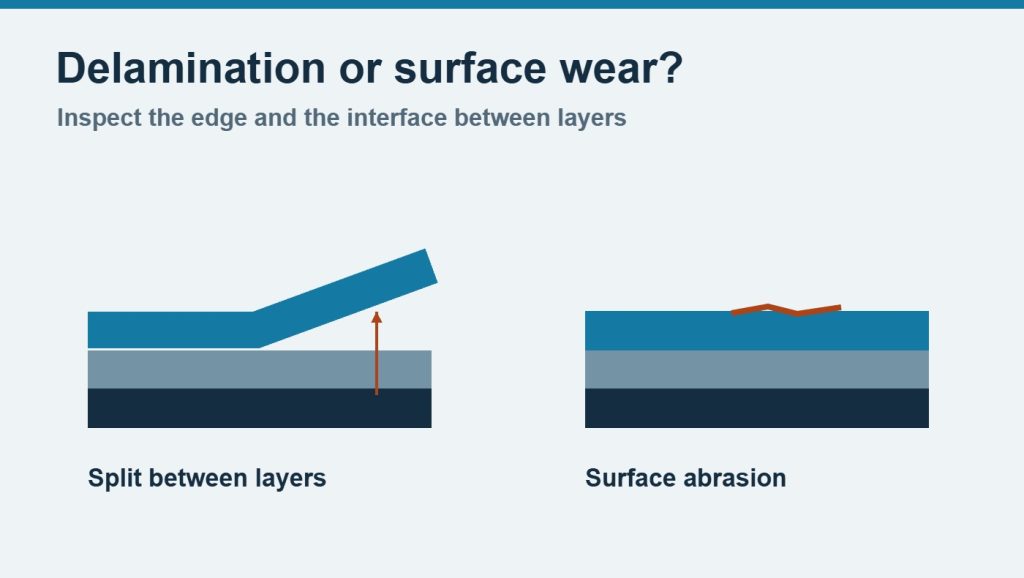
Delamination or a Different Defect? Four Inspection Clues
An accurate description matters because repair instructions and replacement specifications differ by failure interface:
| As-found feature | Do not assume | Evidence to preserve |
|---|---|---|
| Cover peels from intact exposed fabric away from the splice | Every coating lift is a manufacturing defect | Photo of separation boundary and operating contact point |
| Fabric plies visibly separate inside the belt section | A new coating alone resolves carcass failure | Ply count, thickness and bend route |
| Loose step or finger appears only at the joint | The complete belt body has delaminated | Joint type, heat/chemical history and joint orientation |
| Shredded edge or surface abrasion with no layer interface visible | Edge wear proves loss of bond | Guides, side contact, tracking and edge condition |
The photographs should distinguish an observed symptom from a suspected cause. If uncertainty remains, the buyer should mark the failure category provisional and ask for a supplier/OEM review rather than writing "defective adhesive" into the purchase order.
Six Conditions to Investigate Before Ordering Another Belt
Ammeraal Beltech’s Conveyor Belt Technical Manual identifies several delamination contributors in its troubleshooting guidance: tight bends around small pulleys, unsuitable crowning, chemical incompatibility, liquid ingress at cut edges, excessive temperature and repeated reverse bending. These are diagnostic leads, not proof of what failed on a particular LKBELT installation.
1. A pulley or nosebar is smaller than the construction permits
Each pass around a pulley bends the belt through a defined radius. A thicker or more heavily reinforced replacement can experience a different bending demand even if its outer dimensions match. The smallest contacted roller, not only the drive pulley, may govern selection. A stationary nosebar additionally introduces sliding contact; a permitted rotating-pulley diameter does not automatically authorize a nosebar application.
Obtain the actual pulley diameters, contact faces and approved minimum diameter for the proposed belt and joint. Do not use minimum-pulley values from another manufacturer’s product range as a rating for LKBELT.
2. Repeated reverse bending
A lower drive group may take a belt over successive rollers in opposite bending directions. That cycle affects the textile, coating and finished splice differently from a simple two-pulley conveyor. Photograph and draw the complete return route and mark every reverse bend. The general conveyor belt drive types guide provides a separate explanation of drive layouts; the present article addresses their possible relationship to layer failure.
3. Edge exposure and liquid ingress
An unprotected cut edge can expose fabric that contacts washdown water, product liquids or chemical residues. Repeated wetting may affect the interface depending on the construction. A sealed edge may be a useful candidate, but it requires verification of the exact available treatment and the application’s cleaning conditions.
Do not imply that every LKBELT belt is available with a welded or encapsulated edge. Ask the supplier for the specific processing option and its compatibility with the belt’s coating, joint and final width.
4. Chemical or cleaning-system incompatibility
The same solvent, detergent, oil or sanitizer can interact differently with different coatings, adhesives and joints. Record the actual liquid, concentration, temperature, contact duration, rinsing and drying. A statement that a belt is “PU” or “PVC” cannot establish resistance to the complete cleaning cycle.
The food conveyor belt cleaning guide deals with procedure selection. A delamination investigation should add a comparison of the exposure history against the material and edge construction, without simply repeating cleaning instructions.
5. Heat at the product or drive interface
Distinguish ambient temperature, transferred product heat, cleaning temperature and heat generated locally by sliding contact. An unusually warm pulley position or worn slider surface may impose conditions different from the nominal factory ambient. The belt supplier must review the actual exposure and the complete finished belt, including its joint. Never infer a safe operating temperature from the polymer family’s general description.
6. Pulley geometry, alignment and uneven stresses
A pulley crowned beyond the recommended range for the selected belt, a skewed roller or asymmetric loading can create uneven stresses and edge contact. Check the machine geometry before blaming the adhesive bond. The tracking-problems guide is useful for wider alignment diagnosis; do not assume that a tracking symptom is itself proof of delamination.
Inspection Matrix: Observation vs Possible Cause
| Observation | Potential mechanism worth checking | Additional evidence | Purchasing implication |
|---|---|---|---|
| Lifted coating near a small return roller | Repeated bending beyond approved geometry | Full roller route and model-specific bend limit | Select a suitable construction or resolve roller layout |
| Separation beginning at a wet cut edge | Ingress or local edge damage | Cleaning history, exposed fabric and actual edge treatment | Confirm edge-protection options and compatibility |
| Local separation at the joint | Splice geometry or bonding failure | Close-up of both faces and original joint specification | Joint must be evaluated separately from belt body |
| Broad separation after heat exposure | Thermal or chemical degradation | Temperature and exposure history, supplier material data | Re-evaluate complete belt and joint rating |
| One-sided deterioration and rubbing | Alignment, crown or edge contact | Machine geometry and wear pattern | Correct contributing equipment condition |
| Several failures at the same location | Repeated installation/system condition | Maintenance and replacement history | Investigate root cause before repeat ordering |
The table is a diagnostic framework, not a substitute for qualified inspection or a declaration that a specific fault has occurred. More than one mechanism may be present: an undersized return roller and wet unprotected edges, for example, can coincide. Record both the initiating condition and the secondary damage before choosing a construction.
Decide Whether to Stop, Correct the Machine or Specify a Different Belt
| Field finding | Immediate priority | Replacement decision |
|---|---|---|
| Loose layer may snag, contaminate product or interfere with guards | Follow site isolation and equipment-removal procedures | Do not return the belt to service based on a cosmetic patch |
| Two replacement belts fail at the same roller | Check actual roller diameter, bending direction and geometry | Do not approve another like-for-like order until root-cause evidence is reviewed |
| Separation occurs only after a new cleaning chemical is introduced | Identify chemical, concentration, exposure and rinse practice | Request documented compatibility of the finished belt and joint |
| Local splice lift without wider layer separation | Inspect splice method and use conditions | Consider a verified joint-specific remedy only if the OEM/site process permits it |
This is a maintenance triage framework, not a machine inspection certificate. For a broader decision about damage repair versus total replacement, consult LKBELT’s conveyor belt repair vs replacement guide. The present article concentrates on identifying separated layers and preventing a repeat cause.
How to Examine an Existing Belt Without Losing Identification Evidence
Before removing the belt, record the equipment position, normal travel direction, take-up setting and the defect’s location relative to the joint. Photograph the carrying side, underside and both edges. Mark the position only in a way approved by the site and supplier; do not damage a usable reference area or apply contaminants to a food-contact surface.
When the equipment is safely isolated, qualified personnel can inspect accessible belt sections under the OEM procedure. If a sample is removed, retain its labels, packaging and relevant machine information for the supplier. A heavily worn or stretched sample can be misleading for replacement length and thickness, so distinguish measured-as-found values from the approved finished specification.
If a delamination flap creates a snagging, product-contamination or other unacceptable operating risk, follow the site’s equipment-removal procedure. Do not advise personnel to keep operating the conveyor to “see whether the layers get worse.” Any temporary repair must follow the site and machine manufacturer’s accepted method; a cosmetic patch does not prove restored bond integrity.
LKBELT Product Examples: Why the Construction Matters
LKBELT’s R-2M0845-AG PU industrial conveyor belt is described publicly as a 4.5 mm double-fabric PU construction. That is a model-specific construction reference; it does not supply a published peel-strength, repeated-flex life or universal minimum pulley limit. Use the exact model identification when a two-fabric candidate is evaluated.
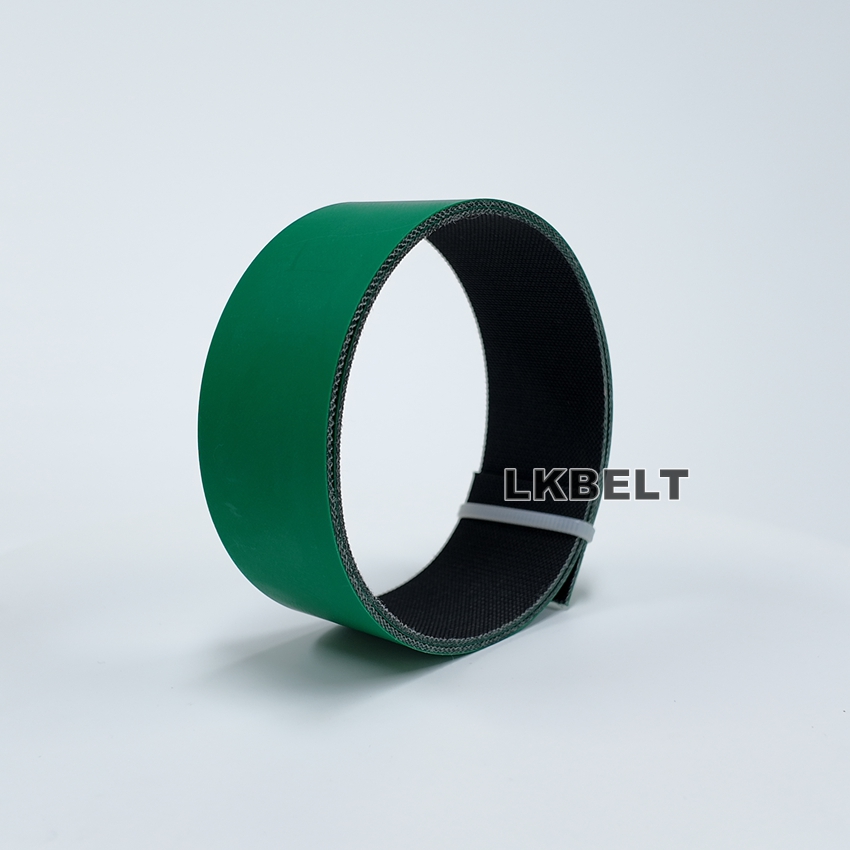
A separate blue PVC flat-belt product displays a coated carrying face and fabric underside. Those visible features may help identify an existing belt but do not prove its bonding method, layer adhesion or chemical limits.
Another relevant reference is the transparent PU belt range, where individual models have their own listed thickness and pulley values. A value tied to one model must not be copied to another. The failure investigation should end in a model-specific finished-belt requirement, rather than “replace the damaged PVC with any PU belt.”
For customers who need a different edge treatment, fabrication method or joint, the LKBELT processing and quotation information supports discussing drawings and sample-based processing. It does not establish that every requested edge seal or bonding construction is available.
Two Practical Engineering Scenarios
Scenario A: Frequent cleaning and repeated edge separation
A food-packaging line repeatedly develops visible separation along one side of its fabric-reinforced belt. The machine is regularly washed and its existing belt has a cut edge. A replacement of the same catalogue family has already failed in approximately the same place; the actual cause remains unknown.
Engineering compares the washdown process, belt-edge exposure, guiding contact and pulley arrangement, and requests the original construction specification. The supplier reviews whether a documented alternative edge treatment is available and whether the full assembly fits the existing pulley and cleaning duty. Quality personnel approve the cleaning and contact requirements independently. Procurement does not simply order “waterproof PU” as an unsupported remedy.
Scenario B: A compact conveyor with an added return roller
A small packaging conveyor begins to experience layer separation after a maintenance retrofit introduced an additional return-side roller. The original belt construction, its joint and the new roller route are recorded.
The OEM identifies the new bend direction and roller diameter, reviews tension and crowning, and asks the supplier to confirm a finished belt that tolerates the complete route. If the existing construction cannot meet the verified duty, the approved solution may require a different belt construction, a changed roller arrangement or both. The supplier’s data and first-belt assessment—not a visual comparison alone—determine the replacement.
These are hypothetical examples, not LKBELT customer cases.
What Should Buyers Include in a Delamination Replacement RFQ?
A useful sourcing package should include:
- Machine model, duty and original belt reference, together with the approved drawing if available.
- Photographs of the defect, both faces, cut edges, joint and contact locations.
- The difference between as-found dimensions and required finished width, length, thickness and tolerances.
- Material and layer construction, carrying texture, underside, joint type and installation access.
- Pulley and roller diameters, crown, return route, reverse bends, support bed and take-up.
- Actual cleaning and chemical exposures, temperature history and frequency of operation.
- Required edge treatment, food-contact documentation or other product-specific approvals.
- First-article acceptance criteria: dimensions, edges, splice, fit and controlled observation under approved operating duty.
Ask each supplier to state whether it is quoting an exact approved replacement or a proposed alternative, and to identify deviations. Save the accepted belt drawing, approved trial findings and order revision for repeat purchasing.
Frequently Asked Questions
Is a separating belt edge always delamination?
No. It can also be cut-edge fraying, coating damage, splice deterioration or contact with the machine. Identify the separated interface before assigning a cause.
Can a new belt fix delamination if the pulley is too small?
Only if the proposed construction and joint are approved for the installed geometry—or the equipment is corrected. A like-for-like belt may reproduce the problem.
Does switching from PVC to PU solve bonding failures?
Not automatically. Complete layer construction, temperature, chemicals, bending and joint design are more informative than the coating name alone.
Should a damaged belt be glued back together on the conveyor?
Do not treat an improvised adhesive repair as restored structural integrity. Follow the OEM/site service process and the belt supplier’s approved repair or replacement method.
What is the most useful photograph to send a supplier?
Send several views: the failure interface, both faces, edges and joint, plus the corresponding machine contact. One close-up of a lifted flap is rarely enough.
Conclusion
Conveyor belt delamination is a symptom with several plausible causes. The practical way to prevent repeated replacement failures is to identify the separated layers, map the full belt route, examine edge and chemical exposure, and resolve any equipment-related stress before approving a substitute.
For an LKBELT review, provide the original model, defective belt photographs, machine drawing, actual exposure and required finished dimensions. The supplier can then discuss available belt constructions and processing options while the equipment owner confirms the root cause and installation acceptance.