
A packaging line begins to attract paper dust after a belt replacement. In another factory, small plastic parts cling to the carrying surface instead of releasing at the transfer. Both symptoms can involve static charge, but neither proves that the belt is defective—or that a belt advertised as “antistatic” will fix the complete installation.
An antistatic conveyor belt is a belt construction with documented electrical properties intended to help control charge accumulation in a suitable conveyor system. A reliable selection must distinguish charging at the product interface from charge on the belt, identify the required electrical test and end-use environment, and check the actual path through rollers, pulleys and grounding. Buyers should ask for evidence for the specific finished belt, not infer conductivity from its colour, polymer or sales label.
Why Can a Conveyor Belt Generate Static Electricity?
Charge separation can occur as a belt repeatedly contacts and leaves a pulley or slider surface, as packaging rubs against the carrying face, or as dry products separate at discharge. A plastic bag or film can remain charged even if the conveyor’s own surface is made more dissipative. The amount and persistence of charge depend on material pairs, humidity, movement, contamination and the available paths for charge to dissipate.
The practical question is not merely whether the belt “makes static”. Identify where the charge is generated, which object retains it and where the unwanted effect occurs. Film sticking at discharge, labels pulling out of position, dust adhering to cartons and repeated shocks to operators can have different immediate causes. Mechanical product adhesion, residue, unsuitable release geometry or a discharge-bar fault can create similar symptoms.
esbelt’s technical explanation of antistatic belt properties describes charging at the bed/belt and product interfaces, including the consequences for product sticking and hazardous environments. Its discussion explains the operating principle; it is not a performance certificate for LKBELT products.
Antistatic, Static-Dissipative, Conductive and ESD: What Is Different?
In procurement discussions these labels are often used interchangeably, but they do not specify the same test or system objective.
- Antistatic describes the intended charge-control function. It must be translated into an agreed measurable requirement.
- Conductive or static-dissipative describes electrical behaviour according to a defined method and test conditions; thresholds depend on the relevant standard and application.
- ESD control concerns an electrostatic-discharge control programme, often involving products, personnel, flooring, equipment and verification—not simply the purchase of one belt.
- Explosion-risk suitability requires a separate assessment of the hazardous area, ignition hazards, permitted equipment and applicable requirements. A supplier’s statement that a belt is antistatic is not approval for a combustible-dust or explosive atmosphere.
For conveyor belts within its scope, esbelt identifies ISO 284 as a reference for electrical resistance testing; its explanation of ISO 284 uses a resistance limit of 3 × 10⁸ ohms for qualifying belt constructions. That figure describes a particular standard-based test requirement, not a measured property of any LKBELT grade, an installed-machine grounding test, or proof of hazardous-area approval. The engineering review must establish whether that standard applies to the actual conveyor belt construction, the requested edition and the site specification. Do not transplant an electrical threshold from one material, product class or test arrangement to another without checking the applicable method.
A belt can be electrically suitable in the laboratory yet fail to resolve the line’s problem if the surface touching the conveyed film is not the charging source or if charge cannot be dissipated through the assembled conveyor.
A Three-Question Diagnosis Before Changing Belt Grade
A supplier can quote more responsibly when the plant separates three questions rather than naming every symptom "static":
| Diagnostic question | If the answer is yes | Next responsible action |
|---|---|---|
| Is the belt or its underside developing charge at a pulley or slide bed? | The belt/bed material pair and dissipation path may be relevant | Identify both belt faces and request an appropriate grade-specific belt test |
| Is a plastic product, film or powder entering or leaving the conveyor already charged? | A documented belt property may not neutralize an insulating product | Have process specialists evaluate product handling, release geometry and, if appropriate, approved ionization equipment |
| Does the line have an ESD-control or ignition-risk requirement? | The requirement extends beyond a marketing label | Have authorized EHS/electrical staff determine the governing machine/site acceptance process |
In particular, grounding an insulating product does not automatically remove its charge. MTF Technik’s guidance describes situations where ionization is considered for plastic parts. Belt selection should not be represented as an alternative to an engineered charge-control process.
Map the Entire Charge-Control Path
Before quoting a replacement, the maintenance and engineering teams should describe the path between the belt and the facility’s approved electrical reference. Components can include the belt body, coated or lagged pulley, shaft, bearings, structure and bonding arrangements. A nonconductive coating or an insulated shaft component may interrupt an assumed path. Never rely on a metal-looking frame alone as proof of adequate grounding.
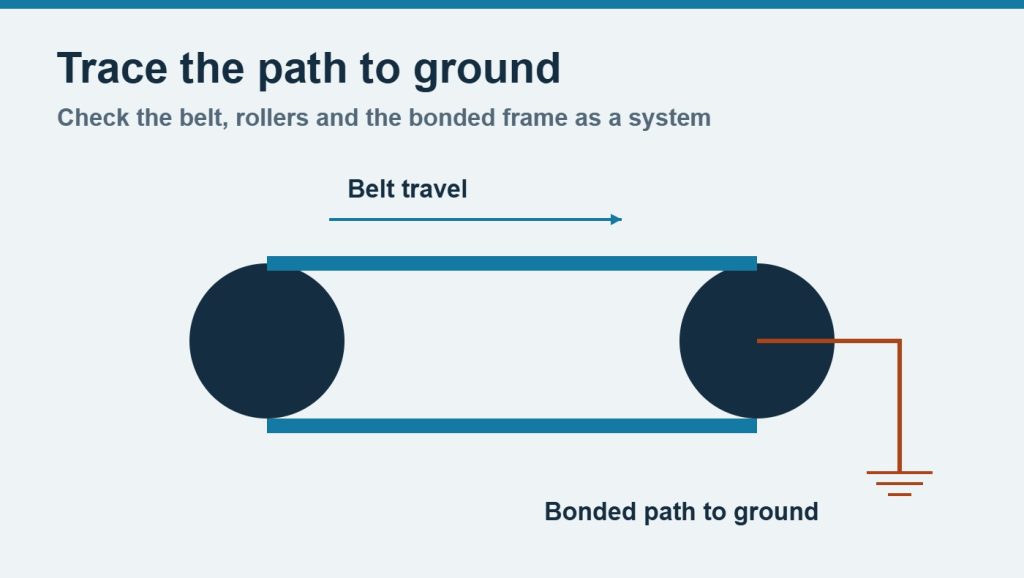
MTF Technik’s static-charging guidance supports the distinction between a static-conductive belt and a conveyor installation whose connected components provide a dissipative path. A qualified electrical or EHS professional should verify the installation against the relevant site standard; belt procurement cannot certify electrical safety for an entire machine.
A disciplined investigation can follow this sequence:
- Record the symptom and exact position. Does material cling to the carrying surface, or does a shock occur near a transfer or frame?
- Identify the conveyed material and charging surfaces. Compare the original belt, the new cover, the bed, return rollers and other contacting components.
- Check the environment. Record dry-air conditions, dust, cleaning residues and changes in speed or product.
- Review the installed belt identification and the electrical requirement specified by the equipment owner.
- Ask qualified personnel to test the complete arrangement by the applicable approved method, rather than assuming a belt change is sufficient.
Do not instruct operators to touch, discharge or modify moving equipment to test static. Where a hazardous atmosphere might be present, defer the installation and any testing to authorized safety specialists.
Which Belt Construction Details Affect the Decision?
The material label alone cannot establish the electrical properties of the finished belt. An antistatic formulation may involve textile construction, coatings or additives; the two outer surfaces can behave differently. An apparent match in width, thickness and colour is not an electrical equivalence statement.
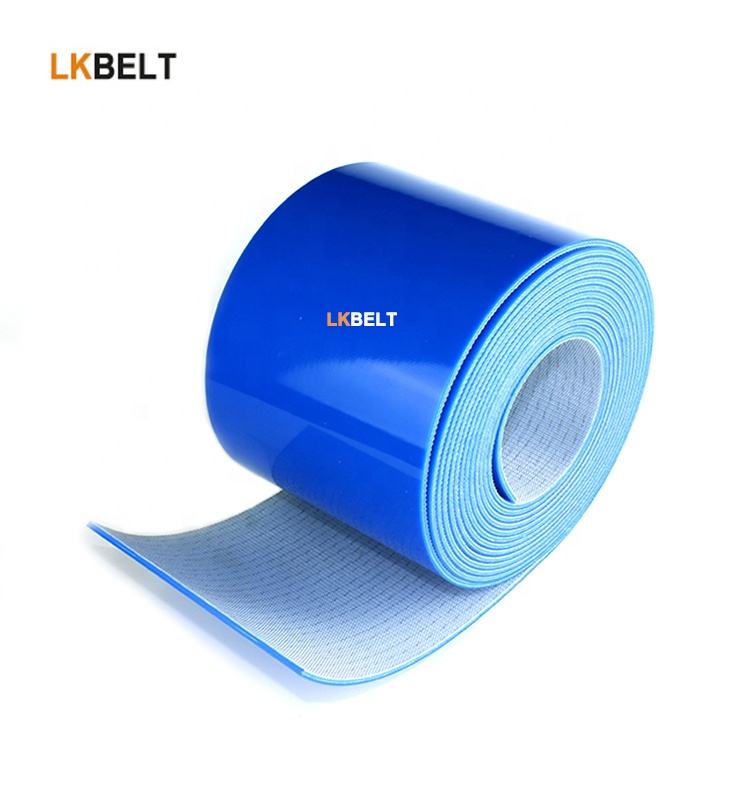
LKBELT’s blue PVC flat conveyor belt is described as a blue coated belt with a fabric underside. That makes it a useful example for identifying the two working faces, not proof that this exact product has an antistatic rating. Similarly, the PVK logistics belt range can be considered for warehouse positions only after confirming the selected grade and any required electrical properties.
The LKBELT logistics application guide specifically asks buyers to communicate electrical and fire-related specifications with the offered belt reference. That is the appropriate commercial link between a static-control problem and the supplier’s actual selection process.
Also check the joint. The finished belt may include a splice, cover transition, applied guide or attachment; the user must confirm whether the applicable test and acceptance evidence covers the finished, installed construction. Do not promise that conductivity is maintained across every type of splice without supporting documentation.
Static-Control Selection Matrix
| Operating observation | Question to answer | Evidence to request | What the evidence cannot prove alone |
|---|---|---|---|
| Film or labels cling to the top face | Is the product or belt retaining charge? | Product condition, process location, test plan | That a new belt alone will cure sticking |
| Dust adheres after a belt change | Did surface material or humidity change? | Original and proposed belt grades; environmental record | That any black or blue belt is conductive |
| Shocks near the discharge | Where is charge generated and dissipated? | Qualified equipment electrical assessment | That a belt certificate verifies the machine |
| Buyer requests an “ESD belt” | Which programme or test applies? | Exact standard, method, limit and acceptance authority | That “ESD” is one universal product rating |
| Dust or vapour may present ignition hazards | Is the system in a classified area? | Site hazard assessment and required approvals | That ISO 284 alone approves hazardous-area use |
What Counts as Acceptable Electrical Evidence?
Before procurement treats two products as electrically equivalent, compare the evidence package, not just a numerical value in an advertisement:
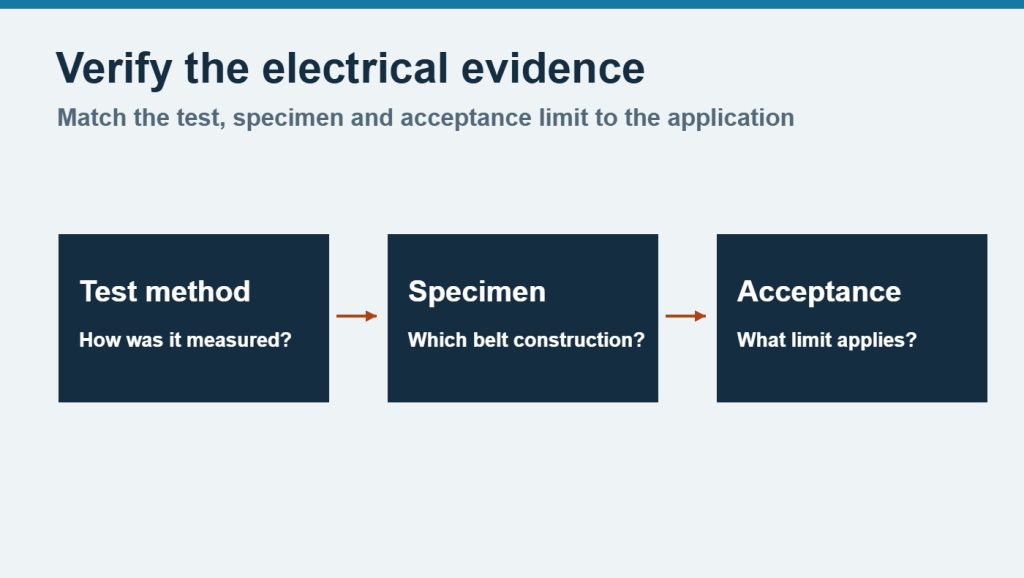
- Identity: exact belt manufacturer, grade, construction and test sample identification; note whether the quotation covers the same grade.
- Method: the named standard, edition, units, electrode or test arrangement and relevant conditioning reported by the laboratory; confirm the specification actually calls for that method.
- Result and acceptance: the measured value, applicable limit, report date and pass/fail basis. One reading without context cannot establish equivalence.
- Finished construction: whether any required joint, surface or accessory must be evaluated separately, and who is responsible for final-assembly verification.
- Site-level check: qualified approval of bonding, earthing, product charge and any ESD or hazardous-area assessment under the site’s procedure.
A seller unable to document a requested electrical rating should quote a candidate for technical review, not a certified antistatic replacement. This distinction is especially important for repeat orders, where the buyer needs a stable grade reference and traceable acceptance record.
Two Industrial Selection Scenarios
Scenario A: Plastic film sticks after the belt is replaced
A packaging line carries thin film products across a flat, fabric-backed belt. After a change of belt construction, the products travel with the upper surface past the normal transfer point. Operators describe the problem as static electricity.
Engineering first reviews release geometry and deposits, then documents charge-related observations under approved conditions. It identifies the actual product-contact material, the backing/bed arrangement and the electrical requirement. Procurement asks prospective belt suppliers for a documented compatible grade, including the joint and operating duty. The decision is not to order an unspecified “antistatic PVC” belt, but to evaluate a complete proposed construction and run an approved line trial that measures product release.
Scenario B: A warehouse has a contractual ESD requirement
A logistics buyer requests replacement belts for several conveyor positions handling sensitive packages. One supplier provides a generic antistatic description; another supplies an electrical test report for a particular belt grade.
The buyer must still verify that the document refers to the offered construction and the specified measurement method. Site electrical personnel then review bonding, pulley contacts and other equipment requirements. Different positions may require different surfaces for grip or accumulation, so one electrically documented grade cannot be imposed across every conveyor without mechanical approval. Store the approved grade, test basis and machine-position reference with each repeat order.
Neither scenario is a claim about a real LKBELT installation or a guaranteed test result.
What Should an Industrial Buyer Put in an Antistatic Belt RFQ?
Provide the following together as one specification package:
- Machine and position: conveyor make, model, location, direction, speed, material being transported, bed and drive arrangement.
- Original and proposed belt: part number, photographs of both faces, total thickness, reinforcement, width, finished length and joint.
- Electrical objective: exact test standard and edition where known, specified resistance or ESD requirement, test conditions, acceptance authority and any required report.
- Site environment: humidity, temperature, dust, cleaning chemistry and whether a hazardous-area assessment applies.
- System interface: drive-pulley coating, slider-bed surface, roller contacts and any documented grounding/bonding limitations for qualified personnel to evaluate.
- Trial approval: product-release behaviour, mechanical fit, belt tracking and prescribed electrical verification, with the responsibilities clearly assigned.
A material enquiry is not an equipment safety approval. If the supplier cannot provide the relevant grade-specific electrical evidence, mark that requirement open rather than accepting a generic marketing description.
Frequently Asked Questions
Is every PVC or PU conveyor belt antistatic?
No. The polymer family, colour and fabric appearance do not establish the electrical properties of a particular finished belt. Request the appropriate grade-specific evidence.
Will an antistatic belt eliminate static electricity on packaging film?
Not necessarily. The film can retain its own charge, and product release may also depend on non-electrical factors. Investigate the material and machine interfaces.
Does an antistatic belt mean the conveyor is safe in a combustible-dust zone?
No. Hazardous-area suitability depends on the complete equipment, site classification, ignition-risk assessment and applicable approvals. Consult qualified specialists.
Do belt joints matter when selecting an ESD or conductive belt?
They can. Ask whether the documented performance applies to the finished joint and belt construction under the intended test method.
What should I request before accepting an alternative grade?
Obtain the complete mechanical belt specification, electrical test basis, installation requirements and an approved first-belt evaluation plan.
Conclusion
An antistatic conveyor belt should be specified as a tested belt construction within a verified charge-control system, not as a coloured product with an ESD label. Identify the charging problem, the electrical requirement, both belt surfaces, the joint and the machine interfaces before requesting a substitute.
LKBELT buyers can submit a belt reference, drawings, photographs, finished dimensions and the site’s electrical requirements for a grade-availability review. Any proposed antistatic performance or hazardous-area use must be verified for the exact offered product and installation before approval.