
A distribution line that carries rigid cartons today may need to handle soft polybags next quarter. Both belt and roller conveyors can transport packages, but they support and control the load differently. A specification based only on nominal throughput can work for one package and fail at a scanner, merge or transfer with another.
Choose a belt conveyor when the product needs continuous support or controlled contact; choose a roller conveyor when the product reliably spans the installed rollers and its accumulation and routing requirements suit that system. Once the equipment decision is made, the conveying belt—or the drive belt inside a powered-roller system—must be specified for its actual machine position. Buying a conveying belt and buying a roller-drive belt are not the same task.
What Is the Difference Between a Belt Conveyor and a Roller Conveyor?
A belt conveyor has a continuous moving carrying surface supported by a slider bed, rollers or a combination. The belt contacts the underside of the product and moves around drive and return pulleys. A roller conveyor instead supports each product on multiple discrete rollers; those rollers can be gravity-driven, powered individually or driven through a common transmission. Some roller systems use narrow round belts, bands or other transmission components to turn the rollers, even though the product never sits on a wide carrying belt.
This distinction matters to LKBELT buyers. The logistics and material-handling application separates conveying duties from live-roller drive and sorter-module positions. An order described as “a conveyor belt for the rollers” is ambiguous until maintenance identifies the belt’s actual function.
Cisco-Eagle’s belt-or-roller selection article usefully compares package types, inclines and operational requirements. Hytrol similarly explains differences in moving and accumulating products in its belts-versus-live-rollers guide. The additional question for a belt supplier is: what construction will the selected machine need when that belt must be replaced?
Start With the Package, Not the Conveyor Catalog
Can the product bridge discrete rollers?
A rigid carton with a stable base can transfer load across roller contacts. A soft bag, flexible pouch, shallow tray, thin carton flap or irregular base may sag, snag or rotate where gaps are exposed. Small objects can be more sensitive to roller spacing and transitions. The decision depends on the smallest and least stable package in the expected mix—not only a photograph of the largest case.
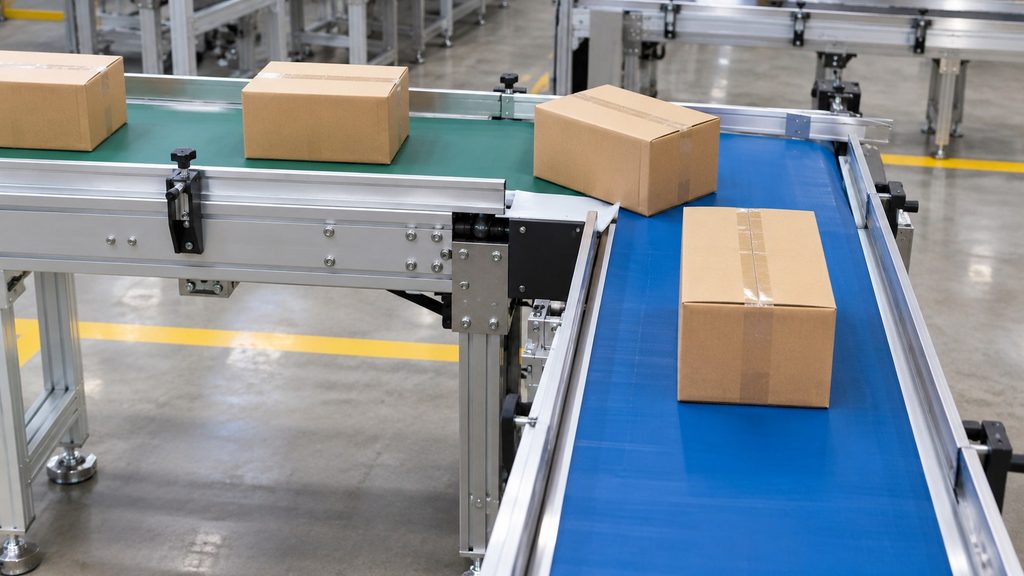
For a roller option, record product footprint, stiffness, orientation and the conveyor’s actual roller pitch, diameter and transfer geometry. Do not substitute a universal number of supporting rollers for a maker’s design rule. Package dimensions, centre of gravity, bottom deformation and movement all matter.
For a belt option, document the required carrying-face texture and product-contact conditions. Continuous support can prevent objects from settling into gaps, but it does not automatically prevent slipping at high acceleration or an incline. If surface grip is critical, test with the actual packaging, including dusty, damp or scuffed samples rather than an ideal specimen.
Is product orientation part of the process?
At scanners, weighing stations and automated label applicators, variation in package speed, rotation or lateral position can cause rejects even when the line’s overall throughput looks adequate. A belt may provide a more controlled contact surface, while a roller conveyor may meet the same requirement using guides, controls or specialized rollers. Define the allowed product movement and the measurement method before declaring one inherently more accurate.
Include the full route: a stable belt run can still hand a package into a problematic downstream roller gap. The existing transfer-point guide explains why product footprint, transfer geometry and the belt’s bending properties must be assessed together.
Will operators pick, rotate or divert cartons by hand?
The original Cisco-Eagle comparison correctly identifies a reason to favour rollers that a belt-only recommendation might miss: packages can often be pushed, removed or shifted sideways more easily on rollers. Pop-up divert devices and manual pack stations may therefore favour a roller arrangement even where a belt would carry the load successfully. The conclusion depends on the guarding, ergonomic design, product weight and actual divert system, not on the conveyor surface alone.
For an existing facility, record every manual interaction and side merge before ordering a different belt texture. Installing a higher-grip surface to improve upstream gapping can make manual sideways movement harder at the next work station. An OEM should approve any system modification; LKBELT can assess a replacement belt for the original machine function.
Accumulation Changes the Material and Surface Decision
Accumulation is the intentional temporary storage of products while downstream processing stops or slows. Many powered-roller designs support separately controlled zones, while a continuously moving belt with stopped cartons may generate surface rubbing and back pressure. But neither system should be described as universally “zero pressure” without knowing the actual controls and mechanism.
When an existing belt line accumulates packages, ask whether products are expected to slide on the moving belt, whether the belt stops with the products or whether a separate accumulation module is used. Those cases create different contact and wear conditions. The correct comparison is not simply belt versus roller; it is the actual accumulation method under the required operating cycle.
An occasional buffer of uniform cartons and a continuously congested feed line should not receive the same surface recommendation. Consider package pressure, scuff tolerance, noise, cleaning, accessibility and the maintenance regime. A surface marketed as high grip may be useful during acceleration but undesirable for a section where product release or controlled slip is needed.
Inclines, Curves and Transfers Need Their Own Checks
A belt often makes sense where positive product contact is needed through a modest incline or decline. The acceptable slope still depends on the actual product and conveyor engineering. Do not import an angle from another company’s rough-top or cleated system into an LKBELT belt quotation. The belt’s carrying surface, support friction, take-up, operating tension and joint must suit the route. For severe inclines, a custom sidewall and baffle construction may be considered only after the full machine layout and cleat clearance are reviewed.
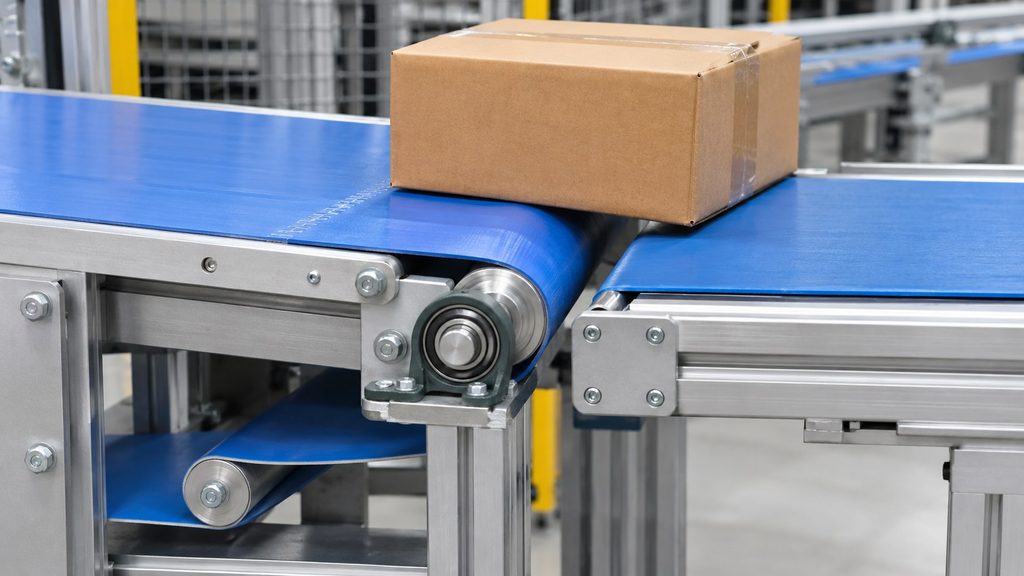
Curves also require care. A roller curve and a curved belt conveyor are different machines. A straight PVC belt roll does not demonstrate that a company supplies specially engineered curved conveyor belts or that a straight belt can be cut into an acceptable curve assembly. For a curve replacement, the maker’s belt part reference and finished drawing are the starting point.
At a roller-to-belt or belt-to-roller handover, capture the effective gap at the product’s supporting surface, elevation change and transition speed. A package can stall, tip or be damaged at the interface even when each conveyor functions properly on its own. Record the actual handover rather than assuming its geometry from machine type.
Belt Conveyor vs Roller Conveyor: Selection Matrix
| Operating question | Continuous belt surface | Discrete roller surface | What to verify |
|---|---|---|---|
| Small, soft or irregular product base | Continuous support may reduce exposure to gaps | Product may sag between contacts | Minimum product size, base stiffness, roller spacing and transition |
| Stable rigid cartons | Viable where grip and orientation matter | Often a viable option | Load per package, control, layout and maintenance |
| Repeated accumulation | Review rubbing, back pressure and stop logic | Zoned designs may suit buffering | Actual accumulation method, controller and product contact |
| Incline or decline | Surface grip and belt route require design review | Depends on powered/gravity arrangement and product | Slope, stopping behaviour and product stability |
| Scan, merge or gapping | Uniform carrying contact can help | Dedicated roller controls may also work | Position tolerance, speed variation and rejects |
| Replacement component | Conveying belt with finished loop and joint | Possibly an auxiliary roller-drive belt | OEM part identity and exact installed position |
The matrix narrows what to investigate; it is not an approval table for a specific conveyor or belt model.
A Two-Stage Acceptance Test Before Choosing a Replacement Belt
The equipment team should first validate the package-handling system; the belt supplier should then validate the belt specification. Treating these as separate sign-offs avoids buying a correctly made belt for an unsuitable transfer.
| Validation stage | Representative test | Required record | Decision owner |
|---|---|---|---|
| Package-support check | Run the smallest flexible parcel and the largest rigid carton through the route | Sagging, tip-over, scuffs and orientation change at each handover | Conveyor OEM / operations |
| Accumulation and divert | Test normal stop/start, release, side-merging and product pressure | Product position and permitted accumulation method | Controls / OEM |
| Belt-to-machine fit | Check both belt faces, support friction, pulley route, take-up and finished joint | Approved material construction and dimensioned belt drawing | Maintenance + belt supplier |
| First-article release | Inspect belt dimensions, then run representative products under the approved guard and safety procedure | Accepted trial report and revision for repeat purchases | Site engineering / purchasing |
Do not infer that better belt traction will fix a roller spacing or transfer-height defect. A line may need a change to its support geometry or controls before a different belt can be evaluated.
Which LKBELT Belts Can Be Relevant?
A blue PVC flat conveyor belt provides a publicly documented example of a glossy carrying face with a fabric underside. Those observed features are useful for identifying an existing belt, but the model and machine-specific grip, minimum pulley and joint requirements still need confirmation. The separately listed product-range values are not automatically the specifications of the pictured blue sample.
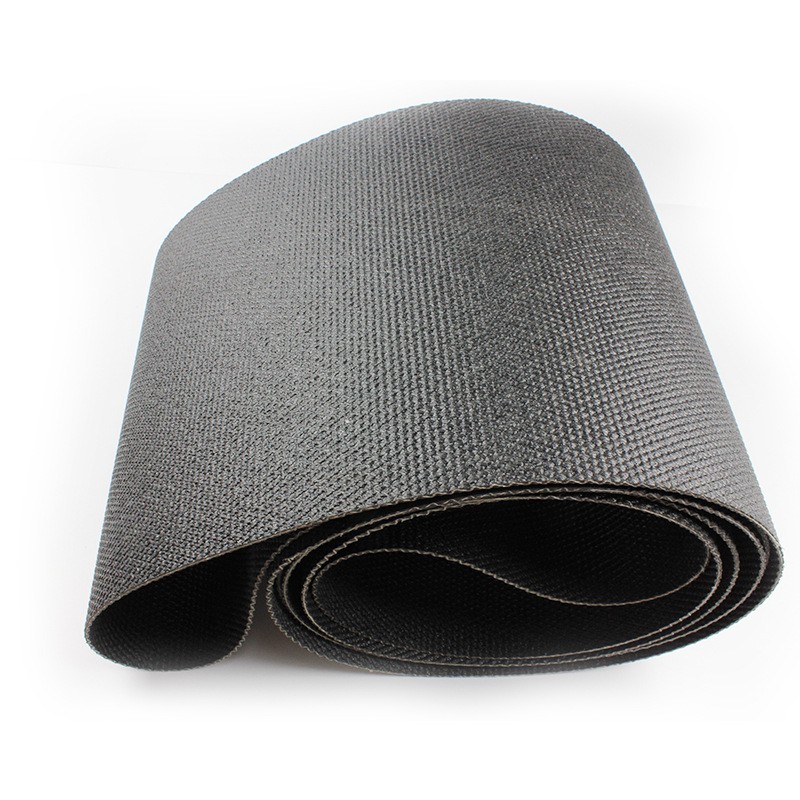
The PVK logistics conveyor belt is another documented product family, shown with a dark textured carrying face. Its public information requests finished size, support type, drive route, package range and operating duty. Neither the PVC nor PVK name is sufficient to select a replacement: compare the underside, top-surface contact, fabric construction and finished joining method for the actual machine.
A live-roller station may instead require a narrow power-transmission belt, not either wide conveying product. Confirm whether LKBELT has a verified matching profile and finished size before treating the part as a standard order. Do not substitute a PU round belt for a specific OEM drive component solely because both are circular in section.
Two Industrial Selection Scenarios
Scenario A: Cartons and polybags on the same line
A warehouse is adding soft polybags to a conveyor originally specified for rigid cartons. Some of the new products snag or change orientation at a roller transfer. Before changing the equipment, engineering records the minimum package footprint, bottom stiffness, bag fill variability, transfer and scanning requirements. A short continuous belt section may be evaluated at the sensitive interface. If selected, purchasing then specifies its finish, underside, finished loop and joint around the exact drive and support route.
The decision cannot be made from package weight alone. A powered roller solution with different spacing or handling may also be possible. The approved trial should compare the problematic polybags, not just the existing cartons.
Scenario B: A roller line with an unexpected belt spare
Maintenance asks for a “replacement conveyor belt” for a live-roller zone, but the removed component is a narrow loop that rotates drive rollers. Procurement first records the roller drive assembly and original part code. It then checks belt section, loop length, routing, pulley or groove contact and any OEM installation requirement. Ordering a wide flat PVC conveying belt would solve a different problem.
The useful outcome is accurate component identity and an approved replacement reference—not a claim that one conveyor type is superior.
When to Keep the Conveyor—and When a Belt Quote Is Not Enough
For a running line with one worn carrying belt, the cost-effective first step is often an approved like-for-like construction check, not a new conveyor concept. If the trouble is confined to a belt cover, joint or incorrect dimensions, submit the original belt and machine evidence for replacement review.
If small packages repeatedly lodge between rollers, a merge cannot preserve orientation, or accumulation logic is unsuitable, stop at the system-design question. An ordinary LKBELT belt quotation does not approve a conversion from rollers to a belt conveyor. Ask the equipment builder to resolve roller spacing, transfer design, guarding and controls, and only then specify any new belt component.
For repeat facilities, label the RFQ by conveyor position rather than by site-wide belt colour: two identical-looking belts may have different undersides, joints and duty requirements.
Replacement RFQ: What to Send After Choosing the Conveyor Type
A quotation should identify exactly which component is being replaced. Include the machine manufacturer, model, location and original part code; a photograph locating the belt within the conveyor; pictures of both belt faces and the joint; and the available OEM drawing.
For a conveying belt, provide finished endless circumference and measurement basis, width, total thickness, construction, carrying texture, underside, joint, guide or attachment information, pulley diameters, support type and take-up range. Note product range, starts and stops, incline, speed and any accumulation rubbing.
For an auxiliary roller-drive belt, provide its original belt section or profile, route, pulley/groove engagement, fitted tension arrangement and part code. Avoid deriving the replacement length from a stretched or broken component without checking the original drawing.
Define a first-belt acceptance: dimensions and identification before installation, permitted joining and fitting method, controlled trial with representative packages, transfer behaviour, tracking, slipping, unusual heat and the site’s approved safety checks. Document deviations so repeat orders use an accepted revision. The general conveyor drive layout guide gives additional context on drive-pulley contact and finished route specifications.
Frequently Asked Questions
Are belt conveyors always better for bags?
No. Continuous support can help a flexible bag, but bag size, filling, transfers and conveyor controls decide suitability. Evaluate the actual product samples and layout.
Do roller conveyors use belts?
Some powered-roller systems use belts as auxiliary drive elements. Those components differ from the wide conveying belts that carry products directly.
Can a PVK belt replace a PVC belt on the same conveyor?
Only after confirming the specific finished construction, underside, joint, pulley route, load and accepted surface performance. The material names alone do not establish interchangeability.
Which conveyor is best for accumulation?
It depends on the accumulation method, product and required pressure or contact conditions. Compare actual control zones, wear and operating duty.
Can a belt conveyor replace a curved roller section directly?
Not without a mechanical system review. A curved belt conveyor is a dedicated arrangement, and its belt geometry differs from a standard straight belt.
Conclusion
Belt versus roller is first a product-support and operating-control decision. For a belt supplier, the next step is distinguishing a conveying belt from a roller-drive component and defining a complete approved replacement. Send the machine layout, product range, original part reference and both-face belt photographs to establish which LKBELT construction can be evaluated for the installed duty.