
A heated processing line has a recurring problem at discharge: the product sticks to the belt, while another proposed belt releases it but allows the product to shift during conveying. Both sales quotations mention “high-temperature non-stick belts.” Neither description answers whether the finished belt will support, hold, release and transport the product through the actual process.
Choose silicone vs PTFE conveyor belts by first defining the required product contact and belt construction—not by assuming one polymer is universally more heat-resistant or less sticky. Silicone-coated and PTFE-coated constructions can both support demanding processes, but their friction behaviour, fabric substrate, open area, joint, edge treatment and machine compatibility are often decisive. A perforated PTFE-coated fiberglass mesh belt is not interchangeable with a solid silicone-coated conveying belt of the same nominal width.
What Are Silicone and PTFE Conveyor Belts?
Silicone is an elastomeric coating that may be applied to a reinforcing fabric or used in other belt constructions. PTFE is a fluoropolymer coating often found on fiberglass or other technical fabrics. In both cases, the finished composite, not only the named surface polymer, determines usable thickness, bending characteristics, mechanical behaviour, temperature limits and joint options.
LKBELT lists a silicone conveyor belt category, including heat-resistant and anti-stick subcategories. This establishes a publicly presented product family, not model-specific temperature, friction, food-contact or chemical-resistance ratings. A buyer needs an identified grade and complete datasheet before accepting any of those properties.
By contrast, LKBELT publishes a detailed PTFE-coated mesh belt range with item-specific openings, reinforcement, thickness and other tabulated details. Those listed specifications provide a more concrete starting point, but the table still does not approve a particular heated machine, splice or finished belt without further review.
A separate PTFE-coated fiberglass mesh product page shows reinforced edges and looped joint ends. The illustrated joint type is an important replacement detail; do not assume every item in the PTFE range uses the same joint.
The First Selection Question: Does the Product Need Grip or Release?
Release and transport stability can pull a design in opposite directions. A low-adhesion surface can help a tacky product detach cleanly. But a product that slides at every acceleration, incline or discharge may need greater contact stability. The required result depends on the actual product temperature, pressure, residence time and surface conditions.
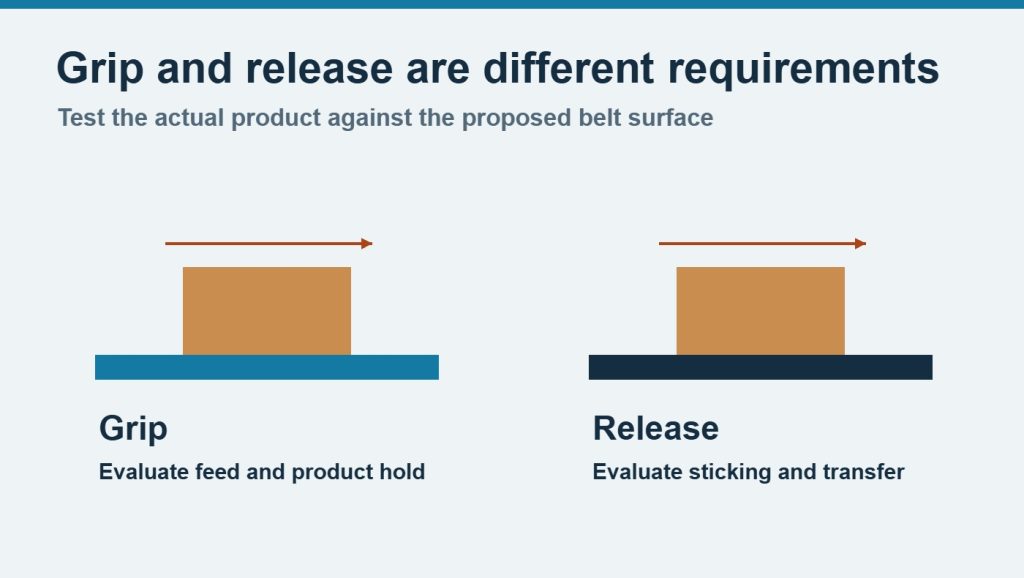
A peer-reviewed study of silicone and PTFE belt cover materials in wood-plastic composite processing investigated product-contact behaviour in a particular heated extrusion context. It demonstrates that friction and adhesion need application-specific evaluation. In that study’s particular wood-plastic-composite tests, reported coefficients of friction were approximately 0.10–0.16 for the tested PTFE belt and 0.42–0.72 for the tested silicone-rubber belt. These are experimental results for those specific materials and conditions, not a guaranteed friction range for LKBELT products. The study also evaluated heated products, so room-temperature assumptions would miss a major variable.
For a sticky confectionery product, ask whether the problem is adhesion to the upper face, build-up at the discharge roller or unsuitable temperature and cleaning conditions. For a hot sheet or extrusion profile, ask whether the belt must hold shape during travel or release without distortion. A supplier cannot choose from the phrase “non-stick” alone.
Open PTFE Mesh vs Solid Coated Fabric: A Structural Difference
An open mesh belt creates spaces for air or fluid to pass through. That can be important in drying, cooling and certain thermal processes. But those openings must also be checked against the smallest conveyed product, soft product deformation, transfer-gap geometry and cleanliness requirements. A mesh that creates desirable airflow can leave marks on a delicate sheet or allow small pieces to become trapped.

Mesh opening is not the same as open-area percentage. A row described as 4 × 4 mm does not, by itself, calculate the belt’s unobstructed airflow or the product’s support pressure. Yarn width, coating thickness, weave, joint and other elements affect the final open geometry.
In the LKBELT high-temperature PTFE mesh range, item 6001 is listed with 1 × 1 mm mesh, fiberglass reinforcement and 0.5 mm thickness. Item 6007 is listed with 4 × 4 mm mesh, fiberglass plus Kevlar reinforcement and 1.2 mm thickness. These values apply to their respective named items. They do not establish the final joint thickness, strength at operating temperature or acceptable wheel diameter of a finished installed belt.
LKBELT’s separate PTFE mesh example makes the same point from an identification perspective: the colour, mesh opening, reinforced edges and joint style need to be tied to the exact requested construction.
A solid silicone-coated belt may provide continuous surface support and different contact behaviour, but that possibility must be confirmed against the available grade and its reinforcement. Do not imply that all silicone belts are nonporous, food-approved, or usable in an oven simply because the category name contains silicone.
LKBELT PTFE Models: Two Verified Examples, Not a Silicone Rating
The public PTFE range lets buyers distinguish mesh grade from a generic polymer label:
| LKBELT mesh item | Published opening | Published reinforcement | Published nominal thickness | What still needs approval |
|---|---|---|---|---|
| 6001 | 1 × 1 mm | Fiberglass | 0.5 mm | Finished length, edge, joint, minimum bending route and operating load |
| 6007 | 4 × 4 mm | Fiberglass + Kevlar | 1.2 mm | The same checks, including actual product support and opening suitability |
The product-range table lists a −70 to +260 °C range for these named items, but the published table is not a blanket approval of a finished endless belt at every temperature, load or joint configuration. It also does not establish how a silicone-coated alternative performs. The separate PTFE mesh product page documents example colours, looped joint ends and reinforced edges; those construction details must match the actual quote.
Critical purchasing gap: LKBELT publicly lists silicone as a product category, but the accessible category listing does not provide an identified silicone grade with comparable engineering data. Request the exact silicone grade datasheet before making a numerical silicone-versus-PTFE product claim.
Temperature: What Buyers Need Beyond a Maximum Number
An actual process can expose a belt to different temperatures at the product, heated air, deck, drive pulley and cleaning station. Distinguish continuous exposure from short thermal peaks and allow for heat-related changes in coating, reinforcement and joint behaviour. Temperature also influences the product’s adhesion and the equipment’s tension or tracking requirements.
The LKBELT PTFE range page lists temperatures by item, but a published material-range value is not a universal approval for every finished belt or installation. The owner should obtain a grade-specific confirmation that addresses the selected joint, edge reinforcement, loading, duration and the conveyor’s mechanical configuration.
Do not convert a competitor’s polymer limit into an LKBELT guarantee. Check compatibility with product chemistry, heating method, ambient conditions and any solvents or release agents applied to the surface. The supplier and equipment manufacturer must review the complete operating envelope.
Comparison Table: Silicone vs PTFE Belt Decision
| Selection question | Silicone-coated option | PTFE-coated option | Evidence required |
|---|---|---|---|
| Product needs grip during conveying | Consider grade-specific surface behaviour | A low-adhesion grade may allow unwanted movement | Representative product transport trial |
| Product sticks at discharge | Confirm actual silicone grade and release behaviour | Consider the documented PTFE release surface | Discharge observation at real temperature |
| Process needs airflow through the belt | Depends on available structure | Open fiberglass mesh options can provide passages | Mesh geometry, support and product dimensions |
| High-temperature duty | Do not infer a limit from polymer name | Use the selected item data and finished-belt review | Continuous/peak process temperatures and joint evidence |
| Small rollers or reverse bends | Reinforcement and joint govern | Mesh edges and joint may govern | OEM bending route and model approval |
| Food or chemical contact | Grade-specific documentation required | Grade-specific documentation required | Actual use conditions and applicable documents |
| Finished belt replacement | Confirm coating, backing and joint | Confirm item number, mesh, edges and joint | Drawing, sample, order tolerance and first-belt acceptance |
This is a decision framework, not a universal material-property ranking.
Joints and Edges Can Decide the Replacement
Belt purchase requests frequently specify the length, width and coating but omit how the endless loop will be completed. At elevated temperatures, a finished joint can become the limiting feature even if the continuous coated area meets the intended process requirements.
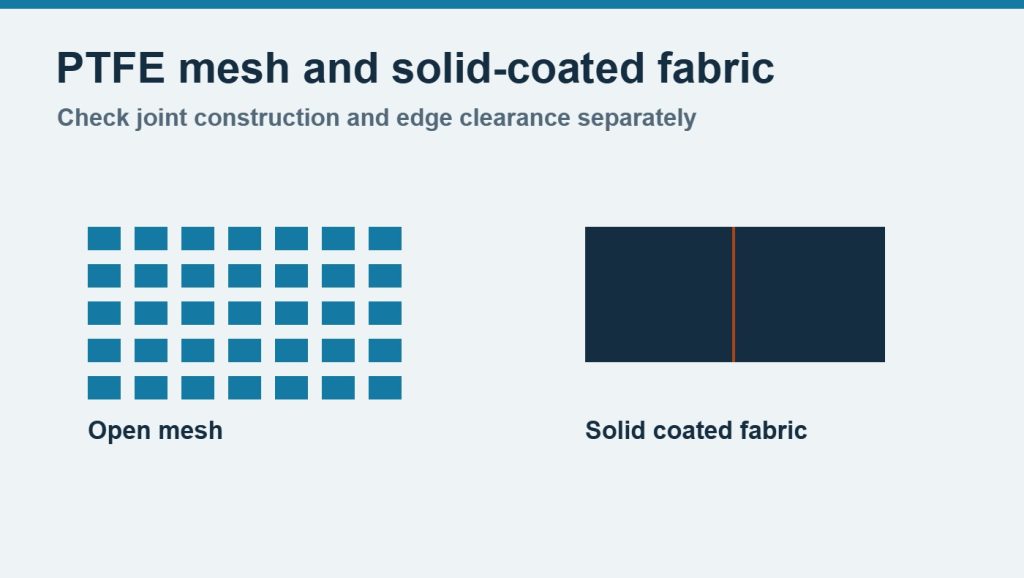
A mesh belt may have reinforcement at its edges and a mechanical-style loop connection, as shown on the LKBELT PTFE product example. Another belt could have a manufacturer-specific overlap or bonded joint. Do not treat these as interchangeable without checking physical clearance, temperature suitability, cyclic bending and fitting access. The belt must pass the drive and return components without damaging the joint or catching at machine guards.
Include the guide and belt-edge geometry on the drawing if tracking accessories are used. A proposed reinforcement change can affect usable product width and edge clearance. For the overall conveyor’s effect on belt geometry, see LKBELT’s components and belt selection guide.
A new mesh pattern may also change how a part contacts the belt during a process. Consider marks, sagging, local bridging and transfer from open support to the next conveyor. These concerns are particularly important for small, soft or irregular products.
A Practical Grip-and-Release Trial for Procurement
When a surface is described as "non-stick", ask the plant to define both required behaviours in advance:
- Carry: does the hot or soft item remain correctly positioned during starts, stops, inclines and the longest residence time?
- Release: does it transfer without unacceptable sticking, deformation, marks or residue at the real discharge geometry?
- Temperature: what are the measured product, air, support and return-side exposures during continuous duty and peak events?
- Belt integrity: do edges, mesh support, joint and tracking remain acceptable in the approved test?
- Cleanability and traceability: can the plant repeat its approved cleaning and link the accepted result to a specific belt grade and order revision?
Record a pass/fail requirement for each before the sample is installed. A material trial that achieves release but fails product alignment is not a successful replacement. The plant should not convert the published research experiment into a performance guarantee for its own production line.
Two Hypothetical Industrial Examples
Scenario A: Sticky product on a heated discharge line
A processor receives two proposals: one silicone-coated solid fabric belt and one PTFE-coated mesh belt. The product leaves a heated station and must remain aligned before it releases onto a downstream conveyor. The original complaint is sticking at discharge, but the plant has not documented whether the product must also be held flat during travel.
Instead of choosing by a marketing claim about maximum temperature, the buyer supplies the actual product sample, temperature history, travel speed and required release behaviour. Engineering compares stable conveying and discharge at representative duty. Procurement requests the exact construction and joint; the maintenance team checks support and transfer geometry. The accepted solution is the grade and finished assembly that passes both transport and release requirements, not necessarily the lowest-adhesion surface.
Scenario B: An open mesh replacement for a drying conveyor
A drying machine requires an open belt to permit airflow. An existing PTFE mesh uses a particular opening, edge reinforcement and joint arrangement. A cheaper quotation offers the same width and nominal coating but a different mesh opening and thicker edge.
The engineer checks the smallest product dimension, airflow requirement, guides, roller diameters and available clearance. The buyer asks for a mesh sample and a drawing of the finished joint, then defines a trial that checks product retention and thermal duty. The new belt is not released for repeat procurement until those differences are approved.
Both examples are hypothetical; they are not claims of successful LKBELT customer installations.
What Should Buyers Include in a Silicone or PTFE Belt RFQ?
Send one complete set of requirements:
- Product being conveyed and its contact behaviour, including adhesion, deformation and acceptable surface marks.
- Machine identity, heated process stage, airflow or fluid-flow requirement, support layout and transfer details.
- Recorded continuous and peak temperatures at relevant locations, duration and exposure to chemicals or cleaning agents.
- Original belt code and photographs showing surfaces, edges, mesh or solid construction and the joint.
- Finished width, endless length, thickness, tolerance, reinforcement and running direction where applicable.
- Mesh opening or solid surface requirement and product minimum dimensions.
- All pulley diameters, reverse bends, tracking arrangements and fitting access.
- Required certificates or declarations for the exact finished belt and intended food-contact use, where relevant.
- Quantity, approved sample, acceptable deviations and production acceptance procedure.
For PTFE mesh requests, include the exact LKBELT product-series item when known. For silicone, ask first for a specific grade datasheet and available processing details; the public category alone does not define a rated product.
Frequently Asked Questions
Is PTFE always better than silicone for non-stick conveyors?
No. The process may require grip as well as release, and actual performance depends on the selected construction and product. Test both requirements.
Does a PTFE mesh belt work like a solid PTFE sheet?
No. Mesh openings change product support, airflow, drainage and transfer behaviour. Specify the open structure and the edge/joint design.
Can I use the published PTFE material temperature as the finished belt’s operating rating?
Not without confirming the specific item, joint, edge construction and intended machine conditions.
Are all silicone and PTFE belts approved for food contact?
No. Request appropriate documentation for the exact selected construction and intended contact conditions.
Can two belts with the same width and thickness be interchanged?
Not by those measurements alone. Compare coating, reinforcement, open or solid structure, joint, edge, pulley compatibility and operating duty.
Conclusion
Silicone-versus-PTFE selection is a choice about product behaviour and finished belt geometry, not simply two heat-resistant coatings. Separate grip from release, solid support from mesh airflow, and material properties from joint and machine constraints.
For an LKBELT enquiry, provide the existing belt reference, process conditions, required dimensions, product characteristics and joint details. The PTFE mesh range offers named specification references; silicone proposals should be supported by the exact grade data before a replacement is approved.