
Two flat power-transmission belts look similar on a workbench: each has a green face and a flexible layered body. Yet the original machine specifies a particular model, pulley diameter, installed length and joining method. Choosing by colour or total thickness alone can change the drive’s strain behaviour, traction and bearing loading.
Select a nylon flat transmission belt by the original machine duty and the identified complete construction—not by the nylon label alone. Confirm the tension member, both friction surfaces, finished thickness, pulley geometry, joint, operating load and tension-setting procedure. Compare exact LKBELT model information against the existing approved specification before substituting one belt for another.
What Is a Nylon Flat Transmission Belt?
A flat transmission belt carries mechanical power by running around pulleys, typically through frictional contact. Many constructions combine a polymeric or textile tension member with friction coatings or contact layers on one or both faces. The load-bearing member, not the colour of the visible cover, strongly influences stretch and dimensional stability. Surface finish influences contact conditions; the overall body and joint determine how the belt bends and fits the drive.
Some flat belts incorporate polyamide sheet or fabric as a tension member, while other industrial flat belts use different materials or reinforcement architectures. Do not assume every “nylon flat belt” has the same ply count, tensile rating or joining method. Forbo’s Siegling Extremultus flat-belt technical information explains that different tension-member families are selected for their mechanical requirements. Those descriptions concern Forbo products and must not be transplanted into undocumented LKBELT model specifications.
The category also differs from a continuous PVC conveying belt. In a transmission drive, the belt’s principal purpose is to transmit torque between pulleys. In a conveyor, the main belt usually supports a conveyed product over a bed or set of rollers. A factory may use both types on one machine, but that does not make their belt specifications interchangeable.
Why TG10, TG15 and RNR15 Must Be Compared as Separate Models
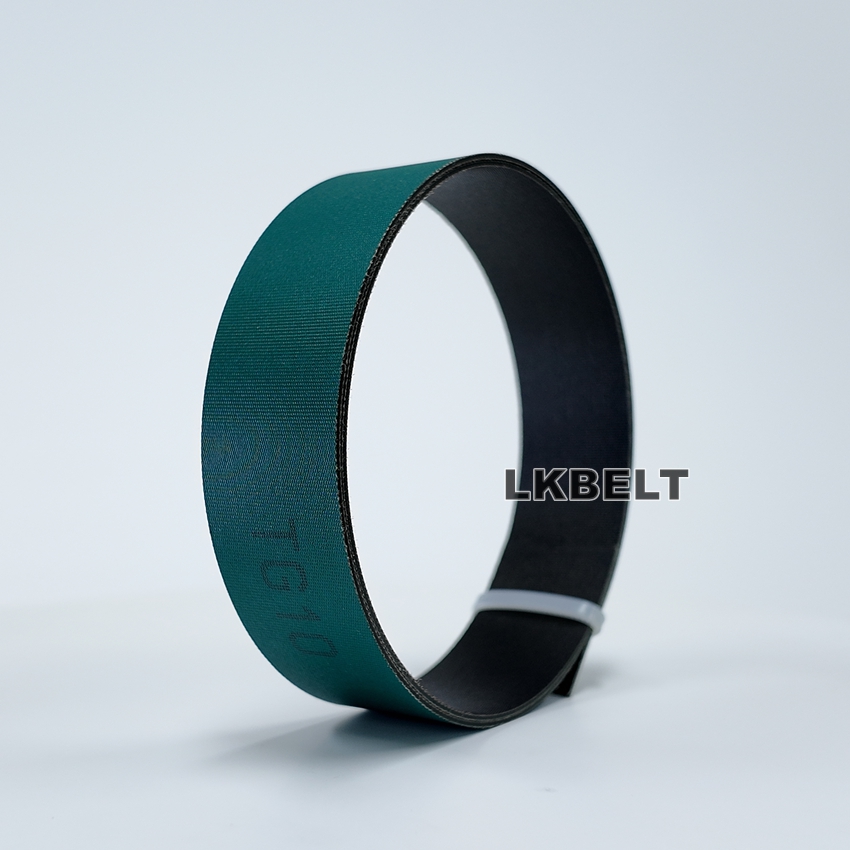
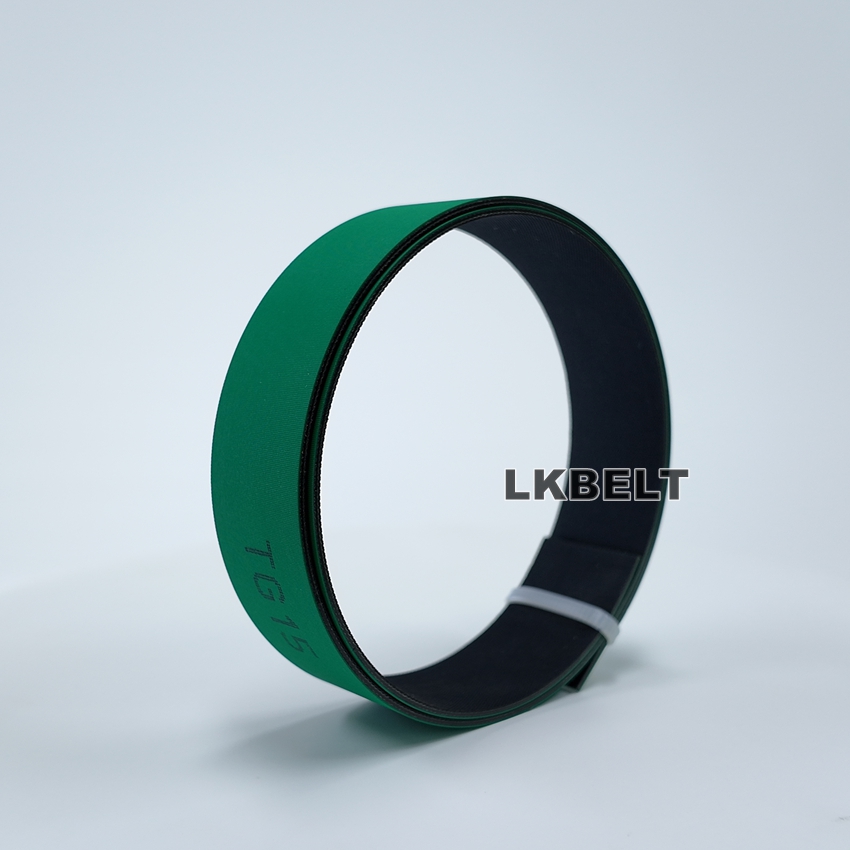
LKBELT provides actual public model references. The TG10 flat transmission belt is photographed with a green textured outer face and a black fabric inner face. The TG15 flat transmission belt also shows a green outer face and black inner surface. These observations can help confirm sample identity, but do not prove that the two models have equal body stiffness, allowable tension, pulley limits or electrical resistance.
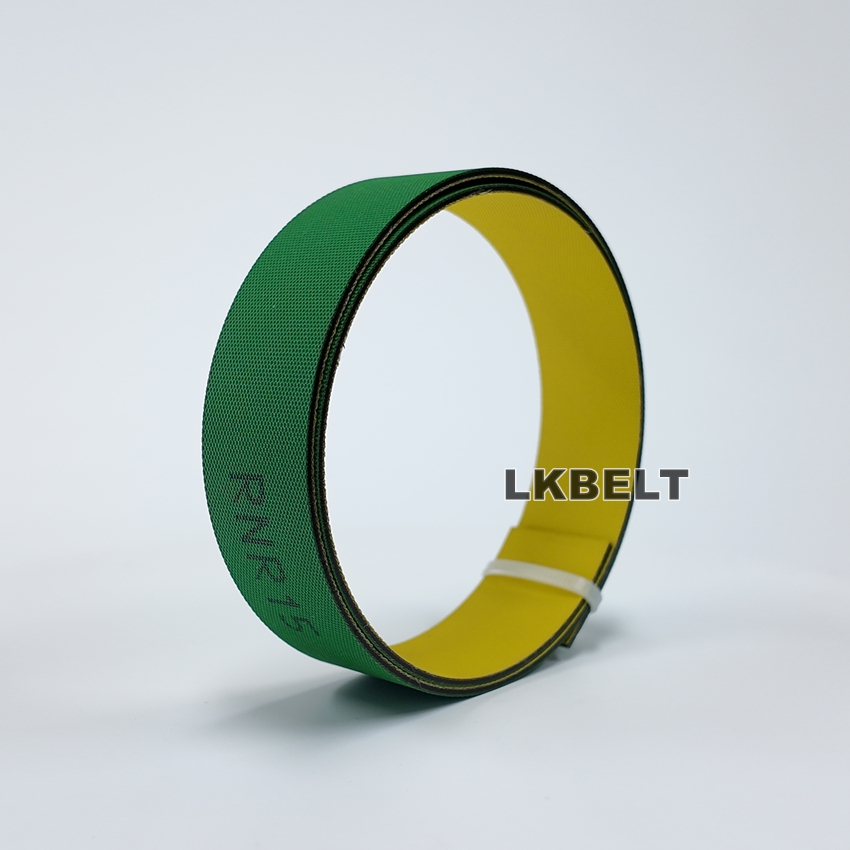
The RNR15 nylon sandwich transmission belt is described with rubber surfaces and a green/yellow visual construction. Its current product information identifies a 1.6 kg/m² listed belt weight and 50 mm listed minimum pulley diameter in the RNR15 row. Treat those figures as published model-specific references, not as compatibility approval for a customer’s machine, a modified joint or a different RNR model.
The TG10 and TG15 product pages include range tables listing other models. A number on a table row for RNR15, TG12 or another reference must not be presented as TG10 or TG15’s verified property. Request the actual candidate’s current technical sheet, supply form, joining specification and approved operating parameters before drawing a design conclusion.
The First Selection Gate: Exact Model, Approved Equivalent, or Unknown
A model name on a worn belt is a helpful lead, but it is not the same as a confirmed finished replacement assembly. Apply this evidence gate before comparing colours or ordering a convenient thickness:
| Replacement route | Evidence available | Purchasing decision |
|---|---|---|
| Exact OEM reference | Current original belt specification, machine position and joint requirements agree | Request the same approved construction and finished size; still verify revision |
| Proposed equivalent | Full candidate data plus OEM/qualified engineering acceptance of differences | Obtain documented substitution approval and a controlled first article |
| Partial marking or sample only | Dimensions or photographs exist, but original design duty is unknown | Hold substitution until model, pulley route and load are confirmed |
| Electrical or special-duty claim | Marketing name only, without relevant model test report | Request test method, limit and evidence; do not approve on the name alone |
This deliberately separates a component identification service from an engineering approval. LKBELT may review a candidate construction, but the machine designer or responsible plant engineer must approve a change that alters shaft loading, belt behaviour or safety requirements.
Six Engineering Questions Before Replacing a Flat Transmission Belt
1. What is the real drive function and operating load?
Record the driving and driven shafts, nominal and actual rotation directions, operating speeds, duty cycle and transmitted load. Include start-up peaks, frequent reversals, shock events and any clutch or idler action. A motor power rating alone does not determine what power is available at the belt throughout every part of the duty cycle. A slipping belt can be a consequence of overloaded driven equipment rather than a defective belt.
The existing belt-drive power transmission guide provides background on effective force and speed. This article instead addresses model-specific selection and replacement evidence.
2. Which face contacts the drive pulley?
A belt may have different outer and inner friction layers. The visible green surface is not necessarily the side used on the driving pulley in every installation. Document the actual belt route, pulley finish, lagging, crown where applicable, and which face contacts each component. Record whether the belt’s other face sees a jockey roller or reverse bend.
A change of belt construction may alter traction, wear and heat. The machine’s pulley layout may also have been changed during maintenance. Do not take a two-colour product photograph as confirmation of a particular coefficient of friction or recommended orientation. Those details require a model-specific drawing or supplier instructions.
3. What do reinforcement and elongation figures mean?
A manufacturer’s published elongation-related or stress-strain figure needs its test definition, units, sample width or thickness convention and applicable belt model. It is not a universal percentage of length to add when ordering. An older belt may have relaxed, taken a set or experienced abnormal stretch. Distinguish the original finished specification from a used belt measurement.
For a replacement, ask for the accepted original model, belt body and joining construction, not merely a visual match. If the original tension member differs from the proposed option, seek an explicit technical review of working tension, start-up load and available take-up. A “nylon core” description by itself does not establish a rated tensile capacity.
4. Can it bend around every installed pulley?
A published minimum pulley diameter is conditional on the named construction and the maker’s specified bend arrangement. The smallest idler, not the main drive pulley, may govern suitability. If the belt reverses over a backside roller, the effective strain and joint behaviour can differ from a simple forward bend. The joint also sees repeated flexing; its thickness transition must pass the pulley without interference.
In a tightly packaged drive, fitting access matters. A fully endless belt may require machine disassembly, while a permissible joining method may offer another service route. Do not assume that all flat belt bodies can use the same splice or be joined successfully on site. Confirm the approved fabrication process for the exact selected product.
5. Does the pulley and bearing system accept the proposed tension?
Pretension is needed for many friction drives, but too much can load shafts, bearings and joints beyond their acceptable limits. A belt with a different stretch characteristic may require a different approved tension method. The equipment OEM’s pulley support and allowable loading can be decisive. Record centre distance, pulley shaft condition, take-up travel, alignment and the original tension-setting procedure.
If the new belt slips, increasing tension until the symptom disappears is not a sound universal practice. Review contact, pulley condition, working duty and measured drive behaviour first. Forbo’s Siegling Extremultus compendium separates belt selection, fitting/tensioning and the operating creep/slippage regions of its own products. Those construction-specific procedures and numerical limits are not TG10, TG15 or RNR15 specifications.
6. What is the actual operating environment?
Describe dust, moisture, oil, process residues, cleaning, temperatures and intermittent or continuous operation. If the application needs static dissipation, provide the required electrical property, test method and grounding arrangement. The TG15 product page asks buyers to specify static-control acceptance criteria, but the public page does not publish a model-specific measured resistance class or hazardous-area approval. Request the specific test evidence and review the full machine’s electrical safety separately.
Model-Level Comparison for Procurement
| Model/reference | Publicly identifiable information | What cannot be inferred | Required purchasing confirmation |
|---|---|---|---|
| TG10 | Green textured outer face; black fabric inner face | Exact working load, joint, friction or minimum pulley from appearance | Model sheet, finished dimensions, drive route, joint |
| TG15 | Green outer face; black inner face; antistatic-related product description | Verified resistance class or hazardous-area suitability | Test method/documentation if required, tension and pulley limits |
| RNR15 | Nylon sandwich/rubber-face construction; listed 1.6 kg/m² weight and 50 mm minimum pulley | Guaranteed compatibility with all 50 mm pulleys, other RNR grades or finished joints | Exact variant, forward/reverse bend, joint and machine duty |
Product-table information must be attached to the named model only. If a newer approved drawing conflicts with a public range row, supplier and OEM review should resolve which revision governs the order.
What the Public Model Pages Actually Establish
The three first-party pages give a traceable starting point, but their evidence is not interchangeable:
- TG10: A named polyamide flat transmission model with photographed green textured and black fabric faces. The public model-specific description does not supply a verified TG10 minimum pulley diameter or working pull value.
- TG15: A distinct named model with similar-looking green/black faces and a request for operating and static-control criteria. Appearance alone neither proves TG10 interchangeability nor an electrical-resistance class.
- RNR15: A named nylon sandwich/rubber-surface model with a published 1.6 kg/m² belt weight, 50 mm minimum pulley and −20 to +90 °C model-row temperature range. These are catalogue references for the specified model and assumed conditions, not approval of a selected joint, reverse bend or the complete machine.
The buyer should ask for the current model-specific datasheet revision, not copy figures from a general family table. Forbo’s product-family compendium helps explain why tension-member materials and coating layers must be assessed together, but does not certify any LKBELT construction.
Two Practical Industrial Scenarios
Scenario A: A machine needs a spare for a TG10-type position
A print-finishing machine has a flat drive belt with a partly legible model marking and a green/black appearance. Purchasing finds both TG10 and TG15 listings and asks whether they can be swapped. Maintenance first records the full marking, belt-face arrangement, original size, pulley route, contact surfaces and machine duty. It then requests the correct model drawing and joining details.
The visible colour may narrow the search but does not establish equivalence. If the original specification is unavailable, a qualified engineering assessment must define the acceptance requirements before any substitute is fitted. Neither a product name nor a catalog photograph is evidence of approved interchangeability.
Scenario B: A shorter-centre drive with a small backside idler
An OEM is revising a transmission drive to occupy less space. The proposed route introduces a smaller return-side idler while keeping the main pulleys unchanged. A belt option that meets the main-pulley requirement may still fail the reverse-bend or joint requirement. The team obtains the complete path and verifies the selected belt and finished joint against every pulley before approving an order.
If take-up travel is limited, the engineering team must also verify the belt’s required installed setting. The hypothetical example has no assumed dimensions or guaranteed outcome; the correct order follows the actual approved drawing.
First-Article Inspection: What Would Make Purchasing Reject the Belt?
A first belt can be rejected even when its colour and width look correct. Record model identity, finished loop measurement basis, thickness, both-face orientation, joint profile, edge finish and a supplier-provided drawing revision before fitting. After authorised installation, compare tracking, permitted take-up position, measured speed, temperature trends and joint passage under the approved loading cycle.
Stop and request engineering review if the supplied model differs from the accepted specification, the splice cannot clear a reverse idler, the required tension is outside the allowable take-up, the belt contact face is uncertain, or an ESD claim lacks the project-required test evidence. Record the accepted belt version and machine position so a second purchase is not decided from memory.
Flat Transmission Belt Replacement RFQ
Provide: equipment manufacturer/model, belt position, original model reference and drawing revision, pulley diameters, pulley surfaces, rotational directions, contact face, centre distance, idlers, bend direction and allowable take-up. Include the original finished width, loop length and thickness with the measurement basis, plus photographs of the belt faces, edge and joint.
Describe expected operating power or torque, speeds, loading cycle, environment and any static-dissipation requirement with its test standard. Ask the supplier to identify the proposed construction, relevant operating limits, approved joining method, expected finished tolerances and changes relative to the original.
A sample-approval plan should cover received belt identification and dimensions, joining and installation under the machine procedure, correct tension-setting method and the recorded operating checks. If a model change requires shaft or bearing reassessment, that is an OEM/engineering decision—not something established by a belt supplier’s general catalogue copy.
Frequently Asked Questions
Are TG10 and TG15 interchangeable because their surfaces look similar?
No. Confirm the specific original and proposed constructions, operating limits, joint and machine requirements before treating them as substitutes.
Does the RNR15 50 mm pulley figure apply to every RNR flat belt?
No. It belongs to the listed RNR15 row. The actual drive and finished joint require their own check.
Can a nylon flat transmission belt replace a PVC conveyor belt?
They serve different primary duties. Do not exchange them without a full machine-specific engineering review.
Is an antistatic product name proof of ESD certification?
No. Obtain the required electrical resistance limits, test method and applicable evidence for the actual belt and installed system.
How do I measure a worn flat transmission belt for a replacement?
Start with the OEM part reference and original finished specification. Record measurements of a used belt separately, including condition and method, and resolve the ordered length with the supplier.
Conclusion
The useful question is not “which nylon belt looks closest?” but “which fully defined model and finished construction meet this transmission drive?” Compare TG10, TG15, RNR15 and any other candidate using the original machine data, both belt surfaces, pulley path, joint, tension and duty. Send LKBELT the original marking, drawing, measured belt details and quantity so the proposed replacement can be reviewed against a traceable specification.