
Consider a hypothetical snack manufacturer lifting fragile products from a processing floor to an upper packaging station. The layout could accommodate a bucket elevator or a Z-shaped belt conveyor, but the equipment decision has consequences for product containment, discharge and replacement parts. Choosing a “high-grip belt” without understanding the machine does not resolve those questions.
A Z conveyor belt and a bucket elevator should be compared by product characteristics, inlet and outlet geometry, sanitation, and the actual lifting mechanism. A cleated or sidewall belt is one possible component of a Z conveyor; buckets and their carrier are a different assembly. Once the machinery is selected, buyers must approve the precise belt, attachments, joint and return path instead of assuming the two systems use interchangeable belting.
How Do Bucket Elevators and Z Conveyor Belts Differ?
A bucket elevator carries material in buckets attached to a belt, chain or another conveying member, depending on the equipment. The buckets collect, lift and discharge the material according to the machine’s design. A Z-style belt conveyor has horizontal or near-horizontal feed and discharge sections connected by an inclined section, often using transverse cleats and, in some designs, sidewalls. Its belt and any attachments must negotiate each transition, pulley and guide.
Not every Z conveyor uses the same belt construction; not every bucket elevator is driven by a belt. The equipment manufacturer’s drawing must establish the actual carrier and drive. Buying a sidewall conveyor belt as a substitute for a bucket-elevator belt or chain assembly would be a category error.
Dynamic Conveyor’s bucket elevator versus Z conveyor comparison already addresses product size, containment, cleaning and maintenance. Its statements about its own Z conveyor design, such as minimized tracking and its service interval, are specific to that manufacturer’s equipment. They must not be applied to every Z conveyor or to an LKBELT belt. This article goes one step further: it translates the equipment comparison into finished-belt design questions that procurement and maintenance must answer.
Start With the Material Being Lifted
Fragility, particle distribution and release
A cereal flake, sticky confection, delicate biscuit and free-flowing powder behave differently at infeed and discharge. A product that piles between cleats may experience compression, breakage or unwanted contact with a sidewall. Fine powder may leak at transitions or build up on a joint or attachment; a large irregular product may bridge a compartment. Equipment selection must consider both the product’s size distribution and how it behaves during starts and stops.
Do not decide from a single representative “average” piece. Record the smallest and largest product, bulk density where applicable, moisture, stickiness, fragility, surface temperature, allowable damage and permitted carryback. Ask where losses occur: at the feed opening, during the incline, at the transition into discharge or on the return run. A different belt surface will not necessarily correct an inlet or chute problem.
Product containment and usable pocket volume
For a cleated Z belt, the cleat height, pitch and usable width between sidewalls influence the compartment into which material can settle. But these geometric dimensions alone cannot establish a rated throughput. Filling efficiency, product behaviour, allowable loading, belt speed, inclining angle and discharge behaviour also matter. Do not invent a universal “pocket capacity” formula for industrial RFQs without knowing the product and geometry.
Sidewalls may improve lateral containment, but their corrugations, attachment interfaces and any joining areas require inspection. A cleat can restrain product on the inclined section while creating a discharge or cleaning difficulty elsewhere. Engineering should treat the overall transfer as an operating process rather than optimize one attachment in isolation.
Who Approves the Equipment, and Who Approves the Belt?
The competitor comparison already explains why particular equipment designs may simplify cleaning or reduce maintenance. However, a system maker’s claim about its own Z conveyor does not prove that a generic cleated belt will provide the same capacity, sanitation performance or tracking behaviour.
| Approval item | System OEM / plant engineering | Belt-component supplier |
|---|---|---|
| Lift height, throughput and allowable product damage | Select machine route, drives, discharge and capacity under actual product conditions | Review belt construction against the approved route and product |
| Product containment | Determine loading, discharge, guarding and leakage requirement | Propose permitted cleat/sidewall dimensions for review |
| Hygiene | Approve cleaning access and validated sanitation method | Provide available evidence for selected material, finished joint and attachment processing |
| Reliability and maintenance | Specify pulley arrangement, operating cycle, access and replacement method | State finished-belt drawing, splice or joining constraints and tolerances |
An RFQ that asks only for “a belt for a Z elevator” is not sufficient to approve a finished assembly. Obtain the installed conveyor drawing and confirm which parts the customer actually intends to replace.
Cleats, Sidewalls and Joint Layout Must Be Designed Together
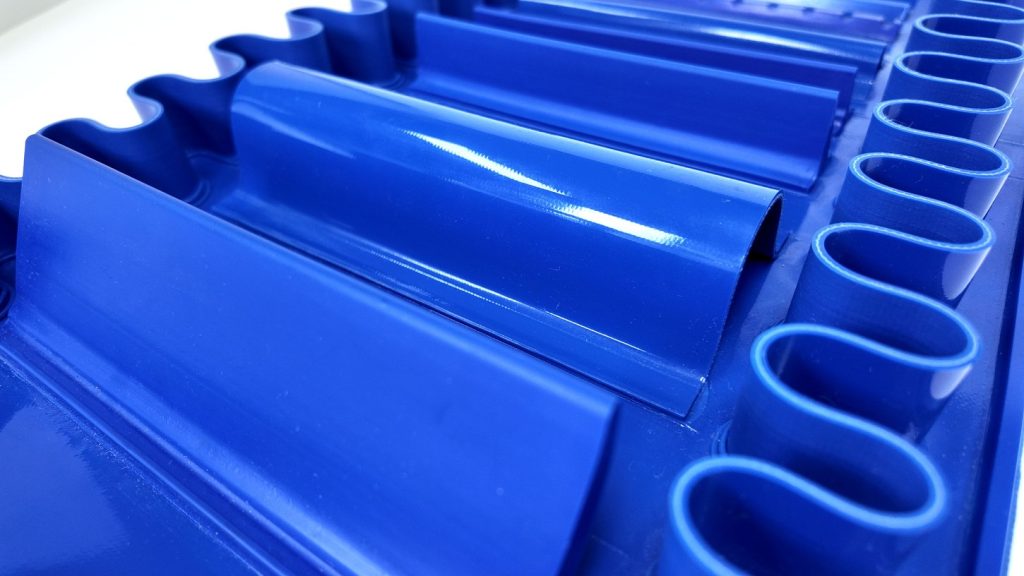
LKBELT’s custom baffle and sidewall belt shows a blue carrying face, transverse cleats and examples of corrugated sidewalls. That is real evidence of a product arrangement and of the dimensional information requested for quotation. It is not evidence that an arbitrary cleat height, adhesive bond or complete Z-conveyor system has already been certified for a customer’s duty.
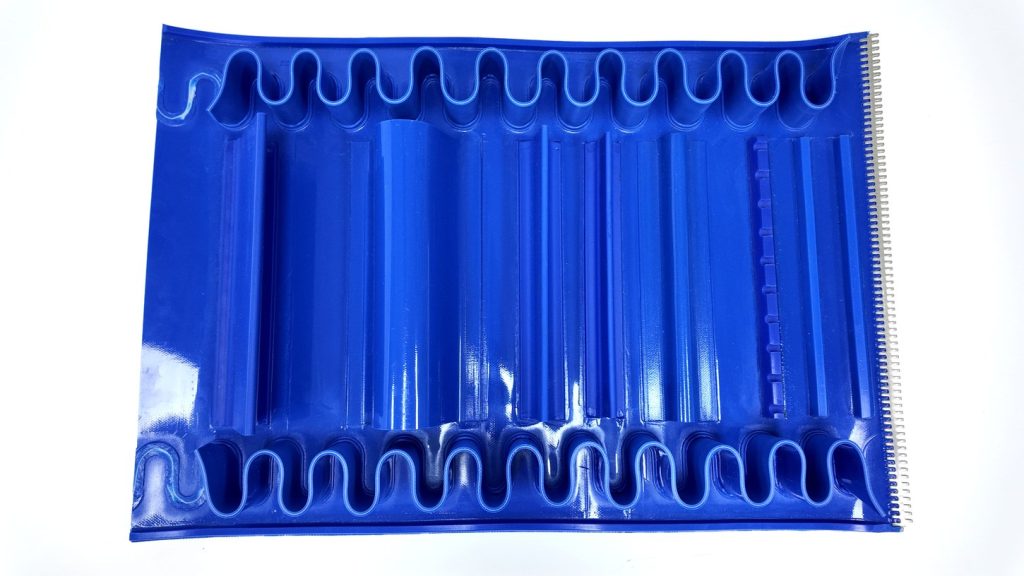
For an RFQ, record the belt’s outside width separately from the usable distance between sidewalls. Show cleat section, height, distance between cleats, orientation and end clearances. Identify whether cleats meet the sidewalls or terminate before them. The attachment layout must work around the pulleys, on the return path and through any scrapers or discharge devices.
Cleat pitch and a closed endless loop
An often-missed issue is how a repeating cleat pattern closes across the finished belt loop. A nominal pitch multiplied by an integer number of spaces must be reconciled with the approved developed layout, belt loop circumference and any reserved joint zone. The order drawing should identify the starting datum, first and last cleat positions and whether the spacing across the joint differs by explicit approval. Do not automatically trim or stretch the approved endless length to make a preferred cleat pitch fit.
The joint may have a region in which cleats or sidewall processing are prohibited or limited. Its position may also affect product retention, bending and maintenance access. Define it on the same drawing as the cleats; otherwise the assembly may be manufactured correctly in separate operations yet fail in the installed machine.
Reverse bends and small transition pulleys
A Z-shaped route can include small pulleys, reverse bending and transitions between horizontal and inclined sections. A cleat that clears the upper conveyor may collide with a return roller. Sidewall folds may distort on a tight bend. The belt manufacturer must know every contacted pulley diameter, direction of bend, belt face contacting the component, joint profile and take-up allowance. A product photograph does not prove the allowable geometry.
The LKBELT conveyor drive layout guide explains the distinction between drive locations and the full belt route. Use it to document the existing machine, not to infer compatibility for a particular attached belt.
Verify the full cleat path, not just the visible incline
Before the first belt is made, trace one cleat through a complete revolution on the machine drawing: feed transition, incline, upper discharge, return pulleys, underside support and take-up extremes. Mark clearance to guards, scrapers, rollers and adjacent cleats, including the finished joint zone. A positive clearance at the large end pulley is not evidence that the same cleat clears a smaller return roller.
A controlled first-article check should include an attachment count, measured positions from one agreed belt datum, sidewall continuity, joint finish and an approved installed clearance test. The diagram should specify whether cleat pitch is measured along the straight belt developed length and how the pattern closes at the joint. These details reduce the chance of reordering a belt that has correct individual components but an unusable assembled layout.
A Practical Comparison for Equipment and Belt Buyers
| Decision factor | Bucket elevator | Z-style belt conveyor | Evidence to collect |
|---|---|---|---|
| Carrying mechanism | Buckets mounted on a machine-specific carrier | Continuous belt with possible cleats/sidewalls | OEM drawing and original parts |
| Small or fragile product | Depends on bucket loading and discharge | Depends on compartment loading and belt discharge | Product trials and damage criteria |
| Fine, free-flowing material | May suit suitable bucket systems | Retention depends on belts, flights and transfer design | Leakage, carryback and cleaning evidence |
| Cleaning | Bucket, chain/belt and housing access matter | Cleat, sidewall, joint and return access matter | Plant sanitation and access requirements |
| Replacement parts | Bucket/carrier/drive are distinct components | Finished belt and attachments require approval | Exact installed part identity |
| Geometry | Head, boot, buckets and discharge mechanism | Horizontal-incline-horizontal route with transitions | Drawings, pulley diameters and clearances |
A machine vendor must decide overall capacity and operating configuration. The belt supplier can evaluate the finished belt specification for the actual approved conveyor.
Food Processing: Hygiene Is More Than Belt Colour
When unpackaged food contacts a belt, the permitted material and finished belt construction must suit the food-contact conditions and destination market. Cleat and sidewall interfaces may create hard-to-clean areas if the design or processing is unsuitable. Cleaning also depends on machine access, chemical concentration, contact time, rinsing, drying and the site’s validated procedure.
The food-processing belt application helps identify the process and contact conditions. For cleaning procedure considerations, use the food conveyor belt cleaning guide as a supporting resource. Do not assume that a colour, PU label or model suffix provides regulatory approval. Ask for documentation covering the actual selected construction, attachments and intended use.
A hygienic equipment claim is not automatically a hygienic belt assembly claim. If a supplier changes cleat bonding, a joint or an exposed edge, the resulting assembly may need a new process and sanitation review. Keep the first approved sample and its records for repeat orders.
Two Industrial Selection Scenarios
Scenario A: Fragile pieces and a congested discharge
A packaging plant has a Z conveyor transporting fragile cereal clusters. The product arrives intact at the upper section but accumulates and breaks near discharge. An engineer first records product shape, compartment fill, belt speed, discharge transition and the receiving machine’s stop/start logic. Changing to a taller cleat might retain more product during the incline yet worsen product release at the upper transfer. A different cleat spacing or surface may be considered only together with the discharge geometry and acceptance trial.
The vendor must review the conveyor’s overall design. LKBELT’s role, if an appropriate belt is confirmed, is to specify and supply the finished assembly for that approved route rather than promise that a new belt will solve a system-control problem.
Scenario B: A requested bucket-elevator “belt” with no part drawing
Maintenance sends a worn carrier photo and asks for a replacement “elevator belt.” The machine may use a bolted bucket carrier, a fabric belt with attachment holes or a chain-based system. Procurement confirms the machine nameplate, carrier type, original part code, fastener pattern and operating duty before asking any belt manufacturer for a quotation. A sample of a cleated Z-conveyor belt would not establish a matching replacement.
The safe outcome may be an OEM parts inquiry rather than a belt offer. It is better to identify a non-match than to ship a visually similar component with an incompatible attachment system.
A Product Trial That Can Actually Reject the Wrong Design
A hygienic food conveyor should be trialled with both the easiest and the hardest product in the range—such as fine fragments, sticky pieces or fragile clusters—rather than with only a uniform sample. At the agreed start/stop and discharge cycle, record carryback, compartment overfill, product damage, loss at the upper transfer and places where residue remains after the plant’s approved cleaning procedure.
Define a pass/fail limit for each observation using the plant’s own validated criteria. The belt supplier should not insert universal breakage percentages or maximum slope claims unsupported by the customer’s machine and product. If product breakage is caused by the discharge chute or control sequence, modifying cleat height alone may leave the problem unresolved.
Replacement Belt RFQ: From System Drawing to Finished Assembly
Request the conveyor manufacturer’s part drawing and identify the exact belt position. Submit the original belt code and photographs of both faces, joint, cleats, sidewalls, attachments and belt path. Specify the finished endless length with its measurement basis, total outside width, usable internal width, base-belt thickness, reinforcement and contact surface.
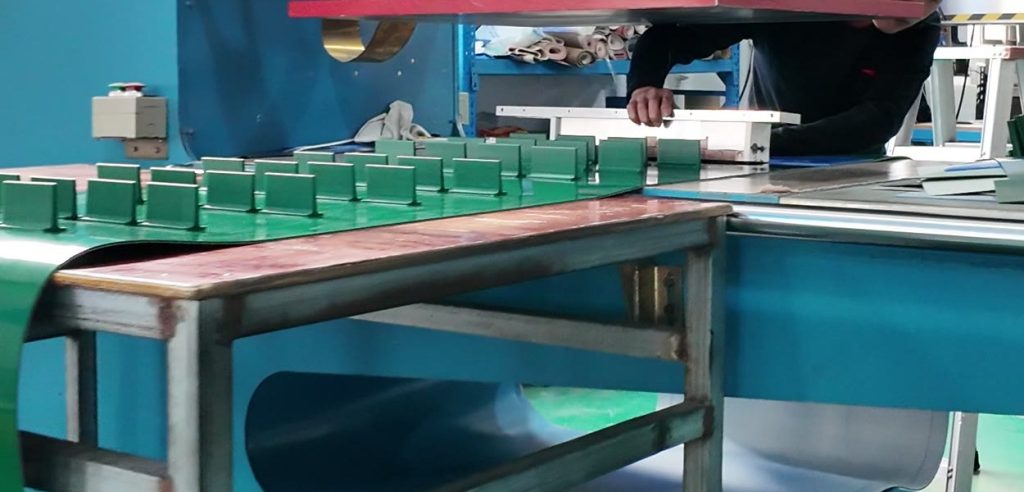
For each cleat, provide cross-section, height, pitch, orientation, first-cleat datum and minimum clearances at ends and edges. For sidewalls, supply height, corrugation/profile, position from belt edges and joining details. Show attachment and joint exclusion zones. Include any underside guides and the corresponding pulley/groove geometry. Reference the original machine configuration, not a hand sketch with missing dimensions.
Add the conveyed product envelope, wet/dry condition, load, speed, slope, washdown or cleaning duty, food contact requirements if relevant, and service temperature. Clarify the quantity, sample protocol and what deviations may be approved. The LKBELT cleated-belt product description can support an inquiry, but the customer-specific design still needs review.
First-belt acceptance
Inspect finished dimensions, attachment count, cleat positions, sidewall continuity, joint geometry and edge finish before fitting. Have qualified personnel install and check the assembly according to the machine instructions. The approved trial should use representative products, intended starts and stops, incline duty and the real discharge. Record carryback, product loss, visible scuffing, cleat interference, abnormal tracking and cleaning access. Do not substitute an unsupported numerical target for a documented plant acceptance criterion.
Frequently Asked Questions
Is a Z conveyor the same as a bucket elevator?
No. Both can lift material, but the carrying mechanisms and replacement components differ. Confirm the actual machine design.
Does a cleated belt need sidewalls?
Not always. Product behaviour, incline, edge loss and equipment geometry determine whether sidewalls are appropriate.
Can a sidewall belt use any cleat spacing?
No. The pitch must work with the approved endless loop, joint and drive/return route. Specify exact datums and positions on the finished drawing.
Will a taller cleat always increase throughput?
No. Feed, discharge, fill conditions and the receiving process may limit useful throughput. Evaluate the complete system.
Can LKBELT supply a complete Z conveyor or bucket elevator?
This article discusses the belt component. Confirm any specific supply request and product capability directly; do not infer complete-machine supply from belt samples.
Conclusion
A bucket elevator and a Z conveyor may both solve a height-change problem, but their carriers, containment and service parts are not interchangeable. For a Z-conveyor replacement, specify the whole belt assembly—base construction, cleats, sidewalls, joint and route—and validate the discharge and cleaning process before repeat purchasing. Share the equipment drawing and product details with LKBELT to establish which belt-processing options can be reviewed.