
A belt may move a carton uphill during a steady production test yet allow it to slide when the line stops. A rough-top cover, transverse cleats and corrugated sidewalls can all help with different aspects of inclined conveying, but they are not three interchangeable answers to the same problem.
Select an incline conveyor belt by identifying how the actual product must be supported and restrained across loading, motion, stopping and discharge. Rough-top texture relies on surface interaction; cleats provide discrete mechanical contact; sidewalls primarily help retain material laterally. The finished belt must also fit the return path, smallest pulleys, joints and available clearances. The incline angle by itself cannot establish which construction is suitable.
What Makes an Inclined Conveyor Different From a Horizontal One?
Gravity acts along the carrying run on an incline, while the contact between a product and the moving surface determines whether it stays in position. During acceleration, braking and emergency stopping, the product can experience different relative motion from steady travel. Cartons, flexible packages, granules and wet food do not behave identically.
FEECO’s incline versus steep incline conveyor comparison explains machine-level differences between conventional troughed bulk conveyors and pocket/sidewall steep-incline systems. Its cited equipment angle ranges are not universal limits for LKBELT lightweight PVC, PU or patterned fabric belts. We use that comparison to identify distinct retention mechanisms, not to assign an allowable angle to a particular LKBELT product.
The belt buyer’s task is narrower: decide what the replaceable belt assembly must do on an already identified conveyor, and obtain the machine and supplier approval for that assembly.
A useful friction calculation—and why it is not an incline rating
For a rigid object resting on a simple, stationary incline, a simplified model gives the downslope force as m × g × sin(θ) and the normal force as m × g × cos(θ). The idealised no-slide condition is therefore μₛ ≥ tan(θ), where μₛ is the static friction coefficient of the actual object–belt surface pair. At a hypothetical 15° angle, tan(15°) is approximately 0.268. This calculation is an explanation of the physics, not a claim that any LKBELT belt can safely carry a carton at 15°.
Real production involves changes in acceleration, product deformation, contamination, vibration, rolling shapes, contact pressure, stopping and package orientation. A belt-to-drive slip condition is a separate interface entirely. Do not set the approved working angle or safety margin from this simplified equation: obtain the actual product-handling test and OEM requirements. Where rollback presents a hazard, proper mechanical controls and engineering approval take precedence over surface selection.
Define the product’s movement requirement
Before choosing a texture, describe the product: rigid or flexible, bagged or unpackaged, smooth or rough bottom, dry or oily, stable or prone to rolling. Identify the heaviest and lightest package, smallest contact footprint, greatest expected elevation change and actual incline direction.
Then record the operating cycle. Is the belt always moving, frequently indexing, or required to hold a product while stopped? Does it reverse or discharge immediately into a short transfer? A surface that provides adequate traction during one condition may fail another. The equipment’s stop system, loading geometry and guides also affect the outcome.
Rough-Top and Patterned Belts: Traction Without Physical Pockets
A rough-top or patterned carrying surface can increase useful contact with some products, but the result depends on texture geometry and the product material. Corrugated cardboard, plastic totes and soft film packages interact differently with the same pattern. Higher friction is not always better: a product may need to release at discharge or slide during a controlled accumulation step.
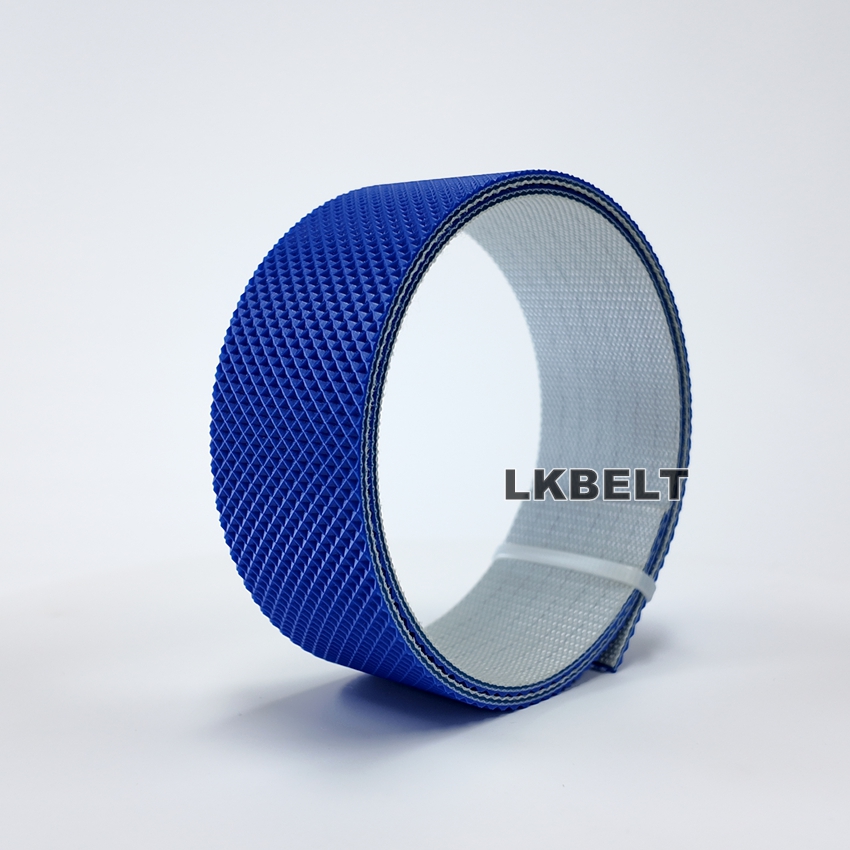
LKBELT’s anti-skid PVC diamond-pattern conveyor belt shows a physically textured PVC surface. Its public description lists different material and pattern options, but that does not establish an incline rating or a verified coefficient of friction for a particular finished grade. Ask for the offered model and conduct an application-specific assessment rather than assuming a diamond pattern guarantees no rollback.
The PVC sawtooth-pattern belt is another example of a raised carrying texture. Tooth height, orientation and pitch must be matched to the actual product and cleaning requirement. A taller surface profile can interfere with small transfers or make trapped debris harder to remove. It is not equivalent to a transverse mechanical cleat simply because its surface is raised.
For a broader comparison of belt-face textures, see LKBELT’s conveyor belt surface-pattern guide. This incline article focuses instead on the full product path under gravity, braking and discharge, not on cataloguing every texture.
A traction check needs realistic conditions
A meaningful test should use the real package surface, weight range, line speed, stop condition and contamination expected at the station. Record whether failure occurs during steady climbing, starting, deceleration, a scheduled stop or product release. Do not extrapolate a trial with one dry carton to wet, oily or flexible products.
If the belt appears to slip relative to the drive pulley, that is a different interface from a carton sliding on the top face. Changing the carrying pattern may not fix belt-drive traction, tracking or roller damage. LKBELT’s belt conveyor tracking guide covers the separate machine-side diagnostic path.
Cleated Belts: Mechanical Separation and Product Restraint
Transverse cleats can restrain product movement or keep units in defined positions. Their design needs more than “add baffles.” The buyer should specify height, shape, base width, spacing, alignment across the belt and the first cleat’s location relative to the seam.
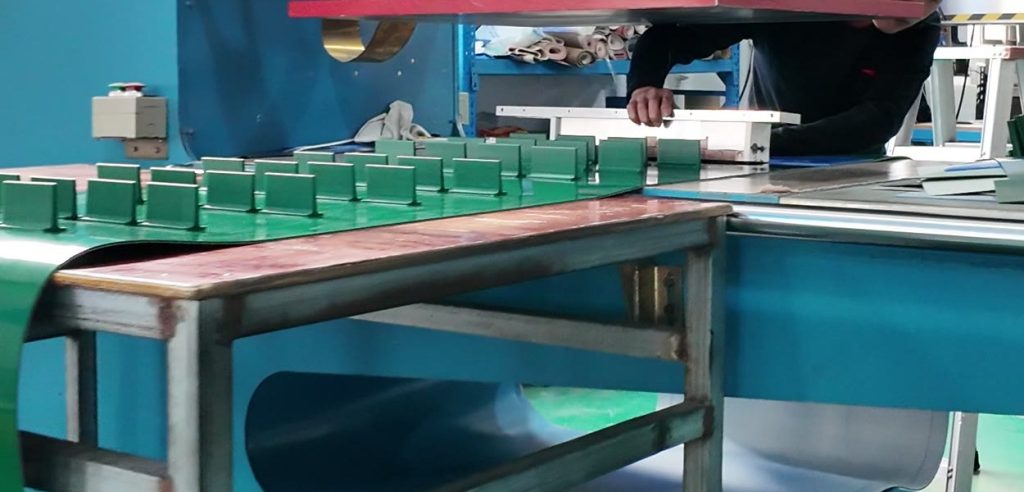
Ask whether the cleat acts on individual rigid cartons or confines bulk or loose material. A flexible pouch may deform around the cleat, while a rigid container may require a contact face that prevents crushing. For regular indexing, the pocket pitch must be compatible with loading and discharge timing, not simply the widest physical space between cleats.
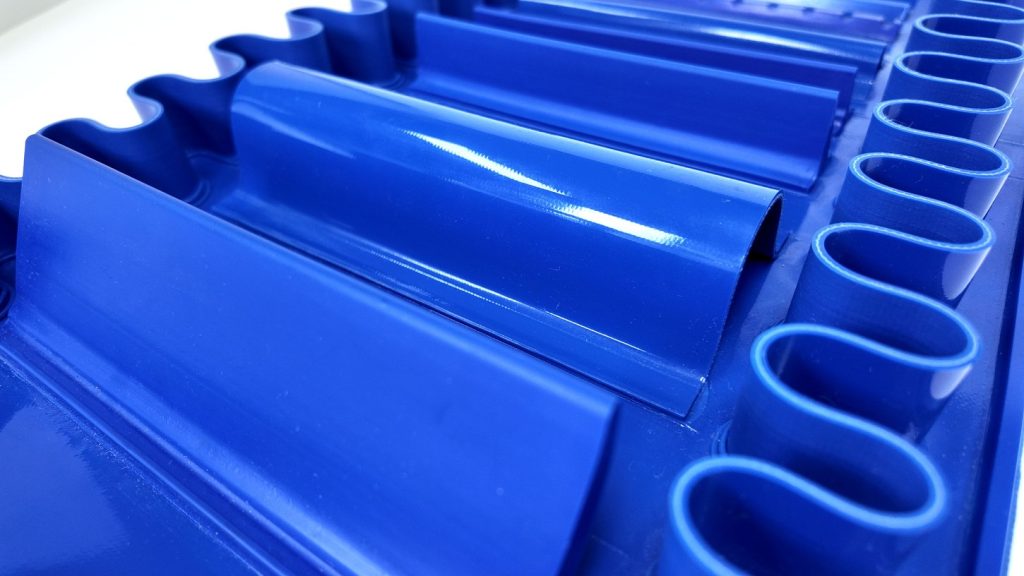
LKBELT’s white PVC belt with sidewalls and cleats shows a combined assembly. Its published dimensions describe what needs to be specified, not a universal approved incline or product class. The blue PVC sidewall-and-cleat product page shows another construction example; here the central decision is whether the application requires positive mechanical retention rather than surface traction alone.
Why cleats change the entire belt route
A new cleat affects return rollers, scrapers, guards, transfer gaps and the finished joint. Photograph the return side and confirm clearance over the entire loop, including the lowest point at the return and the discharge zone. If attachments are welded, request evidence that the base-belt grade and process are compatible.
If a belt is supplied endless, identify the restricted region around a joint where attaching a cleat may be inappropriate. An installation can fail not because the cleat will not hold the product, but because it cannot pass a return roller or the belt cannot be fitted without interfering with the frame.
Corrugated Sidewalls: Lateral Containment Is Not the Same as Longitudinal Restraint
Sidewalls along the belt edges help prevent material spilling sideways. On steep conveyor arrangements, transverse cleats and sidewalls may create pockets that hold bulk or small loose material against fallback. A sidewall alone does not necessarily stop products from sliding longitudinally down the slope.
Record sidewall height, corrugation profile, edge offsets, attachment method and usable carrying width between the walls. A 500 mm nominal belt width does not mean a 500 mm usable product channel if edge walls occupy some of the width; use the actual drawing rather than assuming a specific subtraction.
Verify pulley and return geometry. Corrugated walls need space to deform without being crushed by roller supports. A retrofit of a formerly flat conveyor to a pocket belt may require changes to the supporting machine, guards and discharge arrangements—not simply a new belt order.
Quick Selection Logic: Grip, Cleats or Sidewalls?
Start with the failure, not the material name. If the package slides on an otherwise correctly functioning mild incline and can release cleanly at discharge, assess a textured face using representative packages. If cartons must be spaced, indexed or restrained during stops, evaluate transverse cleats and their impact on product and return-route clearance. If loose material spills over the edges, consider sidewalls; if it also flows backward down a steep path, assess the complete cleat-and-sidewall pocket arrangement. If the root problem is belt-drive slip, machine tracking, a badly designed transfer or insufficient guarding, changing the carry-side surface is not an adequate fix.
The decision also depends on what happens when equipment is stopped. Mechanical features attached to a moving belt are not a substitute for the machine’s prescribed braking, guarding or safe-stop design.
One Practical Comparison for an Incline Belt RFQ
| Product and duty | Belt feature to evaluate | Main risk if selected superficially | Approval evidence |
|---|---|---|---|
| Sealed carton on a mild incline with stops | Textured or rough-top carrying face | Slips during braking or does not release at transfer | Worst-case carton test including stop/start |
| Individual packages need spaced feeding | Transverse cleats | Wrong pocket pitch, impact or collision at discharge | Product envelope, cleat layout, timing and return clearance |
| Loose product in a steep path | Cleats with appropriate sidewalls/pockets | Material fallback or lateral spillage | Machine layout, pocket geometry and material-flow test |
| Product accumulates after an incline | Surface choice plus downstream transfer design | High grip creates excessive pressure or poor release | Combined incline and discharge trial |
The categories are engineering starting points, not fixed angle-based rules. A belt with any of these features still requires suitable reinforcement, underside, joint and drive compatibility.
Stop, Start and Discharge: Three Separate Acceptance Conditions
Stop condition: Review what happens to the product when the belt stops normally and under the site-approved emergency-stop scenario. A carton that remains stable while moving may slide when the line stops; a freely rolling product may need actual mechanical restraint. Do not use unsafe moving-equipment contact tests.
Restart condition: Product may shift or compress against cleats during acceleration. Check the smallest and largest package positions, the distance to the next package and whether flexible film or straps can catch. Look for scuffing, deformed packaging or intermittent rollbacks that do not appear during a single static inspection.
Discharge condition: Verify product release at the receiving conveyor, chute or packing station. Some high-friction patterns make products difficult to transfer cleanly. Cleats or sidewalls may require the receiving equipment to be positioned or guided differently. The conveyor transfer-points article covers gap and transfer geometry; do not treat a belt profile as the sole solution to a machine handover problem.
How Thickness, Reinforcement and the Joint Affect an Incline Belt
The belt must bend around the installed head and tail pulleys and through the return system. Material and surface alone cannot establish minimum pulley diameter. Compare the complete finished construction: base thickness, fabric reinforcement, side guides, attachments and the joint’s local profile. Reverse bends, where present, deserve specific confirmation.
A wider or heavier cleat assembly may alter tracking or pulley loading. If the belt travels over slider beds, investigate underside friction separately from the carrying surface. A large-profile cleat can be suitable for carrying product but unsuitable for a narrow return clearance. Do not change the belt tension to overcome a clearance or geometry mistake.
For food or packaging environments, evaluate cleanability around cleat roots and corrugations, the actual detergent and rinse procedure, and any direct product-contact documentation. “Food-grade,” white colour and polymer labels are insufficient without the applicable product and intended-use evidence.
Two Hypothetical Selection Cases
Scenario A — Cartons on a short packing incline
A packing line moves sealed cartons upward to a case sealer. Operators report occasional backward sliding during stops. The first proposal is a thicker, aggressively patterned PVC belt.
A qualified team records the incline, carton underfaces, load mix, stopping sequence, and transfer geometry. If an identified surface candidate prevents unwanted movement while maintaining discharge and machine fit, a simple patterned replacement may be considered. If stops require more definite containment or indexing, a cleated solution can be evaluated, but it must clear the return route. The case does not assume a particular safe angle or measurable grip improvement.
Scenario B — Granular product on a restricted-footprint incline
A different line carries loose dry product to an upper hopper within a compact footprint. The material is spilling sideways and falling back along the slope. A supplier proposes a pocketed belt with sidewalls and transverse cleats. Purchasing compares the pocket width, cleat spacing, return clearance and feed/discharge locations against the actual equipment. If the current frame cannot accept the sidewall geometry, the project becomes a conveyor engineering change rather than an uncomplicated replacement belt order.
These are hypothetical engineering decisions, not published LKBELT customer results.
What Should Buyers Send for an Incline Conveyor Belt Quote?
Send the exact conveyor position and the original belt construction if available. Then include:
- Machine geometry: travel direction, slope, head and tail pulley sizes, return rollers, take-up, guide grooves, discharge geometry and installation access.
- Product envelope: material, smallest and largest dimensions, mass range, surface condition, rollability and potential contamination.
- Operating duty: speed, acceleration, normal stopping, start frequency, accumulation and reversing requirements.
- Carrying construction: PVC/PU grade candidate, surface pattern and orientation, base-belt thickness, reinforcement and underside.
- Attachments: cleat height, section and spacing; sidewall height and edge offsets; first feature datum; guide or scraper clearance.
- Finished belt: width, endless circumference or approved length basis, joint design, seam-restricted feature zone and tolerances.
- Evidence and approvals: contact requirements, cleaning cycle, site inspection criteria, trial conditions, order quantity and permitted deviations.
A quotation is not an approved production order until the customer and supplier agree on the finished dimensions, construction and test conditions. Keep the accepted version and photographs for future replacement.
Frequently Asked Questions
Is a rough-top belt always enough for inclined cartons?
No. Suitability depends on carton contact, slope, stop/start behavior, contamination and machine fit. A real product trial or appropriate engineering evidence is needed.
Do sidewalls stop products from sliding backwards?
Sidewalls primarily provide lateral containment. Longitudinal restraint may require surface traction, cleats or other machine design measures depending on the product.
Can I add cleats to any existing PVC conveyor belt?
Not without review. Confirm base-belt processing suitability, feature attachment, bending, joint restrictions and mechanical clearance with the supplier and machine owner.
Does one maximum incline angle apply to all PVC or PU belts?
No. Published equipment angles are application- and construction-specific. Product contact and operating conditions must be checked for the exact conveyor.
What is the first dimension to supply for a cleated incline belt?
Provide the full machine layout and existing belt specification; width and loop length alone are insufficient. Cleat pitch, usable pocket width, sidewall geometry and the return route are often decisive.
Conclusion
The best incline conveyor belt is the one that controls the actual product through loading, movement, stopping and discharge while staying compatible with the complete machine path. Treat rough-top surfaces, cleats and sidewalls as different mechanisms, not automatic upgrades. To review a finished LKBELT belt, send the conveyor drawing, product range, operating cycle, proposed profile geometry, joint and return-clearance information before agreeing to production.