
A replacement V-belt can have a familiar marking and still be wrong for the drive. Similar widths can conceal different profiles, constructions, or installation requirements. Understanding those differences helps buyers shortlist a belt before requesting a quotation.
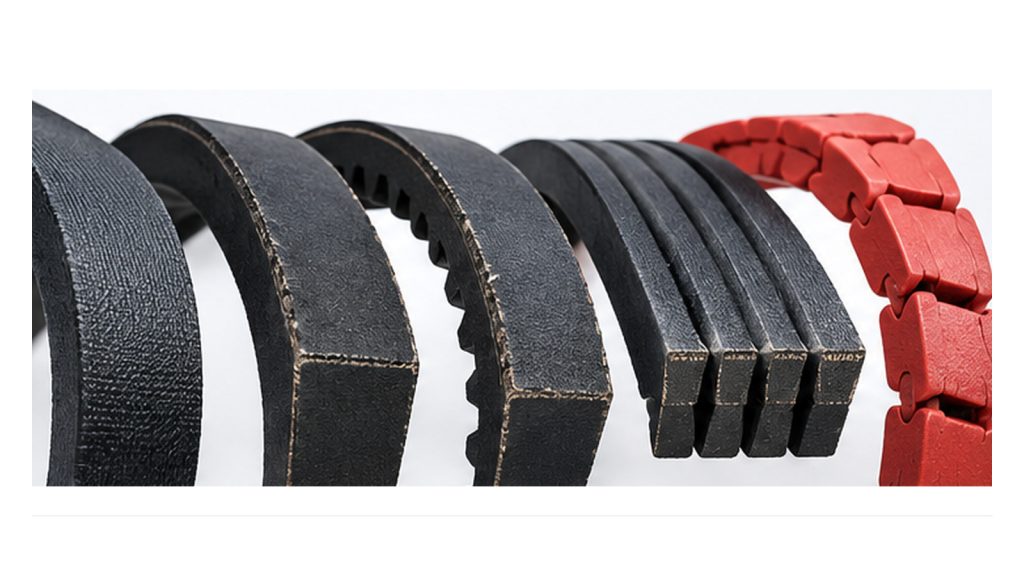
The main types of V-belts are best understood by profile, construction, and configuration. Classical and narrow or wedge identify profile families; wrapped and raw-edge describe construction; cogged identifies a notch feature. Single endless, banded, double-sided, and linked belts describe different configurations. These labels overlap rather than form one list of interchangeable alternatives.
The useful question is which combination fits the machine’s pulley system, duty, and maintenance access. A type name alone cannot answer it.
How Are Industrial V-Belts Classified?
Begin with the profile family. Classical sections include familiar A, B, and C designations; narrow families include SPZ, SPA, SPB, SPC and, in other naming systems, 3V, 5V, and 8V. A full manufacturer designation is more useful than a shorthand family name.
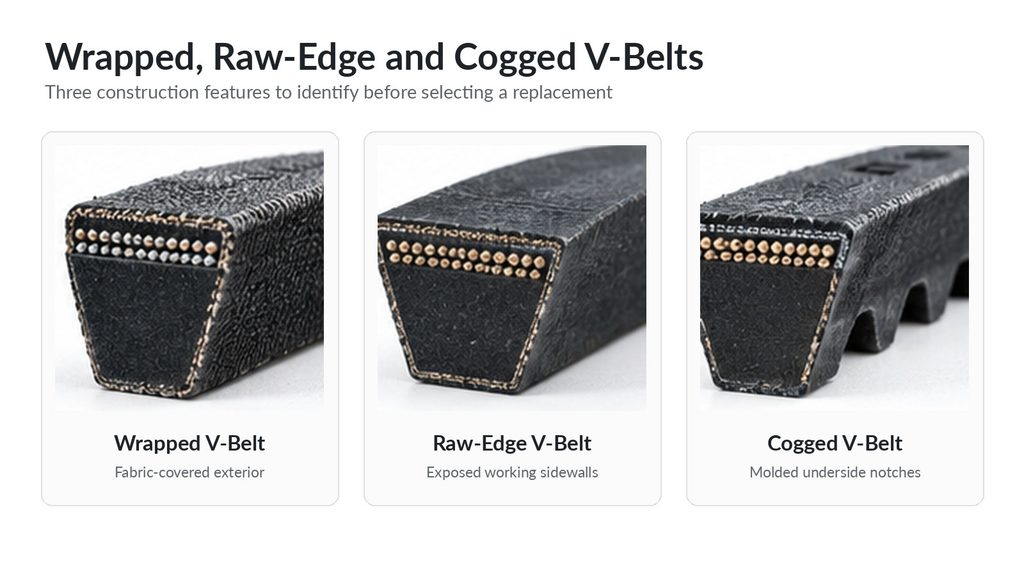
Next identify construction. A wrapped belt has a fabric-covered exterior, while a raw-edge belt has exposed working sidewalls. Molded underside notches add another distinction. A belt can therefore be both classical and raw-edge cogged, or narrow and banded.
Finally, establish configuration and drive purpose. Separate endless belts, joined belts, linked belts, and double-sided belts solve different installation or drive-layout requirements. Variable-speed belts and light-duty sections also need their own identification; an application label does not establish a universal power or speed rating.
Keep material separate too. LKBELT’s product information distinguishes rubber V-belts from separately listed triangular PU products. Similar letters in those listings do not establish the same reinforcement, length convention, or pulley suitability.
What Is the Difference Between Classical and Narrow V-Belts?
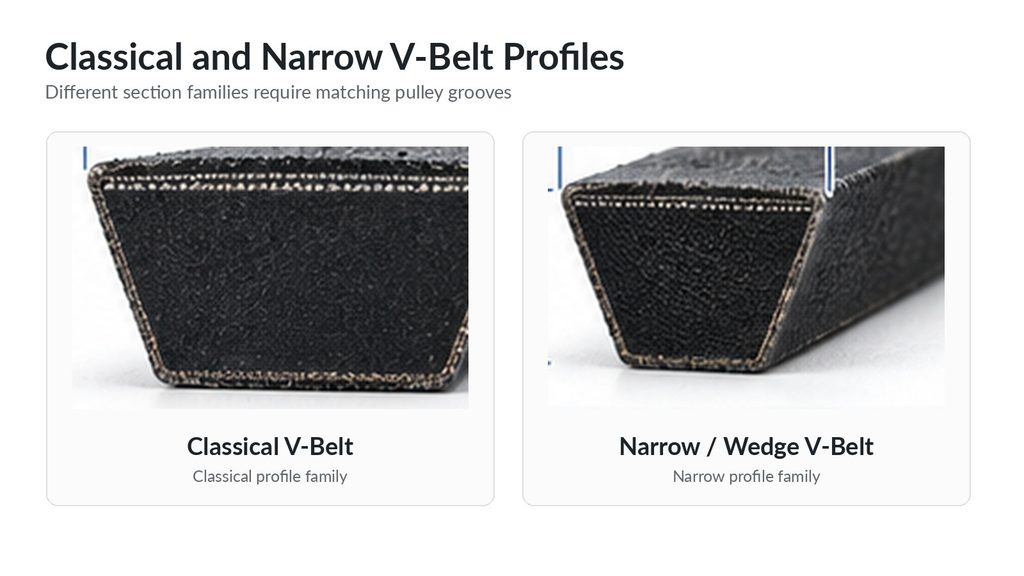
Classical and narrow V-belts differ in cross-section proportions and the drive systems for which their profiles are specified. Narrow or wedge families can be considered where drive space and transmitted duty are important, but they require a compatible pulley arrangement and a series-specific selection.
Comparable top widths do not prove interchangeability. A classical B belt and a narrow-profile belt can look similar from above while seating differently in the groove. Check the complete sheave profile, not just the opening width. Belt angle, groove geometry, length reference, and manufacturer recommendations must be considered together.
The terminology also varies between product systems. Continental’s Conti V information separately identifies wrapped classical and narrow families. Use the selected manufacturer’s documentation rather than assume that every imperial and metric designation is an exact replacement pair.
LKBELT’s standard and cogged range includes A/AX, B/BX, C/CX, and D/DX groupings. These identify related section options, not a blanket approval to exchange constructions. A change from a classical drive to a narrow drive may require a drive redesign rather than a belt-only purchase.
Wrapped vs Raw-Edge V-Belts: Which Construction Matters?
A conventional wrapped rubber V-belt combines tensile reinforcement and an elastomer body with an external fabric covering. In a raw-edge construction, the working sidewalls contact the pulley without that external wrapping over the flanks. Raw-edge describes the working sidewalls; cogged describes underside notches. A raw-edge belt is not necessarily cogged, and it may still contain fabric elsewhere in its construction.
LKBELT’s wrapped and cogged rubber V-belt information describes polyester tensile cord, fabric layers, and rubber options that depend on construction. Its named profiles should be ordered with their complete construction, not treated as one common compound or performance grade.
The choice affects how the belt contacts the groove and bends through the drive. It does not justify assuming wrapped belts are always better in dust, or raw-edge belts always better at high speed. Contamination, pulley condition, ventilation, loading, and the specific belt compound all matter.
Ask for the relevant product data when comparing alternatives. An oil-resistant claim needs its applicable conditions; it does not mean oil contamination is harmless to traction. Likewise, construction alone does not establish noise, service life, or a guaranteed efficiency improvement.
What Are Cogged and Molded-Notch V-Belts?
Cogged V-belts have transverse notches on the inside of the belt. These notches are not timing-belt teeth: conventional cogged V-belts still transmit power by friction against the pulley grooves, rather than synchronous engagement with a toothed sprocket.
Continental describes molded-tooth geometry as improving flexibility in its Conti VX range. The improvement applies to that product range.
The permitted pulley diameter still depends on the exact series and operating duty. A belt may bend more readily yet remain unsuitable for a particular load, speed, reverse bend, or tensioning arrangement. Obtain the relevant limit and identify which pulley-diameter reference the manufacturer uses.
The notch feature also crosses profile families: AX-type classical and XPB-type narrow belts are different selections despite both having molded notches. Do not shorten either requirement to “cogged rubber belt.”
How Do Banded, Double-Sided and Link V-Belts Differ?
Banded or Joined Belts
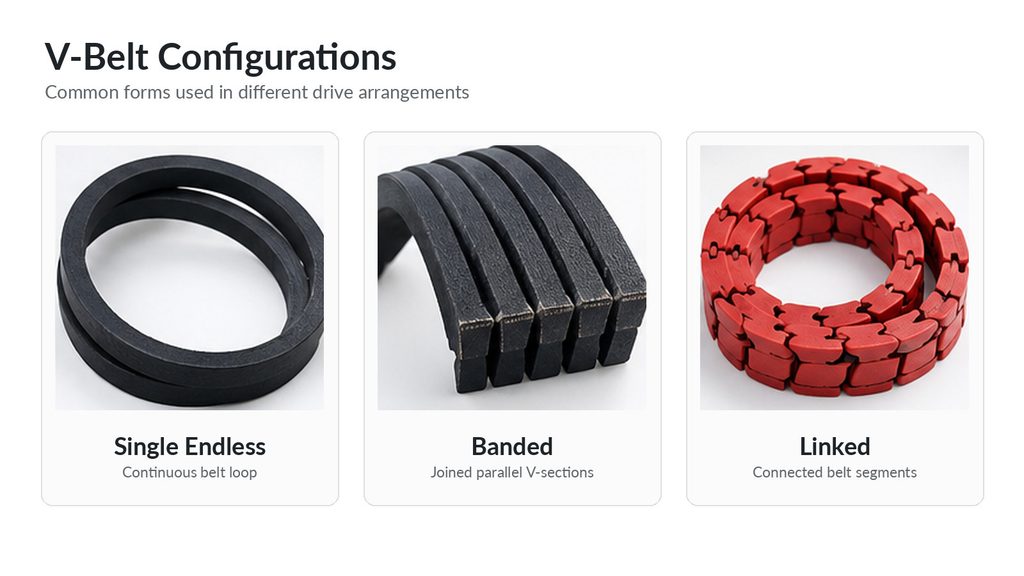
Banded belts connect parallel V-sections with a common backing. They differ from several separate belts running beside one another. Continental’s Conti V Torque Team is a manufacturer example intended for drives with highly erratic loads.
For a proposed joined replacement, verify the section, number of strands, groove spacing, sheave compatibility, and clearance. A joined belt also requires sound, correctly aligned pulleys.
Double-Sided or Hexagonal Belts
Double-sided V-belts have working geometry on both sides for suitable multi-pulley routes. Their selection depends on how the drive engages those sides, not simply on the presence of another pulley.
The Gates Industrial Preventive Maintenance Manual, printed pages 13–14, distinguishes Dubl-V, joined, light-duty, and V-ribbed products. These are separate product systems; a conventional single-sided V-belt should not be assumed suitable for transmitting power from both faces.
Connected Link V-Belts
A linked V-belt is assembled from connected sections instead of supplied solely as a fixed endless loop. This can make it worth investigating where access complicates fitting a conventional endless belt. The assembly, finished length, and installation must follow the selected product’s instructions.
LKBELT’s Power Red Twist Link V-belt page identifies connected links and lists Z, A, B, and C roll options at 30 m per roll. Those are published supply listings, not confirmation of current inventory or the finished length required by a machine.
Confirm the pulley profile and operating duty before considering substitution. The listing does not establish universal equivalence with wrapped or raw-edge rubber belts, and specifications from other link-belt products should not be transferred to it.
Poly-V or V-ribbed belts are another distinct arrangement: multiple small longitudinal ribs share one belt body and require matching ribbed drive geometry. They are not the same as several conventional V-sections joined by a backing.
Fractional Horsepower and Variable-Speed Belts
Fractional horsepower (FHP) families include 2L, 3L, 4L, and 5L. Gates identifies these in its Truflex light-duty range. Its maintenance manual separately discusses 3L, 4L, and 5L PoweRated products, including particular clutching and backside-idler duties. Match the named series, section, length reference, and drive requirements; an FHP designation is not a universal power rating or approval for those duties.
Variable-speed V-belts serve suitable adjustable-pulley drives, where changing the running diameter changes the speed ratio. The Gates manual’s Multi-Speed guidance, printed page 14, describes relatively wide belts, usually with underside notches. Verify top width, outside circumference, groove angle, and the machine’s adjustment range. These belts require the intended variable-speed drive geometry; a conventional V-belt is not a substitute simply because its length is similar.
Industrial V-Belt Type Comparison
This matrix separates the classification dimensions so buyers can identify what remains to be specified.
| Type or construction | Defining characteristic | Relevant drive consideration | What buyers must verify |
|---|---|---|---|
| Classical — profile | Conventional section family | Existing groove and drive arrangement | Full profile, series, length reference, duty |
| Narrow / wedge — profile | Different section proportions | Compatible sheaves and drive selection | Exact designation, groove geometry, ratings |
| Wrapped — construction | Fabric-covered exterior | Contact conditions and compound suitability | Series, reinforcement, environment |
| Raw-edge — construction | Exposed working flanks; underside may be smooth or notched | Groove contact and complete belt construction | Series, notch form, pulley fit, duty |
| Cogged / molded-notch — feature | Transverse underside notches within a specified profile | Product-specific bending behavior | Profile, construction, minimum pulley diameter, duty |
| Banded — configuration | Parallel V-sections joined by a backing | Multi-groove geometry and irregular loading | Strand count, spacing, section, clearance |
| Double-sided — configuration | Working geometry on both sides | Suitable multi-pulley route | Complete profile, engagement and bending requirements |
| Linked — configuration | Connected sections form the belt | Installation access and finished assembly | Pulley fit, duty, assembly instructions, finished length |
How Should Buyers Select the Right V-Belt?
Start with the original marking, equipment parts list, and previous order record. Establish whether the requirement is an exact replacement or a deliberate construction change. A worn sample can help identify the belt but may no longer represent its original dimensions.
Then check the drive: pulley profile and condition, relevant diameters, shaft arrangement, and tensioning travel. Record whether there are separate belts, a joined assembly, or power transmission from both sides. Inspection must follow the equipment’s shutdown and energy-isolation procedures.
Next establish motor power, drive speeds, load variation, starting frequency, and any shock loading. These affect selection beyond the nominal belt section. A supplier needs the actual operating duty rather than an assumed power capacity based on a type name.
Review temperature, dust, oil, chemicals, and installation access. Compare those conditions with the selected product’s documentation. Where several belts share the load, follow the manufacturer’s matched-set and replacement instructions rather than mixing constructions or wear conditions without review.
Finally, confirm size and the length reference. Use LKBELT’s V-belt size chart and length-identification guide for that separate step. Converting length or matching width cannot compensate for the wrong construction or pulley profile.
An unexplained failure also deserves attention before reordering. Cracking, slipping, or uneven wear may involve tension, alignment, contamination, or pulley condition. Changing belt type without investigating the drive can leave the original problem unresolved.
Two Practical Industrial Selection Scenarios
A Classical Wrapped Belt and a Cogged Alternative
Suppose a maintenance buyer has an A-marked wrapped belt and is offered an AX alternative. The relevant questions are whether the exact series suits the existing groove, how its length is designated, and whether its bending and duty requirements match the machine.
A notch feature alone does not settle the decision. Collect pulley diameters, speed, motor power, starting conditions, and the original belt reference. Compare manufacturer documentation before treating the alternative as an upgrade or replacement.
A Drive with Difficult Installation Access
Suppose installing an endless belt requires substantial access work. A connected link belt may be worth evaluating, but convenient assembly is only one criterion. Confirm profile, required finished length, tensioning travel, duty, and the product’s fitting instructions.
Ask whether the proposed link construction is approved for that drive arrangement. A roll option does not establish the correct assembled length or permissible operating conditions.
What Information Should Buyers Provide for a V-Belt Quote?
A useful request replaces “rubber V-belt” with a description of the complete requirement:
- Identification: original brand and full marking, profile, and machine make/model.
- Construction: wrapped, raw-edge, cogged, banded, double-sided, or linked; strand or belt count where relevant.
- Length: value, units, measurement reference, and whether it comes from a marking, drawing, or worn sample.
- Drive: pulley markings and diameters, groove details, shaft spacing, tensioning arrangement, and installation access.
- Duty: motor power, operating speeds, load pattern, starts/stops, temperature, and contamination.
- Purchase: quantity, destination, photographs of the belt and pulleys, and available drawings.
State whether the quotation must match the original or may propose an alternative. If an alternative is offered, ask which construction details differ and how fit and duty have been checked.
LKBELT’s industrial V-belt range provides a starting point for product enquiries. Confirm the specific construction and supply requirements; the wider industry families discussed here are not a promise that every configuration is available.
Frequently Asked Questions
What Are the Main Types of V-Belts?
Identify profile, construction, and configuration separately. Classical or narrow, wrapped or raw-edge, and single or joined answer different questions. Cogging is an additional feature, not an alternative to all other classifications.
Are Classical and Narrow V-Belts Interchangeable?
Do not assume so from similar widths. Check the complete manufacturer profile, pulley groove, length reference, and operating requirements.
Are Wrapped and Cogged V-Belts Interchangeable?
Some manufacturers provide suitable alternatives within defined families, but compatibility must be checked for the exact products. A related designation alone is insufficient.
Does a Cogged Belt Always Work on a Smaller Pulley?
No. Molded notches can improve bending flexibility in relevant constructions, but the actual minimum must come from that product’s documentation and drive requirements.
When Might a Link V-Belt Be Considered?
When installation access or assembled-length requirements make connected construction useful, provided the profile, duty, and fitting instructions suit the drive.
Conclusion
Comparing types of V-belts means matching overlapping specifications: profile family, construction, notch feature, and configuration. The correct combination must suit the pulley system and operating duty.
For an uncertain replacement, send LKBELT the complete belt and drive details so the quotation can address the actual requirement rather than a familiar type name.