
A maintenance team orders a spare conveyor belt so production will not stop when the installed one fails. Months later, the spare is unpacked and found to have a distorted edge, a contaminated underside or an uncertain part number. An emergency replacement can then become another source of downtime. Keeping a belt in stock is useful only when its identity and installation condition survive storage. Good conveyor belt storage protects the finished belt from deformation, moisture, heat, sunlight, contamination and mishandling—and preserves the information needed to install the correct replacement. The rules depend on whether the belt arrives as a roll, a completed endless loop, an open length or a profile/cleat assembly. A dry warehouse shelf alone does not guarantee readiness.
Why Can Stored Conveyor Belts Become Unsuitable?
A conveyor belt is a composite product: a carrying surface, reinforcement, an underside, edges and often a joint or attachment. Its materials may respond differently to bending, compression, humidity, chemicals and temperature. A visible change after storage can be a clue, but it does not automatically prove mechanical failure or establish the original cause. Sparks Belting’s conveyor belt storage guide discusses keeping rolls off damp floors, protecting material from environmental exposure and avoiding storage on roll edges. Those are valuable baseline practices. For an OEM spare-parts programme, however, there is an equally important traceability problem: the correct belt model and finished specification must remain identifiable when the emergency arrives. The storage decision begins at receipt. Is the item a raw roll requiring future cutting and joining, a pre-finished endless replacement, or a custom belt with a guide, cleat or sidewall? Each can require a different support and handling plan. Apply the actual belt supplier’s packaging, bending and storage instructions whenever they are available.
Store Rolls in a Way That Protects Shape and Edges
Keep the roll properly supported
A heavy or loosely wound roll can distort if its weight is concentrated on an unsuitable contact area. Long-term edge-standing storage may expose fabric edges to floor moisture and uneven compression. Use the supplier-approved support method, such as appropriate horizontal cradle, core support or stable pallet arrangement, considering roll diameter, mass and packaging. Do not improvise with a narrow lifting bar or sharp wooden batten against the coating. A support that dents the roll or damages its edge can defeat the purpose of keeping it raised. Large rolls may require rated handling equipment and a defined lifting plan; personnel should follow the site’s material-handling controls rather than rolling or dropping stock across the floor. If a supplier ships a belt on a core, preserve the core and protective packaging unless removal is required. Store the roll so it cannot collapse or be crushed by adjacent inventory. A partly used roll should be rewound and protected under the approved handling method, with its new remaining length and material identification recorded.
Protect the exposed belt faces
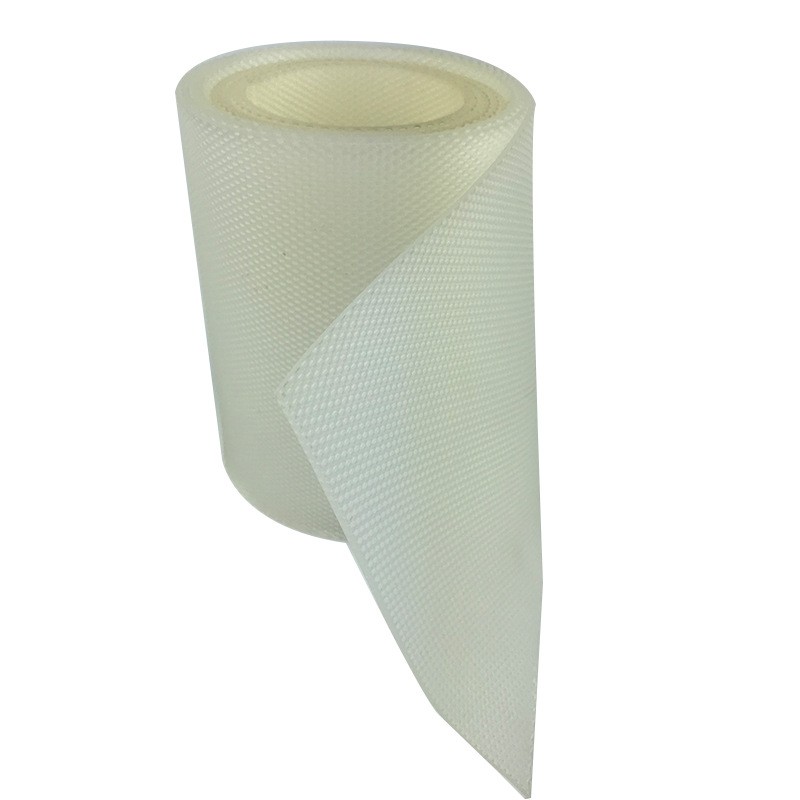
A belt’s top and underside serve different jobs once installed. Dust, oil, adhesive residue or abrasive particles can compromise both. Protect unused roll ends and open layers from workshop debris, welding spatter, direct sunlight and chemical splash. An apparent black or blue coating is not evidence that a belt tolerates a solvent or an outdoor storage period. LKBELT’s blue PVC flat conveyor belt and PB20-B-AO black matte PVC belt both show exposed fabric undersides. A clean carrying face does not tell the receiving inspector whether the backing or edges remained dry and undamaged. Incoming and pre-use inspections should photograph both sides when there is any doubt.
Avoid unsupported temperature and humidity rules
Extreme heat, cold and moisture may affect particular polymers, fabrics and joints. But the acceptable storage range and any necessary acclimation depend on the specific belt construction and supplier instruction. Sparks Belting includes a specific cold-storage conditioning recommendation for its context; do not convert that example into a universal temperature, acclimation duration or shelf life for every LKBELT PVC, PU, rubber, silicone or PTFE construction. Record warehouse conditions when unusually high heat, humidity or direct sun exposure could matter. If stock has been kept outside the specified range, quarantine it for technical review. A visually normal belt may still require inspection or a manufacturer determination before installation.
What About Endless Belts, Joints and Cleats?
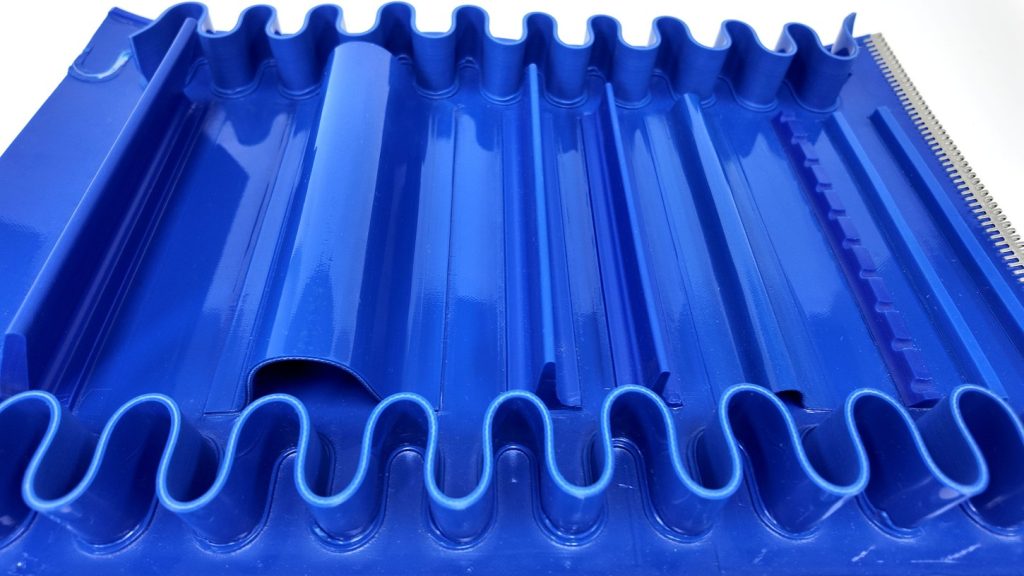
A finished endless belt should be supported without introducing permanent sharp folds, tight kinks or concentrated pressure on its splice. The supplier-approved minimum storage bend or coil geometry matters. Avoid suspending heavy endless loops from a small hook or folding them to fit a shelf without confirmation. For a mechanical splice, protect pins, fastener edges and any supplied closure parts; keep joining hardware with the associated spare. For a finger, lap or other bonded/fused joint, prevent abrasion, contamination and compression at the connection. The LKBELT splice guide explains why the finished joint is part of the replacement specification, not merely a way to join two ends. Storage must protect that approved geometry. Cleated, sidewall and V-guided belts add contact-sensitive features. Store them so raised attachments are not flattened under another roll or bent against packaging corners. Keep attachment dimensions and positions on the spare’s identification sheet. An apparently intact base belt can still be unusable if a guide has been compressed or a cleat detached. For long or large finished belts, request the supplier’s packing drawing and handling instructions. Do not assume that every endless belt should be wound into a tight coil or folded into a carton. Custom assemblies should be packaged for their actual geometry.
Conveyor Belt Storage and Release Checklist
| Stage | What to record or inspect | Main failure to prevent | Who should approve an exception | |—|—|—|—| | Receiving | Model, drawing revision, dimensions, quantity, packing condition | Wrong or unidentified spare | Purchasing + maintenance | | Roll support | Core/cradle, contact width, orientation, security | Camber, crush marks, edge damage | Supplier / stores supervisor | | Environment | Temperature/humidity limits if supplied, light, contamination | Material or joint degradation | Supplier / engineering | | Finished joint | Splice protection, visible condition, hardware present | Damaged or incomplete connection | Qualified maintenance | | Special profiles | Cleat/guide/sidewall shape and clearance | Crushed or deformed attachments | Engineering / supplier | | Stock rotation | Batch, receipt date, supplier shelf-life instruction | Untraceable or expired stock | Stores + quality | | Before installation | Both faces, edges, joint, dimension/identity cross-check | Installing the wrong or degraded belt | Equipment owner / maintenance | This checklist does not establish a universal usable life or certification. Follow the maker’s shelf-life, handling and acceptance rules for the exact material.
Use a Hold–Release Decision Instead of Guessing at Shelf Life
A belt can be in stock and still be unsuitable for immediate installation. Before a shutdown, use a documented decision path:
| Condition found during stock check | Disposition | Evidence needed |
|---|---|---|
| Identity, drawing revision and machine position match; packaging and belt condition are acceptable | Ready for planned installation, subject to normal OEM commissioning | Receiving record, storage history and supplier instructions |
| Storage conditions unknown, label missing, unusual set or edge damage suspected | HOLD / quarantine; do not cut or fit to the machine | Photos, dimensions where safe, purchase traceability and engineering review |
| Visible compromised joint, crushed cleat, delamination or nonconforming construction | Reject or authorized rework under manufacturer/OEM procedure | Written disposition and replacement specification |
| Material used after an approved storage deviation | Conditional release only with written approval | Supplier or responsible engineer’s documented assessment |
This is a quality-release workflow, not a validated visual test for belt strength. No fabricator can reliably determine remaining usable life from colour or a single photograph. If a supplier imposes a shelf-life date or acclimation rule, record it with the original material/batch and follow it; do not substitute a universal FIFO rule for material-specific restrictions.
For high-criticality spare positions, confirm the correct belt before the planned outage. Store a linked machine position, order revision and contact person with each spare. If an old belt has been replaced by a newer approved drawing, an otherwise pristine stocked belt may no longer be a suitable spare.
How to Label Spare Belts for Rapid Replacement
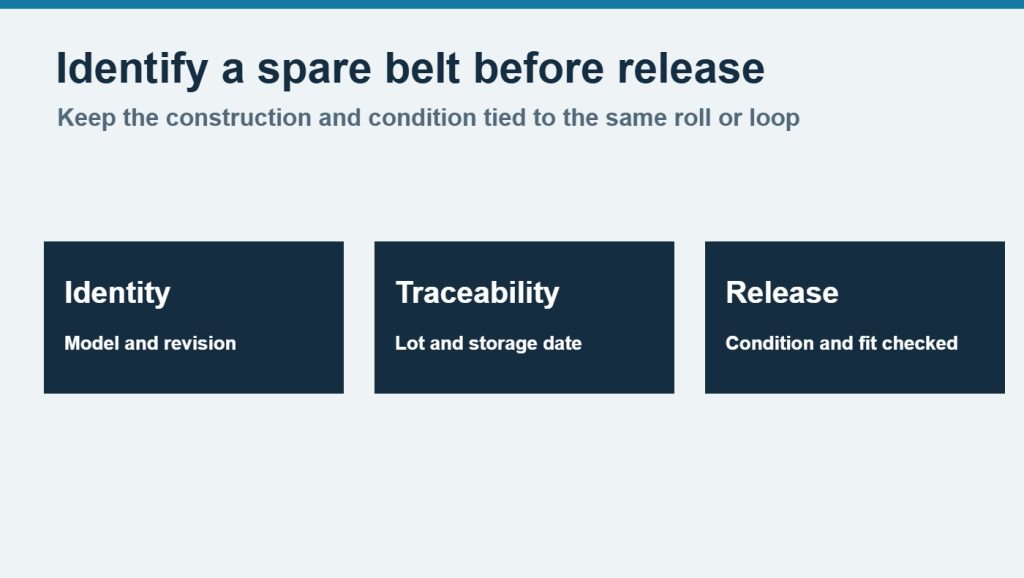
A label that says “PVC blue belt” is not enough for a production plant that owns several similar conveyors. At a minimum, record the equipment position and revision, belt supplier/product code, material and face description, finished width, circumference or open length with measurement basis, total thickness, underside, joint type and any attachments. Include the order or drawing revision, quantity, receipt date and storage location. Where applicable, link the actual technical drawing, photos and acceptance record rather than relying on a handwritten number. If a belt is cut from a master roll, maintain traceability from the original roll or batch to the finished spare. After partial use, update the remaining usable length instead of leaving the original quantity unchanged. If the spare has a food-contact requirement, preserve the documentation for the identified finished construction and intended use. A white colour or model suffix cannot replace the required evidence. Equally, an antistatic claim requires actual technical documentation; it does not follow from a black surface or a supplier category label.
Two Industrial Spare-Stock Scenarios
A warehouse holding several similar PVC rolls
A hypothetical distribution-centre maintenance store has two blue PVC rolls used on different conveyor sections. One section runs over a long slider bed; the other has a compact pulley route and a different finished joint. The rolls look similar, and their labels only state width. The store should quarantine the unverified stock for identification. Recover purchase records, both-face photographs, backing details and original part codes. Confirm which roll has the required underside, bend compatibility and joint specification before fabricating a replacement. Avoid cutting a belt merely because it is the right colour and width; doing so may turn a usable master roll into an incorrect spare.
A custom cleated belt arriving months before installation
A manufacturer receives a pre-finished cleated belt for a planned equipment shutdown. The carton is stacked beneath heavier stock, and some raised features appear distorted when unpacked. The team should preserve the packaging evidence, identify which cleats have changed, compare the belt with the approved drawing and request supplier review. Do not assume that a short run will straighten a deformed attachment or restore the original spacing. The installation decision should be based on the approved finished-belt criteria, not on whether the belt can be forced around the machine. The joint, guides, dimensions and machine access must also be reviewed.
A Simple Spare-Belt Stock Card for B2B Buyers
The following fields can be copied into a maintenance inventory or purchasing system. They also form a useful checklist when asking LKBELT to identify or remake an older spare.
| Field | Example of what to record (not a model specification) |
|---|---|
| Machine / belt location | Customer’s asset ID, conveyor station, orientation |
| Approved specification | Drawing revision, product code and purchase-order line |
| Finished geometry | Width; finished loop length or open length with measurement basis; thickness; joint; features |
| Contact surfaces | Carrying cover, exposed underside, required material/cleaning compatibility |
| Lot and storage | Batch or roll trace, delivery date, storage location, handling/condition record |
| Release responsibility | Stores owner, maintenance approver, supplier contact and any open deviation |
This record does not replace the supplier’s material-specific storage instructions, but it prevents an unidentifiable blue or black roll from being mistaken for an approved replacement.
Pre-Installation Inspection: What Can Be Checked Without a Running Trial?
Inspect the packaging and identity first. Check both belt faces, edges, attachment condition and any visible creasing, corrosion of fasteners, contamination or joint damage. Compare the belt code and drawing revision with the machine position and latest purchasing approval. Where it is safe and suitable, measure the finished width, length reference, thickness and feature positions using the supplier method. A large endless belt may need special handling to avoid damage during uncoiling; do not open it solely to obtain a casual tape measurement if the approved procedure says otherwise. A visual pass does not demonstrate tensile capacity, food-contact compliance or suitability for a small pulley. Physical installation and any running test must follow the OEM’s energy-isolation and commissioning procedures. If there are signs of degradation or exposure outside approved storage conditions, hold the spare for supplier/engineering disposition rather than using production equipment as an uncontrolled test bed. The LKBELT repair-versus-replacement guide covers in-service damage decisions. A stored spare has a different question: is it the correct, identifiable and undamaged finished construction to install in the first place?
Frequently Asked Questions
Should conveyor belt rolls be stored on their edges?
Not as a default. Edge-standing can concentrate load and moisture exposure. Use the supplier-approved roll support method for the weight and construction.
Is there one shelf-life limit for all conveyor belts?
No. Any shelf-life or conditioning requirement must come from the specific manufacturer and material documentation; do not infer a universal limit.
Can a replacement belt be stored folded?
Only if the supplier approves that packaging and bend geometry for the exact belt, joint and attachments. Sharp or prolonged folds can be unacceptable.
What should I inspect before installing a long-stored spare?
Confirm the product identity and revision, both faces, edges, joint, dimensions where required, storage history and any unusual deformation or contamination.
Does an intact carrying surface mean the stored belt is ready?
No. The underside, joint and attached profiles can have damage that is not visible from the top.
Conclusion
Conveyor belt storage should preserve more than a roll’s appearance. Protect the belt’s shape, contact surfaces and finished features, and keep the drawing and batch identity with the spare. Before a shutdown, verify the replacement against the actual machine and supplier instructions. Buyers can provide LKBELT the part reference, storage history, drawings and current photographs to review whether a stocked belt remains suitable for the intended installation.