
Two PVC conveyor belts can share a similar blue top surface yet behave differently on the same slider bed. One runs quietly through a long carton-handling line; another requires more drive pull, develops underside wear or drifts after a replacement. The difference may have little to do with the visible coating. It can lie in the fabric backing, its finish, the support surface and the finished belt construction. Choose conveyor belt fabric backing by its verified contact with the installed conveyor—not by coating colour, ply count or a generic “low-friction polyester” label. Identify the bed, pulleys and return rollers that touch each belt face; document load and operating conditions; then obtain backing and finished-belt approval for those interfaces. This is especially important when replacing a coated fabric belt with a visually similar alternative.
What Does Fabric Backing Do on a Conveyor Belt?
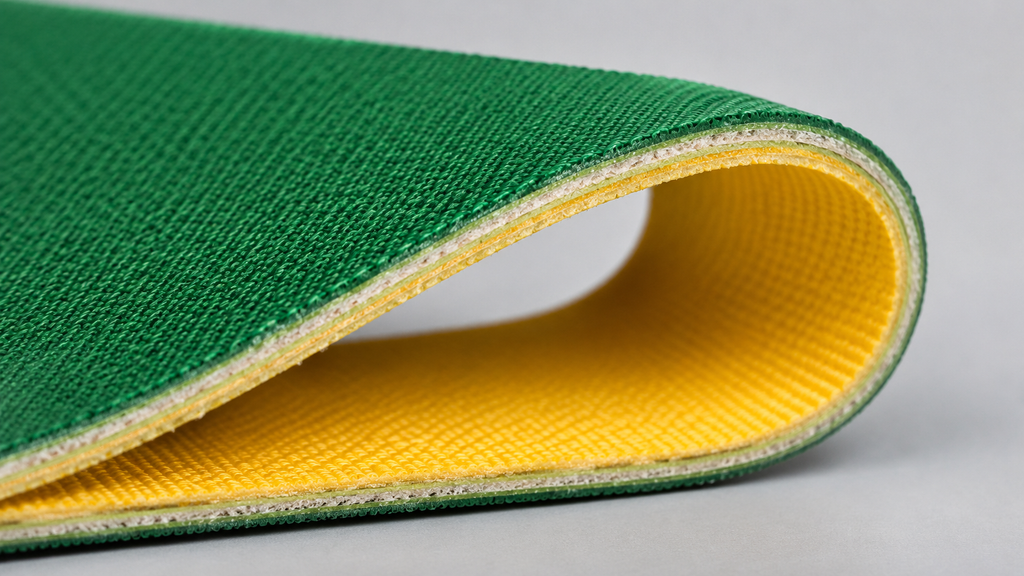
In a fabric-reinforced conveyor belt, textile layers may provide tensile strength, dimensional stability and the body that supports the coating. Lateral stability depends on the complete construction and equipment; fabric material alone does not guarantee accurate tracking. The exposed underside fabric, where present, has an additional role: it is an actual running surface against a slider bed, pulley or return roller. The fabric embedded inside the belt and the fabric visible at the underside are related, but they should not be treated as interchangeable specifications. Sparks Belting’s article on the purpose of textiles in conveyor belting explains that textile selection can influence strength, stiffness, fastener retention and sliding contact. These are genuine engineering considerations. However, a description of fibre families alone cannot tell a purchaser the drag, wear rate or pulley suitability of an LKBELT belt: those characteristics belong to the specific finished construction. For example, LKBELT’s blue PVC flat conveyor belt has a glossy blue carrying face and a fabric underside in its published photographs. The PB20-B-AO black matte PVC belt likewise shows fabric underneath a different carrying finish. Neither photograph, by itself, identifies a friction coefficient, yarn specification or permissible minimum roller diameter. When requesting a replacement, send two photographs: one square-on view of the carrying face and another of the underside and edge. The second picture is not merely supporting documentation—it helps prevent an order that matches the colour and width but changes the working contact surface.
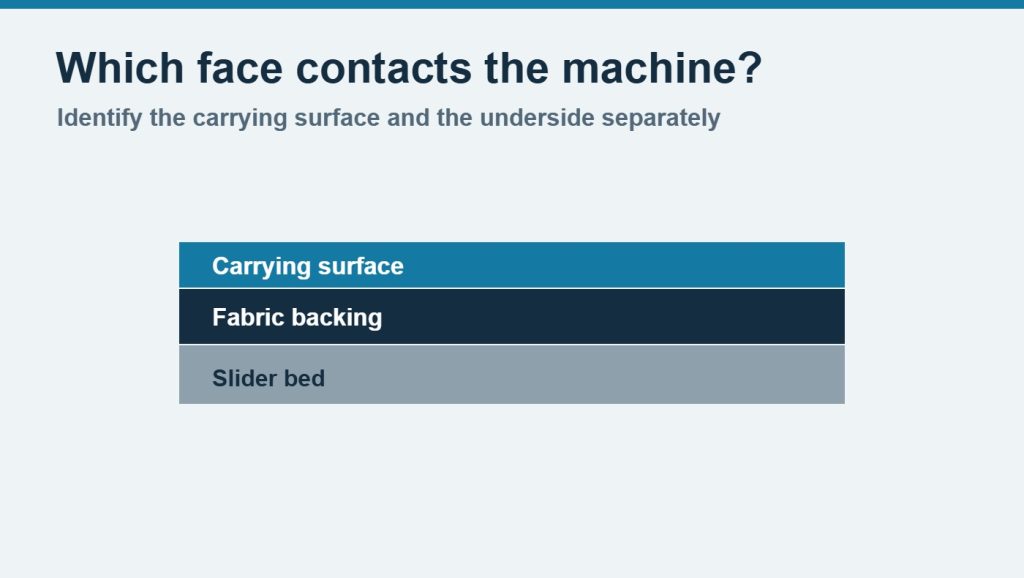
Which Belt Face Actually Touches the Machine?
Slider-bed support
A slider bed supports a substantial length of the carrying run. As product load presses the belt against the bed, the underside slides over metal, polymer or another approved bed material. Friction is influenced by the actual mating surfaces, normal load, cleanliness, moisture and speed. A long sliding contact area can create a different drive requirement from a roller-supported conveyor even if both carry identical cartons. The LKBELT conveyor component guide describes why support surfaces and pulley paths belong in replacement selection. For fabric backing, the purchasing consequence is specific: ask whether the proposed underside is qualified for the installed bed, not merely whether the belt is made from PVC or PU.
Drive pulleys and snub rollers
The driven pulley needs appropriate traction at the belt surface it contacts. In a conventional arrangement this may be the underside; with certain lower drives or additional roller routes, other contacts and reverse bends are possible. The support bed may favour reduced sliding drag, while the drive requires enough traction to move the loaded belt. These demands must be evaluated together at system level. Do not try to solve insufficient drive traction by assuming that an exposed fabric underside should always be rougher. Belt tension, pulley surface, wrap and the conveyor’s actual load also matter. Excessive tension can create another problem, including unnecessary bearing or joint loading. If a replacement slips, investigate the mechanism before changing the belt grade.
Product-carrying surface
The top face does a different job. It may need to grip cartons during acceleration, allow packages to release at discharge, or withstand a specified cleaning process. A low-drag underside does not guarantee suitable product handling. The selection sheet should therefore list top-face and bottom-face requirements separately.
Do Polyester, Nylon and Cotton Backings Behave the Same?
No. Different fibre families can contribute different stiffness, moisture response, extension behaviour and surface characteristics. Weave construction, yarn treatment, finishing process, coating penetration and ply arrangement can change the resulting belt substantially. The names polyester, nylon and cotton describe materials, not a tested performance certificate. A polyester-rich fabric can be used in certain light-duty parcel conveyor belts; nylon may be incorporated for different mechanical requirements; cotton may be encountered in particular processing or product-contact uses. None is automatically a universal substitute for another. In addition, a supplier’s label may describe the carcass rather than the exposed underside. Obtain the actual construction drawing or datasheet if that distinction matters. The LKBELT reinforcement guide covers the wider structural role of plies and textile reinforcement. The additional question here is narrower: what happens at the exposed backing-to-machine interface? That needs a different set of inspection records and acceptance checks from a generic ply-count comparison.
How to Identify Underside Wear Before Ordering a Replacement
The pattern of underside damage is often more informative than the fact that the belt is worn.
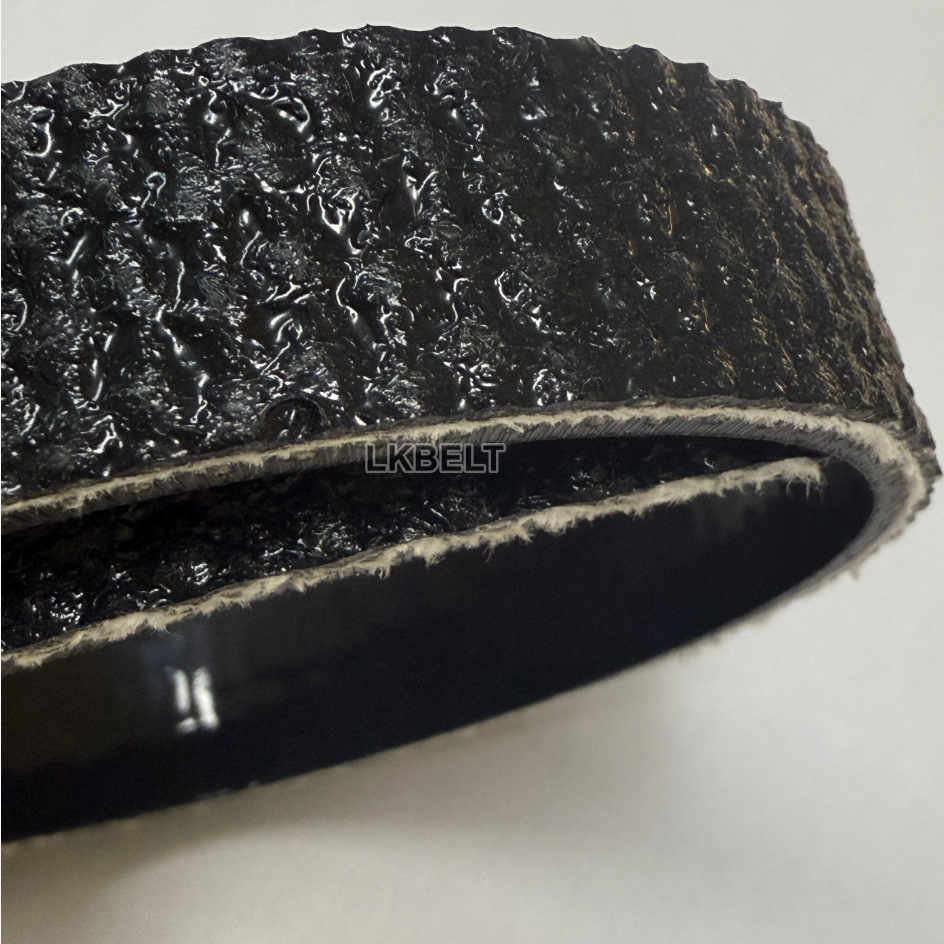
- Uniform polishing across a long contact zone: examine the slider-bed condition, product loading, contamination and operating duty. It may be ordinary contact wear or evidence of excess resistance; appearance alone cannot quantify either.
- Narrow lengthwise stripes: look for a protruding support edge, roller misalignment, scraper contact or guide/groove interference at corresponding positions.
- Wear concentrated near one belt edge: check frame geometry, loading position, tracking history and asymmetric bed contact before blaming the fabric grade.
- Localized scuffing near the joint: inspect finished splice thickness, backside profile and clearance through the complete pulley route.
- Deposits or unusual sticking: identify whether moisture, cleaning residue, adhesive or process material is involved. Do not use a generic lubricant to hide an unresolved compatibility issue. Perform hands-on inspection only after equipment isolation under the OEM and site procedures. A machine may require qualified troubleshooting of the motor, bearings, drive pulley or mechanical alignment. A new backing will not correct a damaged support bed.
Backing selection checklist
| Observed interface | Information to record | Why the backing matters | Approval required | |—|—|—|—| | Long slider bed | Bed material, length, condition, typical load | Sliding drag and contact wear | Exact underside/bed compatibility under duty | | Roller-supported run | Roller sizes, spacing, contact face | Local contact and bending route | Belt body and joint flexibility | | Driven pulley | Shell finish, diameter, wrap, load and speed | Available traction at actual contact face | Drive suitability and tension limits | | Reverse-bend section | Roller size, belt face against roller, joint path | Reverse flexing may limit the construction | Belt and splice bend approval | | Wet or cleaned line | Actual chemistry, duration, temperature, drying | Fabric edge and backing exposure | Resistance and cleaning documentation | | Replacement joint | Join type and face transitions | Joint can alter local contact | Finished joint profile and operating limits | This table is a screening framework, not a substitute for belt-grade calculations or the machine manufacturer’s specifications.
How to Compare a Candidate Backing Without Guessing Its Friction
A product photograph confirms the presence of an exposed woven face; it does not establish that the proposed belt will draw less power or wear more slowly. Request the candidate’s datasheet and, when the change affects a long slider bed or an essential line, agree on an equipment-specific comparison before committing to a production quantity.
| Test or record | Keep constant or document | What the result can establish |
|---|---|---|
| Baseline run | Conveyed load, line speed, bed condition, ambient conditions and drive configuration | A reference for an existing approved belt |
| Trial belt details | Exact product code, exposed underside, total construction, joint and installation tension | Which construction was actually tested |
| Drive observation | Motor current or input power at matched operating points, plus slip or traction symptoms | A system-level difference; current alone is not a friction coefficient |
| Contact inspection | Underside wear map, bed hot spots, joint transitions and edge contact | Where the candidate interacts differently with the machine |
| Approval | OEM acceptance criteria, allowable drive load, temperature, tension and wear review period | Whether this finished belt suits this installation |
A reduced motor current is not by itself proof of a superior fabric: load variation, tension setting, motor control and roller condition can change the measurement. Likewise, a high-friction cover does not automatically improve traction when it is not the face touching the drive pulley. Do not improvise oil or lubricant on a slider bed unless the conveyor and belt suppliers explicitly approve it for the application.
This test plan is especially helpful when a maintenance team has only a damaged old belt and several visually similar PVC replacements. If a supplier cannot document the intended contact surfaces and operating envelope, record the proposal as unverified, not “equivalent.”
Two Replacement Examples: Similar Belt, Different Outcome
A parcel line changing from a roller bed to a slider bed
Imagine a warehouse replacing one short conveyor with a longer slider-bed section while retaining the same nominal belt width and a comparable top cover. Procurement selects a familiar PVC belt by colour. During engineering review, however, the revised route includes a much longer underside sliding contact and an additional snub pulley. The team should compare the exposed backing against the new bed, estimate the required drive pull using the equipment designer’s method, and confirm the belt’s permissible tension and bend conditions. A fabric-backed grade that served the original roller conveyor might still be suitable—but compatibility has to be demonstrated for the revised bed and pulley route. Simply specifying the old width would leave the principal change undocumented.
A packaging line with a recurring underside stripe
Suppose maintenance finds a narrow wear stripe on the underside of a PVC belt. Two suppliers offer a replacement with the same material, width and length. Before choosing either, maintenance maps the stripe to the conveyor frame and notices a corresponding fixed support edge. If that contact requires correction, the engineering decision is not just “choose a harder backing.” The support must be assessed, and the repaired equipment and proposed belt must be approved together. The final RFQ should preserve images of the original underside, the contact location and the corrected support drawing. This helps avoid repeated purchases that reproduce the same wear mechanism.
What Specifications Belong in a Fabric-Backed Belt RFQ?
A useful request includes the machine make or drawing; belt position; original belt code; carried product; top-face finish; underside fabric identification where known; ply and reinforcement information; width, finished endless length and thickness; the approved joint; and belt route. Add the slider-bed material and condition, pulley diameters, direction of bending, tension arrangement, load, speed and environmental exposure. For model evidence, LKBELT also shows a white carrying face and fabric underside on its PB10W-FDA PVC belt. The model suffix alone is not food-contact evidence. If the application involves direct food contact, request applicable documentation for the selected construction and use conditions. Ask a supplier to identify which product parameters are already established and which require drawing confirmation, a representative sample or a machine trial. A sample should be assessed for dimensions, face identity, joint fit, tracking, underside contact and operation at the agreed duty. Do not accept a claim about reduced drag or extended life without comparable evidence.
Frequently Asked Questions
Is fabric backing always lower friction than a coated underside?
No. The result depends on the exact surface pair, load and environment. A generic backing label does not provide a tested friction value for the installed bed.
Can I choose a belt using only the top colour and total thickness?
No. Identify the underside, reinforcement, joint and complete pulley route. Similar-looking tops can conceal different machine-contact surfaces.
Why can a replacement belt create more drive load?
Changed underside/bed contact, contamination, route geometry or tension can increase resistance. Qualified diagnosis should isolate the reason rather than assuming the new polymer is at fault.
Does exposed fabric mean the belt is suitable for wet cleaning?
Not automatically. The actual backing, edges, joint and complete belt construction need compatibility evidence for the cleaning procedure.
Can a supplier identify the fabric grade from a photograph?
A photograph can reveal the face and visible weave, but it usually cannot establish yarn composition, treatment, ply structure or approved performance limits.
Conclusion
Conveyor belt fabric backing is a working interface, not a minor visual feature. Compare the belt’s underside with the actual slider bed, pulley and return path; inspect the evidence behind wear; and specify the finished belt and joint before approving a replacement. Buyers can send LKBELT both-face photographs, conveyor drawings, dimensions and operating conditions for a construction-specific review.