
A food-packaging plant plans to replace a continuous fabric conveyor belt with a modular plastic belt because damaged modules can be changed individually. The new belt appears to offer easier maintenance, but the existing conveyor has smooth drive pulleys, small transfer rollers and a specific tensioning arrangement. A belt-only purchase cannot resolve those mechanical differences.
Choose modular plastic vs fabric conveyor belts by comparing the complete conveying system, not just the belt surface or repair method. Modular belts typically use interlocking plastic modules, hinge rods and matched sprockets; fabric-reinforced PVC or PU belts typically use a continuous body and require a compatible friction-driven pulley arrangement. Changing between these families can affect the drive, support bed, take-up, product transfers, sanitation procedure and replacement inventory.
What Is the Structural Difference?
A fabric conveyor belt is generally supplied as a continuous coated or reinforced strip made endless with an appropriate joint. Depending on the product, it may include a coated carrying side, fabric underside, internal plies, guides or cleats. Its entire construction and splice must be suitable for the drive and return pulleys.
A modular plastic conveyor belt is assembled from linked modules, usually with rods passing through hinge features. Its underside engages with appropriately designed sprockets in a positive-drive arrangement. Module pitch, rod geometry and sprocket design are connected mechanical specifications; a buyer cannot choose a replacement by plastic colour or overall belt width alone.
Habasit’s Plastic Modular Belts Engineering Guide documents how particular modular series use interlocking modules and matched sprockets, and distinguishes flat-top from open-grid and hinge arrangements. Those are useful design principles, not approval or ratings for a different manufacturer’s products.
LKBELT’s blue modular plastic conveyor belt publicly shows an open module construction and asks customers to match the module geometry, hinge arrangement and sprockets. The white Type B modular belt shows a slotted module surface. Neither product page proves a particular food-contact certificate, resin, pitch, finished strength or cleanability result for every buyer’s installation.
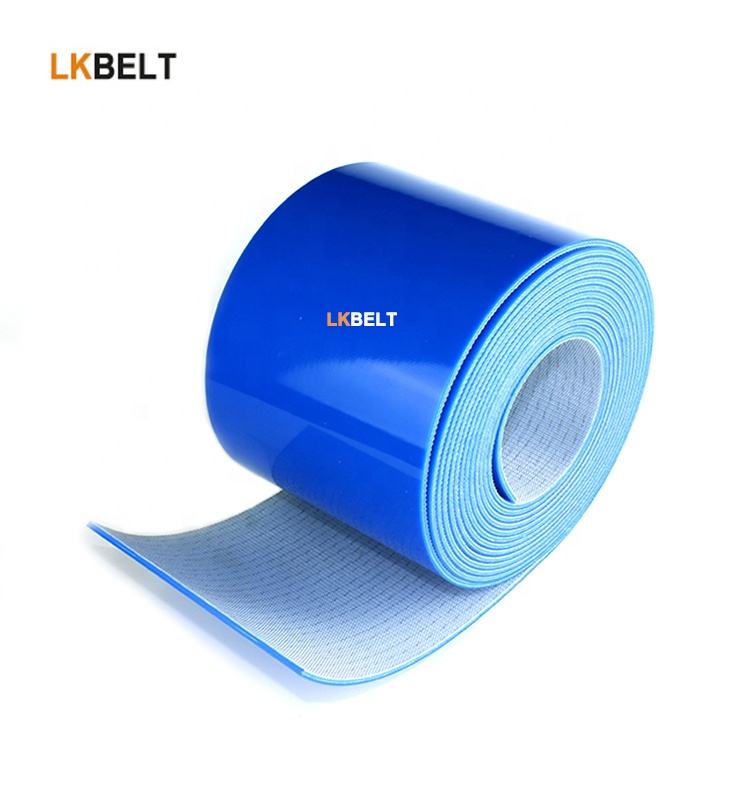
For the continuous-belt alternative, the LKBELT blue PVC fabric-backed belt demonstrates a coated carrying face and fabric underside. A transparent PU fabric conveyor belt range provides distinct finished-belt reference options. These examples help buyers compare construction families without assuming that the pictured materials are mechanically interchangeable.
Why a Belt-Only Retrofit Often Fails
The primary dividing line is the drive and belt path. A friction-driven fabric belt can rely on contact between the belt and a driven pulley. A modular belt’s links must engage compatible sprockets at their specified pitch and profile. Installing a modular belt over smooth existing pulleys normally requires an engineering review and potentially a drive-system change; the exact feasibility depends on the conveyor design.
The return path, wear strips and support structure can also differ. Modular links articulate as they wrap around sprockets and other supports. A continuous fabric belt bends as a laminated assembly. The smallest transfer element and take-up scheme therefore need separate approval for each candidate.
Even two modular belt families may not interchange. Their rod retention, hinge type, module pitch and underside drive features can differ. Obtain a sample, drawing or identifiable series for the existing modular system before a purchase order is accepted.
The LKBELT conveyor drive types article explains drive-layout terminology. The issue here is not where the drive is mounted, but whether the proposed belt family is compatible with the actual drive contact and mechanical arrangement.
The Sprocket Question Competitor Guides Make Clear
The Habasit guide distinguishes positive drive from friction drive and describes the polygon effect (chordal action) as modular links articulate around a sprocket: the moving belt speed can vary slightly through the rotation. The importance of that effect depends on the actual modular series, pitch and sprocket tooth count. It is not a universal percentage to copy from another product’s chart.
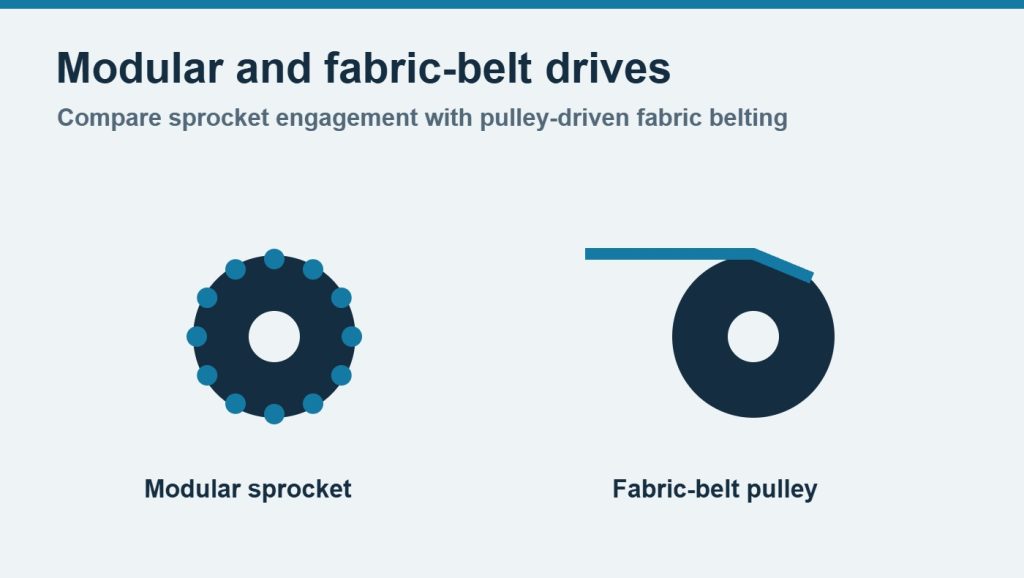
For a compact transfer with tight spacing, the OEM should therefore check more than the nominal belt speed: confirm sprocket diameter and tooth count, drive and idler positions, transfer support, product stability and any indexing tolerance. A conversion quotation that only includes the belt but omits matched sprockets and required changes to the return path is incomplete. See the Habasit modular engineering guide for the manufacturer-specific illustrations; its design values apply to its own products, not to LKBELT modules.
Product Support: Closed Surfaces vs Open Grid
One reason to consider modular belts is the availability of different product-contact geometries. An open grid can permit water or air to pass through, while a flat-top style offers a more continuous support surface. A slotted surface can be helpful in one duty and unsuitable for very small, fragile or sticky products in another.
The LKBELT blue modular product shows an open pattern. Its colour and visual openness do not quantify the open-area percentage, nor do they determine how a small product will transfer. The Type B product shows a slotted surface. For either belt, obtain module dimensions and assess the smallest product and its orientation.
A continuous PVC or PU fabric belt may provide a more continuous product-contact surface for small items or a transfer requiring a particular nosebar geometry. That does not mean a fabric belt is superior for every small transfer: its thickness, joint and allowed pulley radius also matter.
Habasit’s engineering guide distinguishes physical open area from open contact area, which matters when specifying airflow and product support. These quantities cannot be inferred from a photograph or from a single nominal slot dimension.
Hygiene and Cleaning: Neither Construction Is Automatically Superior
Modular belts may enable drainage and replacement of individual damaged sections, but their hinges, rods, sprockets, wear strips and underside have cleaning and inspection implications. A fabric belt may present a relatively continuous carrying face, while its cut edges, joints and underlying reinforcement can introduce different contamination concerns.
One source of misunderstanding is the word “plastic”. Neither a blue modular belt nor a white PU-coated fabric belt is automatically compliant for direct food contact. The exact resin, coating, pigments, joint/accessory materials, use conditions and destination market must be covered by applicable documentation.
The independent food-conveyor cleaning guide at LKBELT covers cleaning practices and inspection. The choice here is narrower: determine whether the design allows those practices to be performed and verified on the installed belt assembly.
Before promising sanitation improvements, ask: Can personnel inspect the hinges and rod ends? Can the belt be removed safely for approved cleaning? Do the original conveyor covers and support frame create inaccessible crevices? What does the food processor’s validation protocol require? A module that can be removed quickly does not, by itself, demonstrate an acceptable hygiene outcome.
Comparison Table: What Changes With the Belt Family?
| Decision factor | Fabric-reinforced continuous belt | Modular plastic belt | Required check |
|---|---|---|---|
| Drive | Commonly friction-driven over a pulley | Sprocket-driven with matched engagement | Installed drive and transmission compatibility |
| Structure | Coating, textile, underside and finished joint | Modules, hinges, rods and drive pattern | Exact model/series and parts |
| Product contact | Continuous or textured coated surface | Flat, open, slotted or other module surfaces | Smallest product, marks and transfer geometry |
| Repair | Joint and local repair depend on approved method | Individual modules may be replaceable if accessible | Downtime, spares and safe access |
| Cleaning | Consider edge, fabric and joint exposure | Consider hinges, rods, sprockets and supports | Validated cleaning and inspection route |
| Replacement sizing | Finished loop length, width and joint | Installed module pitch, width, row count and drive geometry | Supplier-specific measurement basis |
| Retrofit | Usually compare belt grade on existing pulleys | May require drive and support modifications | OEM engineering decision before quoting |
This table provides a starting comparison. It does not establish that one family lasts longer, costs less or meets a universal sanitation standard.
Retrofit Bill of Materials: Compare the Complete Scope
Buyers comparing "fabric replacement" with "modular conversion" should request quotes against the same approved machine duty and flag which components are included:
| Scope line | Fabric belt replacement on existing conveyor | Conversion to modular plastic |
|---|---|---|
| Belt assembly | Correct coating, backing and finished joint | Correct modules, rods, retention and finished width |
| Drive interface | Confirm pulley surface, tension and minimum bend | Confirm matched sprockets, tooth form, shaft layout and retention |
| Supports and return | Verify existing bed/rollers and splice passage | Check wear strips, return guides, catenary arrangement and clearances |
| Transfer and guarding | Confirm existing nosebar or transfer geometry | Review sprocket-end transfer, gaps, guards and product handling |
| Hygiene and documentation | Review joint/edge access and required declarations | Review hinge/rod accessibility and resin-specific declarations |
| Commissioning | Controlled replacement trial and records | OEM-approved system retrofit, trial, spare-module plan and operator training |
Commercial implication: a modular belt quoted without conversion hardware can appear cheaper than a complete system-ready solution. Separate belt price from engineering, shutdown, installation and validation costs. Neither construction has a universally lower lifetime cost.
Replacement Measurements Are Not Interchangeable
For a fabric conveyor belt, ask for its finished endless circumference, width, thickness, coatings, reinforcement and joint. If only a worn belt is available, note how it was measured and whether it was stretched or shortened during service. Record the machine’s take-up position and pulley sizes.

For a modular belt, begin with the module series and pitch, full installed width, row arrangement, belt length as defined by the supplier, hinge-rod type and sprocket engagement. An overall length measured with a tape can be misleading if the module count or installed catenary arrangement is unknown.
The correct modular belt may be supplied in widths made from combinations of modules, and the specific retaining method matters at the edges. For an existing modular line, request both the installed module count or manufacturer-defined length basis and the take-up/catenary arrangement; multiplying pitch by a guessed row count does not certify the installed loop. A buyer should request a compatible sample or clear photographs of the upper face, underside, hinge and sprocket. A supplied drawing is particularly valuable when a manufacturer has changed a series name over time.
The LKBELT blue modular product page explicitly asks for module geometry, hinge-pin and sprocket information. Its listed conveyor-system dimensions and load references must not be mistaken for a guaranteed rating of that blue belt model. The same caution applies to the Type B product’s system-level data.
Two Practical Industrial Scenarios
Scenario A: Wet-processing line considering modular conversion
A factory currently uses a continuous fabric belt in a wet-processing area. Cleaning teams propose a modular alternative because individual links can be replaced and an open pattern may promote drainage.
Engineering evaluates the product dimensions, drainage requirement, drive-pulley arrangement, return path, guides and available machine space. Quality personnel compare how the proposed hinge design can be cleaned and inspected under the plant’s protocol. Procurement requests the exact modular series, resin and documentation, rather than ordering a visually similar blue belt. If compatible sprockets and supports are not available or the retrofit cannot be validated, the change cannot proceed as a straightforward belt-only replacement.
Scenario B: Small-carton transfer remains on continuous fabric
A packaging line handles small cartons through a short straight transfer. A modular proposal is attractive because damaged links can be replaced, but the original equipment uses a friction-driven pulley system and has very limited transfer clearance.
The OEM checks whether the modular pitch and transfer device can pass the smallest carton without tipping, as well as whether the shaft and frame can accept the sprocket arrangement. The supplier separately evaluates an alternative fabric construction with a verified joint and bending limit. The selected solution is the one that meets actual equipment and product requirements; it need not be the construction with the more appealing repair feature.
These are hypothetical decisions, not real LKBELT conversion cases.
How to Check a Modular Replacement Before Ordering
For a like-for-like modular belt replacement, use this sequence:
- Identify the existing series, manufacturer reference and module/hinge geometry.
- Inspect the sprocket tooth profile, shaft arrangement and required positions.
- Record the original belt width, module arrangement, rod type and retention details.
- Identify the carried product, smallest transfer dimension, load and required openings.
- Record cleaning chemicals, temperature, operating duty and any contact-documentation requirements.
- Confirm the available support strips, return rollers, guides and fitting access.
- Obtain the supplier’s technical confirmation for a sample or first assembly and its accepted drawing.
For a conversion from fabric, add an OEM engineering review of drive, frame, tensioning, guard and sanitation changes. Do not describe the change as a drop-in replacement unless that has been demonstrated for the exact conveyor.
What Should Buyers Include in a Modular vs Fabric Belt RFQ?
A complete RFQ should distinguish replacement-in-kind from a family conversion. It should identify the current belt, conveyor model, product, duty and all critical dimensions, and state clearly whether the supplier is being asked to quote a compatible part or evaluate a different mechanical system.
For fabric options, provide the cover, backing, reinforcement and joint drawing. For modular options, provide series, pitch, modules, rods, sprockets, open area where specified and material documents. For either, include the belt’s operating environment, quantity, required first-article approval, available spares and intended maintenance access.
Request the supplier to list deviations in writing. An attractive unit price is not comparable if one quotation covers only belt modules while another includes the necessary new sprockets, support modifications and commissioning responsibility.
Frequently Asked Questions
Can a modular plastic belt replace a fabric PVC conveyor belt directly?
Usually not without a technical compatibility review. Modular systems use matched sprocket engagement, while many fabric belts operate with friction-driven pulleys.
Are modular belts always easier to clean?
No. Open and hinge designs can help drainage or access, but cleaning depends on the complete belt and conveyor assembly and its validated procedure.
Can damaged modular belt sections be repaired individually?
Many designs allow replacement of sections or modules, but the correct spares and safe access are required. Confirm the manufacturer’s method and the actual damage.
Is a white or blue modular belt automatically food-grade?
No. Request the required documentation for the exact resin, colour formulation and intended use conditions.
What is the most important replacement dimension for a modular belt?
Module pitch and compatible series geometry are essential, together with width, rod/hinge details and matched sprockets. Overall width alone is insufficient.
Conclusion
Modular plastic and continuous fabric conveyor belts solve some of the same product-handling problems through different drive and structural systems. A meaningful comparison checks the actual machine, product, cleaning regime and maintenance plan before considering a switch.
LKBELT buyers can share the original belt or module reference, machine drawing, photographs, dimensions, sprocket details and operating conditions for review. A proposed change in belt family should remain an engineered, documented approval—not a substitution based only on material or colour.