
The marking has worn off a flat belt on a production machine. Maintenance can still measure the loop and see two different faces, but a replacement ordered by colour and approximate size may slip, run against a guide or leave too little take-up travel.
Start flat belt identification with the machine position, original part reference and the surfaces that contact each pulley. Record the old belt’s construction, joint and measured dimensions with their measurement basis. Then confirm the finished width, thickness, loop length and allowable drive duty with the supplier before approving a replacement.
What Is a Flat Power Transmission Belt?
A flat power-transmission belt transfers motion by friction at the pulley. A flat conveyor belt carries product and may be supported along its working run by a bed or rollers. A spindle or tangential belt can contact a row of spindle whorls along a machine-specific route. Follow the belt path and identify what it drives or carries before opening a parts catalogue.
A timing belt meshes with toothed pulleys. A V-belt engages a matching groove through its sides. Check the belt cross-section and pulley geometry when a worn sample is difficult to recognise. These differences determine which dimensions and drive information belong on the inquiry. LKBELT guide to transmission belt types
How Do You Identify an Unmarked Flat Belt?
Record the machine manufacturer, model and exact belt position. Look for the part number in the machine manual, parts list, drawings, previous orders or the records for an identical drive. Photograph any remaining print before removing the belt. Decode a partial marking with the original supplier when possible. Similar-looking codes can refer to different constructions across manufacturers.
Under the machine’s approved isolation and service procedure, photograph the installed path, both faces, edges and the joint. Label which face contacts each drive pulley, idler or spindle whorl. Show any reverse bend and record the direction of travel. A close-up of the edge can show a layered build, but the drawing or supplier specification establishes the material and construction of the tension member. Note where glazing, uneven wear or a lifting joint has changed the sample’s appearance.
How Should Width, Thickness and Length Be Measured?
Record old-belt measurements separately from the specified replacement dimensions. Measure width across the belt at several representative positions using a suitable rule or caliper. Mark any worn edge and report the range if the dimensions vary. Measure total thickness in several less-worn sections with a suitable caliper or thickness gauge, using consistent contact pressure. Take separate readings at the joint if its profile differs. Report units, instruments and measurement positions so the supplier can interpret the readings.
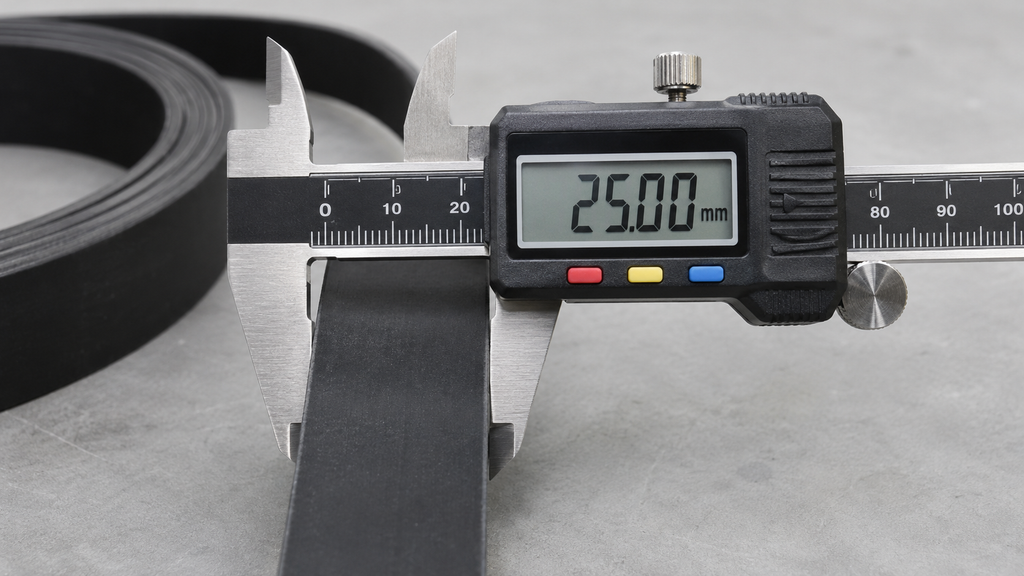
For an intact loop, record whether it was measured installed or removed, which face was followed, and whether the belt was relaxed or held under tension. TYMA’s identification guide shows how a string around the outer face can be measured to document the outside length of its sample. If you use a string, keep it on the same reference path around the loop and record the method. The resulting number describes that surface of that sample under those measurement conditions. TYMA flat belt identification procedure
Inside and outside circumference follow different paths through the bends. A nominal catalogue length or a specified factory loop length may use another convention, including a defined measurement load. Ask the supplier which basis and tolerance apply to the offered construction. A worn, stretched or previously rejoined belt can also differ from the original drawing. Avoid converting a used-belt circumference into an order length until the supplier confirms the reference and checks the take-up range.
For a broken belt, preserve the pieces and photograph torn ends, missing material and any earlier repair. If the supplier wants the pieces measured, state which parts are present and how the measurement was taken. Establish finished length from the original documentation or a supplier-approved reconstruction using the actual drive geometry. Include the tensioner’s position and usable travel so the supplier can review both fit and adjustment after installation.
How Do Nylon Sandwich and Spindle Flat Belts Differ?
RNR15 nylon sandwich transmission belt
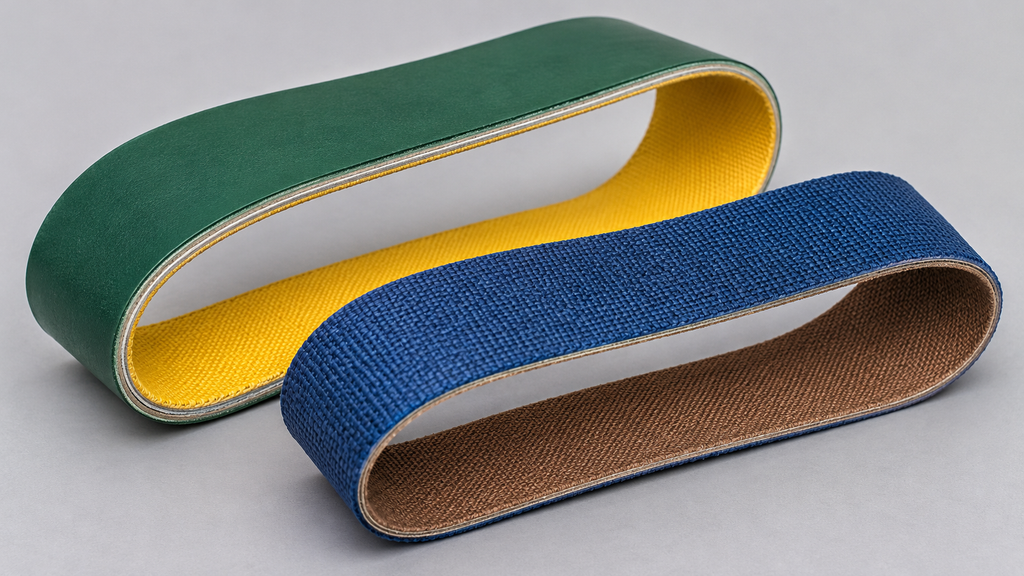
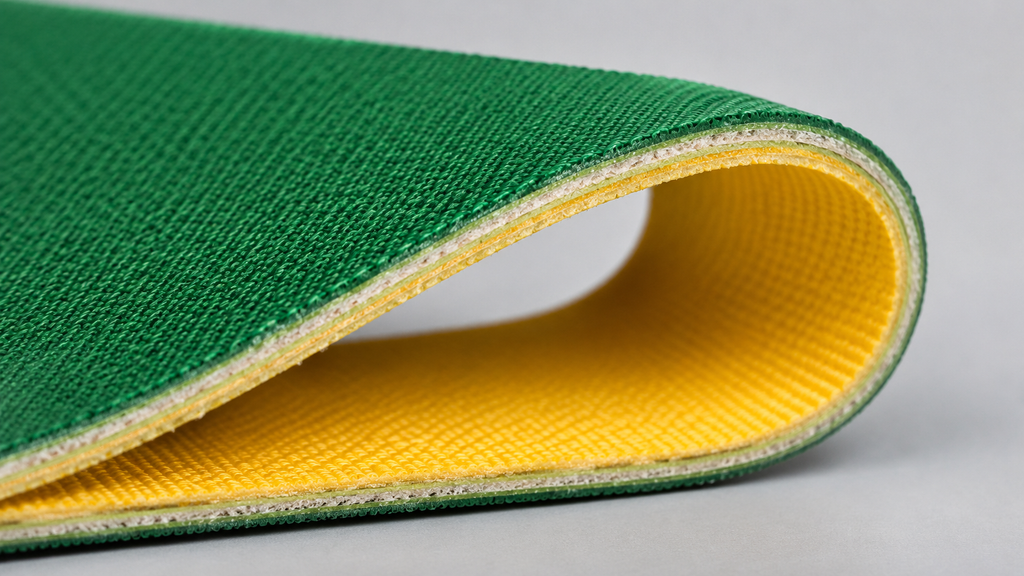
LKBELT’s RNR15 nylon sandwich transmission belt is listed with rubber surfaces, a green outer face, a yellow inner face and a visible layered edge. Its product page publishes a 50 mm minimum pulley diameter for RNR15. Use that value as a model-specific screening check and ask the supplier to confirm the finished belt and joint for the full route, including any reverse bend and the required load. Confirm the tension-member construction and installation tension for the belt being offered. Establish drive-face orientation from the machine and approved specification.
S09-B polyamide spindle belt
The S09-B TS-55 polyamide spindle belt is shown with a blue textured outer face, a brown fabric inner face and a layered edge. Its listing asks for the actual spindle-drive arrangement and finished dimensions. Confirm the machine model, drive pulley and whorl diameters, contact faces, belt speed, spindle speed, wrap, tensioning travel and joint. The model-range table on the page contains separate entries. Request the limits for S09-B itself before approving a replacement.
RNR15 is listed for flat power transmission, while S09-B is intended for a spindle drive. Similar appearance, colour or nominal dimensions give too little evidence to approve interchangeability. Map the actual contact faces across the drive pulleys and, where present, the spindle whorls. Ask the supplier to approve the offered belt for that route, including the fitting tension, available take-up travel and finished joint construction.
How Do Covers, Tensile Members and Joints Affect Selection?
Treat the two faces, the tension member and the joint as separate order details. The working face needs suitable friction against the actual pulley surface. A second face may also contact idlers or whorls. Record oil, moisture, fibre dust and other conditions at those interfaces. Forbo documents polyamide sheet and fabric tension members with different face materials and joining options. Habasit likewise documents distinct covers and tension-member constructions for different power-transmission series. These examples show why a material label alone leaves the construction open. Forbo polyamide flat belts · Habasit power transmission belts
Forbo’s polyester range illustrates another distinction. It lists a spliced fabric construction and a truly endless cord construction in the same material family. A closed loop can therefore arrive with a splice or with continuous reinforcement, depending on the supplied design. Specify the approved form, fitting access and any joint profile limit. Ask for the finished belt’s working load, extension and bend requirements rather than using joining guidance for a different product. Forbo polyester flat belts
How Do Pulley Diameter, Crowning and Tension Affect Replacement Fit?
Record pulley diameters and face widths, face condition, shaft alignment, centre distance, wrap and the full idler route. Document whether each pulley is flat or crowned and provide the actual profile or drawing where available. Crowning is a drive-specific detail. Check the offered belt against the existing pulley geometry and ask which minimum diameters apply to forward and reverse bends.
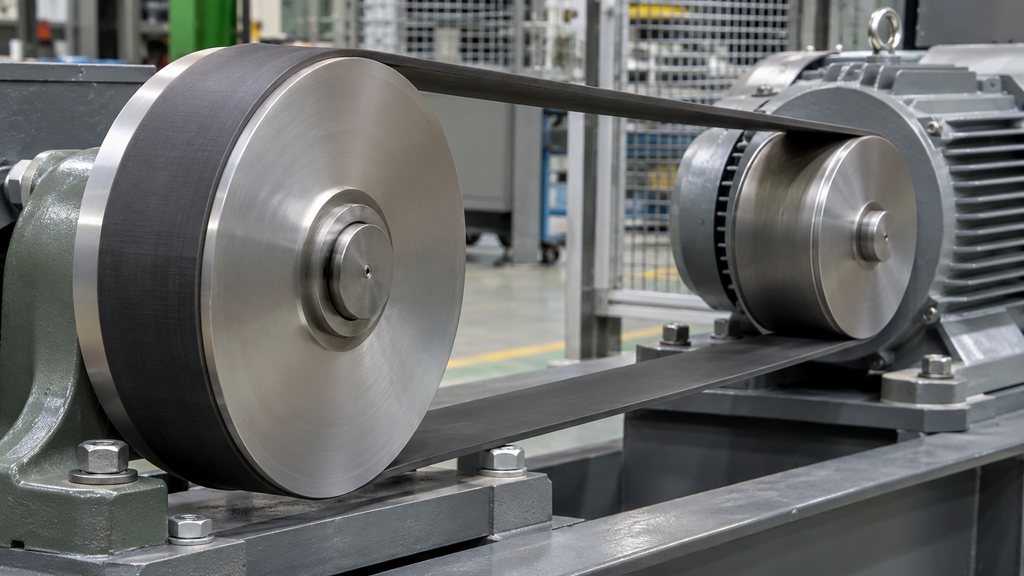
Report the machine’s transmitted power or load, speed, starts and stops, available take-up travel and installation access. Ask for the fitting tension and measurement method specified for the offered belt. If the old belt slips, tracks sideways, runs hot or makes unusual noise, record when the symptom appears. Include pulley contamination, glazing, guide contact, joint damage and any uneven speed. These observations help maintenance determine whether the pulley condition, alignment or duty needs attention before the selected belt can be assessed.
Flat Belt Identification and Replacement Matrix
| Identification item | What buyers should record | Why it matters | Supplier confirmation |
|---|---|---|---|
| Original identity | Marking, machine model and belt position | Identifies the part and its actual function | Offered model and approved substitute, if any |
| Both faces | Surface photos and contact orientation at each pulley or whorl | Identifies the working interfaces | Cover materials and running orientation |
| Used and finished dimensions | Old readings with method, condition and length basis, plus original drawing | Distinguishes wear from order dimensions | Finished width, thickness, loop length and tolerances |
| Reinforcement and joint | Edge, joint, path and installation access | Affects load, repeated bending and fitting | Rated construction and approved joint or endless form |
| Pulley route and tension | Diameters, crown, wrap, alignment, reverse bends and take-up | Determines fit and available adjustment | Permitted route and fitting tension method |
| Operating duty | Power or load, speed, environment and symptoms | Defines the conditions for selection and testing | Approved duty and first-belt checks |
Two Practical Industrial Scenarios
Worn nylon sandwich transmission belt
Suppose a machine stops and the removed layered belt has an unreadable marking. Its faces resemble RNR15. Photograph both faces and the edge, locate the existing joint and measure width and thickness in representative sections. Record the loop measurement face and condition. Send the pulley route, diameters and take-up range with the original drawing or parts reference if available. The RNR15 listing gives a construction to discuss. The supplier still needs to confirm the offered model, surface orientation and finished length before the resemblance can inform an order.
Spindle flat belt with repeated slipping
Suppose a textile drive slips after repeated belt replacements and shows wear along one edge. For a proposed S09-B replacement, document the original belt and whorls, then ask maintenance to check pulley surface condition, alignment and fitting tension under the machine’s procedure. Record whether slip appears at startup or at operating spindle speed. Compare the supplier’s specified contact face, joint and take-up requirements with the existing machine. Agree how tracking and spindle speed will be checked during an authorised first-belt trial.
What Should Buyers Send for a Replacement Flat Belt RFQ?
Give each supplier the same record so deviations are easy to compare.
- Identity and history. Machine model, belt position, original part and drawing revision, prior orders and any recurring symptom.
- Old sample. Photos of markings, both faces, edges and joint, plus width, thickness and loop readings with units, method, condition and applied tension if known.
- Finished belt. Required dimensions and length basis, surface orientation, reinforcement, approved joint or endless form, installation access and permitted alternatives.
- Drive and duty. Pulley or whorl drawings, crown, diameters, centre distance, wrap, alignment, reverse bends, guides, take-up, speed, transmitted load and exposure to oil, dust or moisture.
- Acceptance and order. Quantity, approved drawing, required documentation, sample checks and responsibility for releasing any substitute.
If a drawing is missing, send a marked-up layout and identify which dimensions were measured on site. Ask the supplier to confirm the finished specification and state deviations in writing. LKBELT industrial belt enquiries
Inspect the first delivered belt against the approved drawing. Check length on the agreed basis, width, thickness, faces, edges and any joint. After authorised fitting, verify that the specified initial tension is achievable within the available travel. Use the machine’s approved test procedure to assess tracking, slip, heat and speed under representative duty. Record the accepted construction and settings before releasing a repeat order.
Frequently Asked Questions
Can width and circumference identify a flat belt?
They narrow the search. Confirm the machine position, faces, reinforcement, joint and supplier length convention before ordering.
Does colour identify a nylon flat belt?
Use colour to describe the sample. Confirm the material from the marking, drawing or a written supplier specification.
Can a flat conveyor belt replace a flat drive belt?
Confirm the actual function. A drive belt needs suitable traction, working load, extension and bending performance for the pulley arrangement.
How do I order a replacement for a broken loop?
Preserve the pieces and document their condition. Use the original drawing or a supplier-approved length determination based on the machine and available take-up.
Can I change the original joint construction?
Have the supplier and the responsible equipment team approve the new form for the belt, load, pulley route and fitting access.
Conclusion
Reliable identification starts at the machine. Document the contact faces and construction, keep worn-belt readings separate from the approved finished dimensions, and check the proposed belt against the pulley route and duty. The accepted drawing and first-belt trial then give maintenance and purchasing a common reference for the next replacement.