
A replacement belt can have the right width and a familiar marking yet still be wrong for the pulley. Before comparing quotations, identify the complete tooth system, construction and supply form that the machine requires.
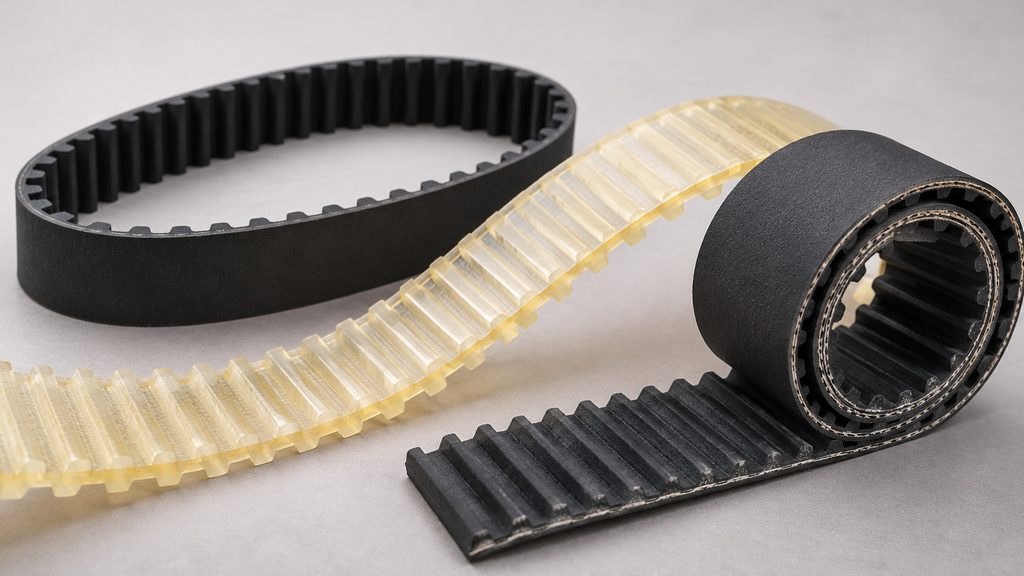
An industrial timing belt is a flexible toothed belt that engages matching pulley grooves to transmit synchronized rotary motion or drive linear movement. Its teeth provide positive engagement, while internal tensile members carry belt tension. Selecting one requires matching its profile, dimensions and construction to the complete machine and operating duty.
What Is an Industrial Timing Belt?
Also called an industrial synchronous belt, it is used where the relationship between movements matters: coordinating shafts, moving a carriage, or advancing products at controlled intervals.
A conventional friction belt transmits force through friction against a pulley. A timing belt transmits driving force through its mating teeth. This distinction explains why a toothed drive can maintain a defined motion relationship without relying on intentional frictional slip.
The teeth do not make the belt rigid or eliminate the need for correct installation. Nor does every belt with notches qualify as a timing belt: flexibility notches in a V-belt do not turn it into a synchronous drive.
How Does an Industrial Timing Belt Work?
In a rotary drive, the driving pulley engages the belt teeth and moves the belt, which turns the driven pulley. The pulley tooth counts establish the nominal speed relationship. In a linear arrangement, a rotating pulley can move a belt-connected carriage along a travel path.
The tooth body transfers force into the reinforced belt structure. Several teeth participate in engagement, depending on the drive geometry. The tensile members resist longitudinal extension; they do not make the belt immune to deformation under load.
Synchronous motion does not mean perfect positioning under every condition. Tooth deformation, belt extension, pulley clearances and machine compliance can affect the result. Overload, unsuitable tension or an incorrect pulley match can also disrupt engagement, including tooth jumping or ratcheting.
The Gates Industrial Preventive Maintenance Manual identifies belt pitch, pitch length, width and tooth profile as key dimensions and addresses synchronous-drive problems. Its product-specific instructions should not be transferred to another belt without checking applicability.
Noise, efficiency and service life still depend on the belt series, pulley arrangement, installation and working duty.
What Is Inside an Industrial Timing Belt?
The complete construction normally includes a tooth body, a backing and embedded tensile reinforcement. A tooth-facing fabric or an additional backing material may be specified for particular contact conditions.
The tooth body must mesh with the pulley. The backing protects the structure and may contact idlers or conveyed products. Tensile cords carry longitudinal loads and influence extension and bending behavior. Their material and arrangement are therefore part of the specification, even when they cannot be identified from the outside.
Depending on the product, reinforcement may include steel, glass fiber, aramid or carbon-based cords. These are construction choices, not interchangeable upgrades. Ask for the actual cord specification and applicable bending limits rather than selecting solely by a material name.
For example, LKBELT lists a T10 PU timing belt with Kevlar cord. The reinforcement designation is useful, but a replacement inquiry still needs the full tooth profile, width, length reference and pulley information. The profile reference chart on the product page covers multiple families rather than the exact specification of every supplied belt.
PU vs Rubber Timing Belts: What Is the Difference?
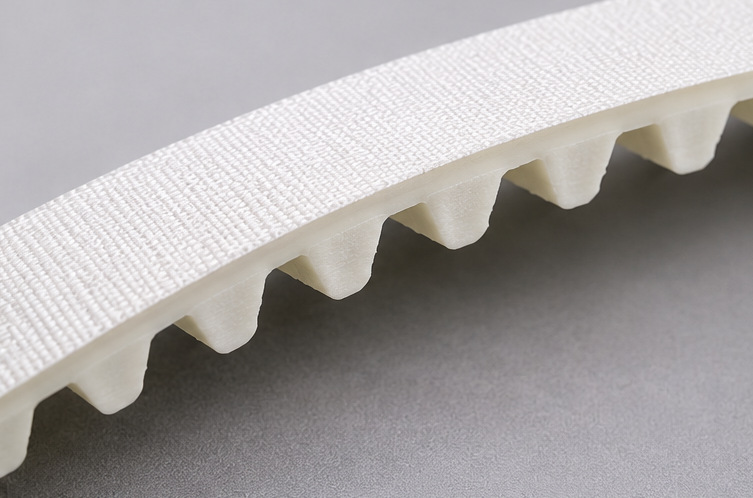
Polyurethane and rubber describe the belt body material, not the whole drive specification. Rubber timing belts use product-specific elastomer compounds; PU belts also vary in formulation, manufacturing route and reinforcement.
For procurement, compare the complete constructions against actual exposure: conveyed material, oils, cleaning agents, moisture, temperature, speed and repeated bending. Obtain documentation for the selected compound rather than assuming that every PU belt has the same chemical resistance or that every rubber belt tolerates the same heat.
The manufacturing route matters too. Some thermoplastic PU constructions can be joined into loops or fitted with attachments, while other products are manufactured endless. That does not mean any PU strip can be welded into an approved transmission belt.
LKBELT lists both PU timing belts and rubber timing belts. Use those families to begin an inquiry, then compare the specific tooth system, reinforcement, belt form and operating requirements. Neither material is a universal winner for accuracy, flexibility, wear or noise.
Any food-contact, electrical or other special requirement needs documentation for the selected construction. Appearance and color cannot establish compliance.
Why Do Tooth Pitch and Profile Matter?
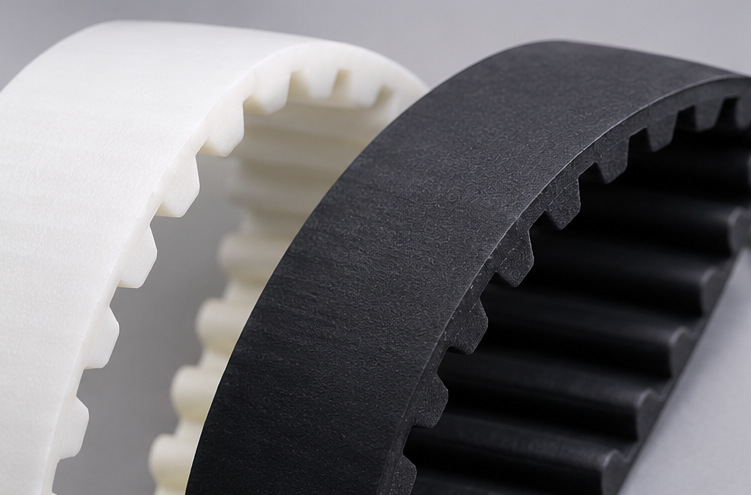
Pitch is the spacing between adjacent tooth centers measured along the belt’s pitch line. Profile describes the tooth geometry. Both must suit the pulley system.
T and AT families use trapezoidal-type geometries, while HTD and STD belong to different curved-tooth systems. These family names are not interchangeable merely because a nominal pitch matches. Metric and imperial designations also need to be distinguished.
Matching pitch alone does not approve a replacement. Tooth shape, pulley groove geometry, series compatibility, belt width and the drive arrangement must agree. A belt that appears to sit in the grooves may still be an unsuitable substitute under operating load.
Keep the existing full marking and request the pulley drawing or an identified sample when the series is uncertain. Avoid reducing a product designation to its most familiar characters.
Consider two LKBELT product listings: the TK10 (13×8) PU timing belt and the RPP5M-PAZ PU timing belt. Both ask buyers for the existing marking and pulley details alongside width and finished length; the RPP5M-PAZ listing also requests clear photographs of the toothed face and outer surface.
Their different designations illustrate why the full series and pulley geometry matter. TK10 must not be treated as standard T10 solely because its name contains “10.”
Open-Ended, Truly Endless and Spliced Timing Belts
Material, belt form and tooth profile are overlapping classification dimensions. A PU belt can be described by its material, supply form, reinforcement and profile at the same time.
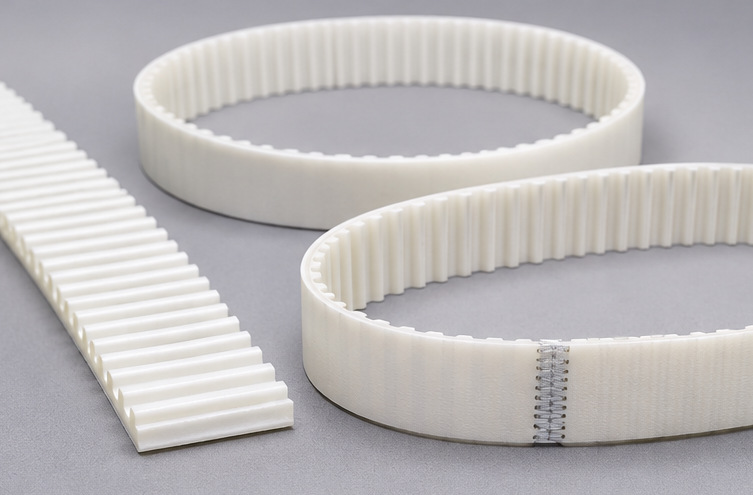
An open-ended timing belt is supplied as a strip. It is often used with clamps in linear mechanisms, where the end attachment and required travel are part of the design. Its cutting length must account for the specified clamping arrangement.
A truly endless belt is manufactured as a loop without an end-to-end splice. A spliced or welded endless belt is made by joining an open length. Both are loops, but they do not necessarily have the same tensile-member continuity or approved duty.
BRECOflex’s timing belt construction overview distinguishes these forms and their applications. The performance comparisons and construction codes for its products are not universal ratings for other suppliers.
For a further product-specific example, Continental’s SYNCHRODRIVE information published by Mulco describes continuously manufactured PU belts used open-ended or joined endless. This establishes a distinction within that range, not the available forms of every LKBELT model.
The proposed belt form must suit the actual transmission, linear-motion or conveying duty. A joined loop selected for conveying cannot be substituted for a truly endless power-transmission belt on dimensions alone.
Where Are Industrial Timing Belts Used?
In power transmission machinery, a timing belt connects shafts whose rotations must remain coordinated. Selection requires the driven load, torque and speed, together with starts, stops and shock conditions.
In linear-drive equipment, the belt converts pulley rotation into carriage movement. Travel, acceleration, moving mass, clamps and allowable displacement error become important purchasing inputs.
In packaging and synchronized conveying, belts can coordinate feed rollers, transfer products or carry fixtures at defined intervals. The tooth system controls the drive relationship, while backing surfaces and attachments must suit product handling and machine clearance.
These duties can coexist on one machine. A belt suitable for moving products is not automatically suitable for transmitting the machine’s main drive power.
Industrial Timing Belt Selection Comparison
| Selection factor | Main options or considerations | Why it matters | What the buyer must confirm |
|---|---|---|---|
| Body material | PU or specified rubber compound | Determines the material being evaluated | Exact grade and exposure suitability |
| Tooth system | Profile family and metric or imperial pitch | Defines mating geometry | Full designation and compatible pulley series |
| Pulley arrangement | Grooves, tooth counts, width, flanges and idlers | Affects engagement and bending | Drawings, condition and approved belt/pulley combination |
| Belt form | Open-ended, truly endless or joined endless | Changes installation and load-path construction | Form approved for the intended duty |
| Reinforcement | Product-specific tensile cords | Affects extension and repeated bending | Cord construction and applicable limits |
| Dimensions | Width, pitch length or tooth count; open cutting length | Separates ordering references | Units, tolerances and length definition |
| Operating duty | Torque or moving load, speed, acceleration and environment | Defines more than a static fit | Application data needed for selection |
| Facing and backing | Tooth fabric, added cover or attachments | Changes contact behavior and finished geometry | Material, thickness, positions and clearance |
Two Practical Industrial Selection Examples
An Open-Ended Belt for a Linear Axis
Consider a hypothetical carriage driven along a machine axis. An inquiry stating only belt width and travel omits the end connections and loading conditions.
Provide the axis layout, stroke, pulley profile and tooth count, moving mass, acceleration and reversal cycle. Show where the belt is clamped and how tension is adjusted. Distinguish required strip length from usable carriage travel.
The reinforcement and clamps must be evaluated together with the belt. A change intended to reduce extension may also change bending requirements or the approved end attachment. Specify the required positional performance without assuming the belt alone determines it.
An Endless Belt for a Packaging Drive
Now consider a hypothetical drive coordinating two rotating packaging-machine shafts. A replacement must preserve the identified pulley system and required timing relationship.
Record the belt marking, tooth count, width, pulley details, installation space and duty, including repeated starts and peak loads. Confirm the intended endless construction rather than accepting any loop of the same size.
If the machine loses registration, investigate the drive condition before assuming a different belt material will solve it. The purchasing specification should capture the required motion relationship and operating load, while detailed accuracy analysis remains a separate engineering task.
How Can Buyers Identify a Replacement Timing Belt?
A practical replacement check starts with the complete original marking and the machine drawing or previous order. Photograph the tooth face, backing and both edges, preserving suffixes that may identify a facing, reinforcement or special construction.
Next identify the tooth profile and pitch, then record width, tooth count or the correct length reference. Finally, establish material, reinforcement, belt form and the drive’s operating duty before comparing alternatives.
If the marking is missing, use a safely removed sample and the pulley drawing. To estimate pitch, measure a defined span across several tooth intervals and divide by the number of intervals, rather than the number of visible teeth. Record the result and units, then compare the profile geometry with documented pulley requirements.
For an identified endless belt, tooth count and nominal pitch define its nominal pitch length. A tape reading around the outer backing or tooth tips is a different reference. Record the tooth count where practicable rather than treating those circumferences as interchangeable.
Worn teeth, stretched or damaged samples and incomplete markings can mislead identification. Include pulley information and flag uncertain observations instead of rounding them into an assumed series. A candidate identification still needs compatibility review.
For LKBELT’s TK10 (13×8) and RPP5M-PAZ listings, send the complete designation with tooth-side photographs and a pulley drawing or sample. If a belt carries a Kevlar-cord designation, include that reinforcement information as well. Together these details give a supplier a much stronger basis than width and appearance alone.
What Should Buyers Send for a Timing Belt Quote?
Prepare one inquiry containing:
- Existing manufacturer, complete marking, machine model and previous part reference.
- Tooth profile and pitch, with photographs or a drawing where identification is uncertain.
- Belt width, tooth count or pitch length, units and required tolerances.
- Open-ended cutting length and clamp details, or the required endless construction.
- Known body material, reinforcement, tooth facing, backing and attachments.
- Pulley profile, tooth counts, face width, idlers and installation arrangement.
- Torque or moving load, speed, acceleration, starts, reversals and environmental exposure.
- Required positioning performance, compliance documents, quantity and drawings.
Separate confirmed specifications from observations and estimates. If proposing a substitution, identify what changes and request approval against the machine requirements.
Frequently Asked Questions
What Is the Difference Between a Timing Belt and a V-Belt?
A timing belt engages matching pulley teeth. A conventional V-belt transmits force through friction in its pulley grooves. They require different drive designs.
Is an Industrial Timing Belt the Same as a Car Timing Belt?
They share the toothed-drive principle, but industrial selection depends on the specific machine and duty. Automotive replacement schedules do not define industrial belt service intervals.
Can PU and Rubber Timing Belts Be Interchanged?
Only after checking the complete specification and drive approval. Similar width, pitch or appearance does not establish an acceptable substitution.
Can Timing Belts Jump Teeth?
Yes. Unsuitable loading, tension or engagement can disrupt synchronization. Toothed construction does not remove inspection and maintenance requirements.
Are All Endless Timing Belts Manufactured the Same Way?
No. A truly endless construction and a joined endless loop differ in manufacture. Specify the required form and approved duty, not only the word endless.
Select the Complete Belt and Drive Combination
The correct industrial timing belt depends on matching tooth geometry, dimensions, reinforcement and finished construction to the machine. A familiar name or matching width is only a starting point.
Review LKBELT’s industrial timing belt range and send the belt identification and operating requirements for a focused replacement or selection inquiry.