
Two conveyors can use belts of the same width and carry the same cartons, yet route the belt very differently below the frame. A replacement that works on the straight run can meet an unsuitable bend or joint clearance at the drive.
Compare conveyor belt drive types by tracing the finished conveying belt through the installed layout. Identify the driven pulley, wrap, supports, return rollers and take-up. Confirm the belt’s running face, reinforcement, joint, bend limits and finished length for that route. Motor location helps describe the machine, while the full belt path determines the replacement specification.
What Are the Main Conveyor Belt Drive Types?
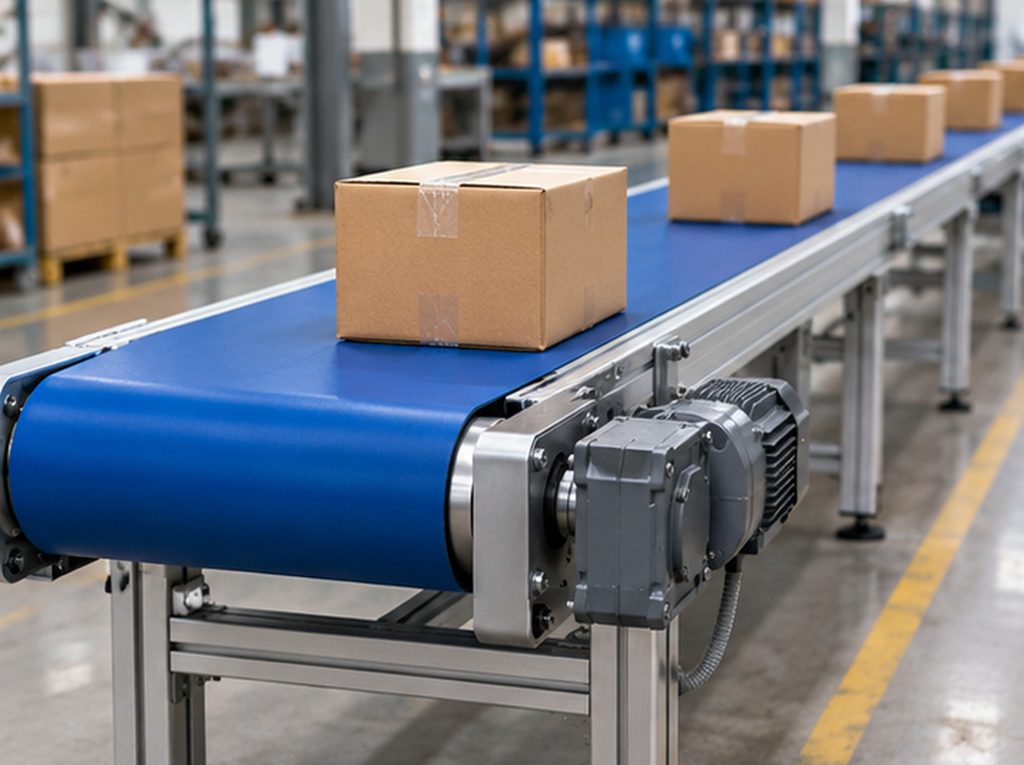
End and center primarily describe where the driven arrangement sits. Internal describes a motor integrated within the pulley, which can occupy either location. Direct and indirect describe how an external motor transmits power to the drive shaft. Record these details separately on the equipment drawing.
End or Head Drive
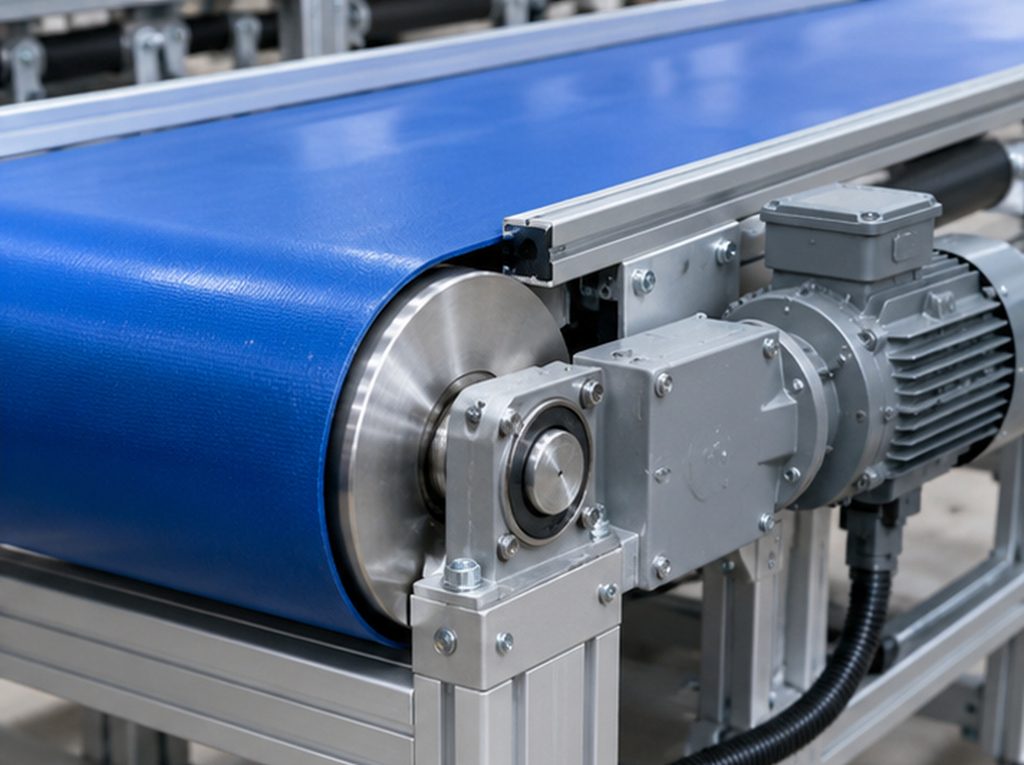
An end drive powers a pulley at one end of the conveyor. On a conventional discharge-end layout, that pulley pulls the loaded carrying run toward discharge. The return then travels back toward the other end. Infeed-driven and reversing arrangements need their own engineering review because the load and tension distribution can change with direction.
For replacement purposes, mark which end is driven and the normal travel direction. Include the actual discharge pulley, wrap and any snub nearby. An “end drive” description alone leaves the support type, return path and tensioning arrangement open. Those details determine where the belt bends and which face touches each component.
Center or Lower Belt Drive
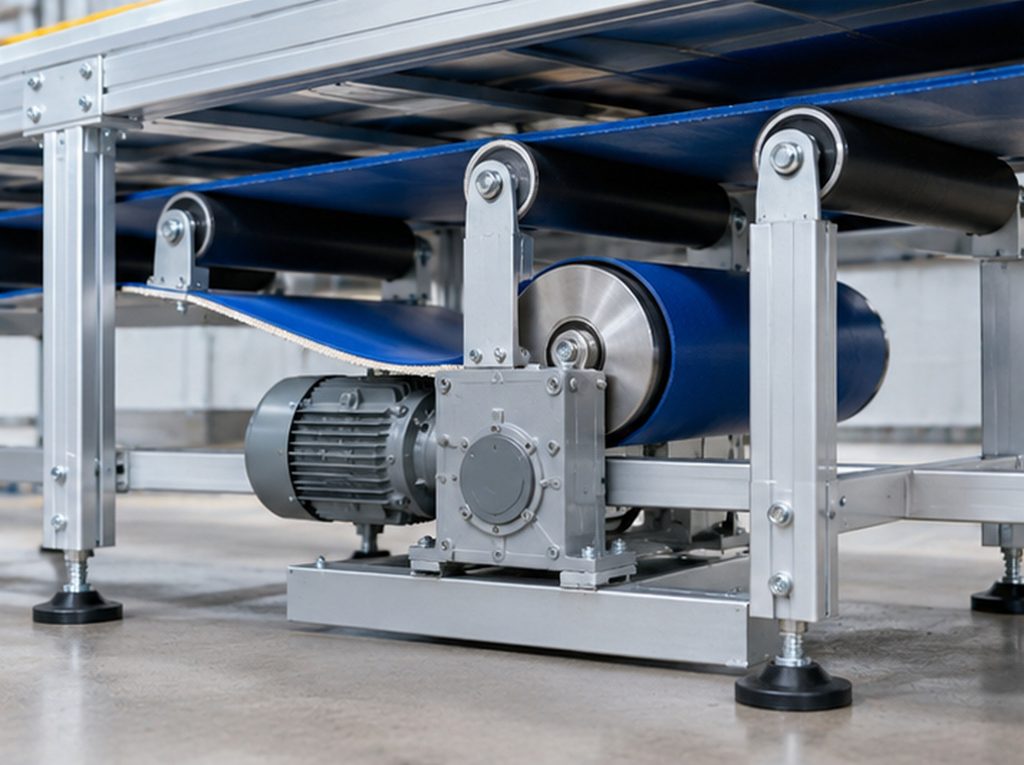
A center drive acts on the belt below the transport level. It can sit at different positions along the frame. A typical arrangement routes the return through a driven roller and additional idlers. Those contacts can increase drive wrap and change how the belt bends. Small end pulleys or transfers may be elsewhere in the route.
Document every roller in the lower drive group and identify its function. Check whether each touches the underside or the carrying face and whether it introduces a reverse bend. Confirm the actual arrangement from the conveyor drawing. mk describes the typical drive group and distinguishes it from an end-driven conveyor. mk North America guide to conveyor drive types
Internal Drive or Motorized Drum
An internal drive houses the motor within the driven pulley. The drum can be at the end or within a lower drive arrangement. Its internal motor identifies how the pulley is powered. The conveying belt still needs the correct contact with the drum shell and the permitted operating tension. Habasit explains that drum motors dissipate some heat through the belt. Review shell surface, belt contact and wrap, surface temperature under load, and continuous operating duty with the equipment and belt suppliers. Confirm material compatibility for those conditions. Habasit drum-motor engineering guidance
Record the drum reference, shell diameter, usable face, surface or lagging, crown where fitted and installed wrap. Obtain the conveyor’s belt requirements and take-up specification. For a positively engaged system, also identify the belt and mating drive profile or sprockets. A standard friction-driven fabric belt and an engaged belt system have different selection requirements.
Direct vs Indirect Drive: A Different Classification
Direct and indirect describe the power path from the motor or gearmotor to the conveyor drive shaft. A direct arrangement connects to the shaft without an intervening chain or belt transmission. An indirect arrangement uses an auxiliary transmission, such as a chain or timing belt. mk lists both direct and indirect variants for head and lower drives. mk Technology Group conveyor drives
Identify the component on the purchase request. The wide conveying belt supports the product and travels around the conveyor. An auxiliary timing or drive belt connects other parts of the drive and has a separate part reference, route and specification. A worn auxiliary drive can cause a motion complaint that the conveying belt supplier needs recorded as a separate service finding.
How Does Drive Layout Change Belt Selection?
Wrap, traction and operating tension
On a friction drive, the pulley must transmit the required pull through contact with the belt. Wrap, pulley condition, surface treatment and friction at the contacting belt face affect traction together with operating tension. Identify the surface actually touching the driven pulley; depending on the arrangement, it may be the underside or another belt face. Additional snubs can change wrap, but also add contacts and bends. Show them in the drawing rather than assuming that a drive label defines the contact angle.
Ask the equipment team for the intended load, speed, start-stop cycle and direction of travel. Then ask the supplier to confirm the finished belt’s working limits under those conditions. Installation pretension and tension while running serve different roles. Avoid correcting slip by changing tension without reviewing the cause and the limits of the belt and equipment. Conveyor belt tensioning and checks
Belt faces and support contact
Product grip and underside drive traction are separate interfaces. The top face contacts cartons or other goods. The underside may slide over a bed, run on supports and wrap the drive. A lower arrangement may bring the top face against a backside roller as well. Label these contacts on the route and identify the actual bed and pulley surfaces.
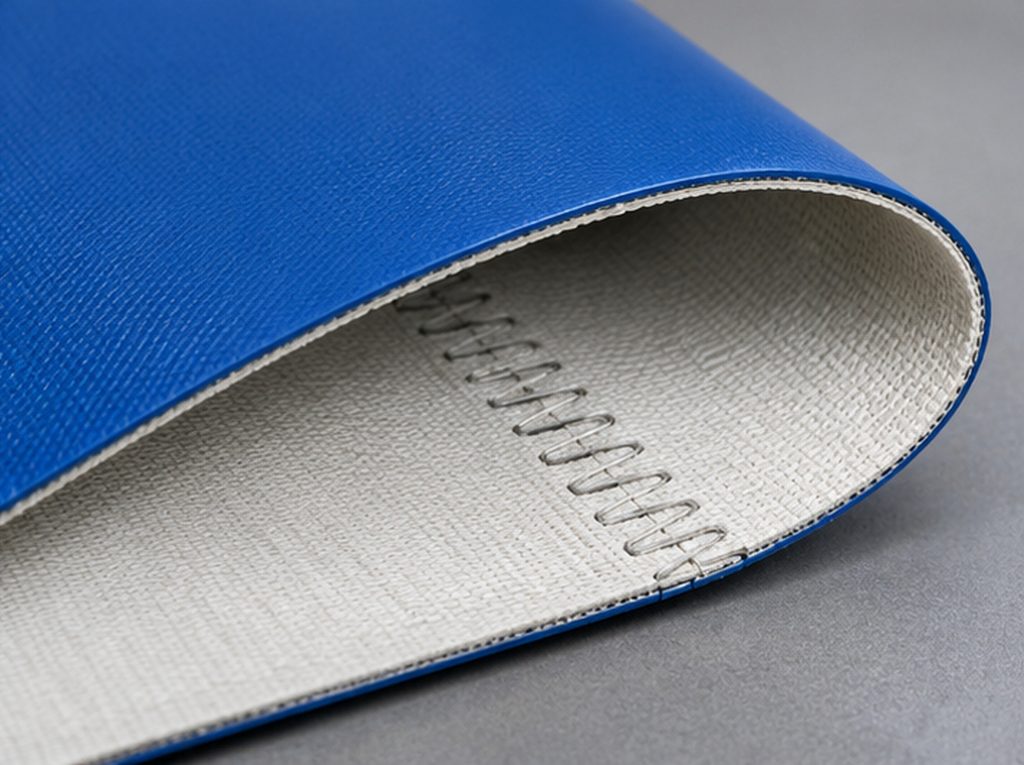
LKBELT’s blue PVC flat conveyor belt is shown with a glossy blue carrying face and fabric underside. Those details help identify the two faces on a sample. Ask for the exact grade and confirm how the fabric runs against the drive shell and support bed. A glossy cover provides too little evidence to assess those underside contacts.
The PB10W-FDA white PVC flat conveyor belt likewise has a white PVC face and fabric underside. Use the model reference with photos of both sides and the installed drive. Confirm the selected construction, seam and exposure. The model identifier and colour leave the applicable contact documentation and cleaning compatibility to be verified for the offered belt.
Bending, support resistance and joint profile
Trace the loop from the driven pulley through all return and end components. Record diameter, wrap, contact face and bend direction. A small backside roller can govern the permitted construction even when the driven pulley is large. Include any guide grooves or fixed supports that the joint must pass. Habasit’s fabric-belt guide explains drive and support arrangements and their interaction with belt traction, friction and bending within its documented range. Habasit Fabric Conveyor Belts Engineering Guide
Compare the candidate belt’s underside against the bed material, load distribution, moisture and debris conditions. Increased sliding resistance changes the pull the drive must deliver. The supplier needs both production duty and the installed support arrangement. Conveyor components and belt compatibility
Check the finished joint through every contact. Record total thickness and transitions on both faces, the joining construction and any orientation requirement. Verify permitted repeated bends as well as physical clearance. An added guide or profile belongs in the same review. Conveyor belt splice compatibility
Finished length, take-up and fitting access
Measure or obtain the specified full loop length using the supplier’s stated reference. A frame length alone cannot describe the additional path around a lower drive group. Record whether any measurement comes from a used belt, the equipment drawing or a layout calculation, and state the take-up position and usable travel. Confirm the agreed order length and tolerance before manufacture.
LKBELT’s transparent PU conveyor belt page shows pale translucent roll material and requests finished dimensions, joint, support and pulley details. Its separate model table lists other constructions. Identify the actual offered grade and approve the finished loop against the drive route. The roll photograph gives useful appearance information but leaves the completed assembly to be specified.
Confirm whether the conveyor accepts an endless loop or needs a supplier-approved joining arrangement at the machine. Show drive cassette, shaft and frame access where they constrain fitting. Arrange inspection and installation under the OEM and site procedures. Record any recent rerouting or roller replacement so the supplier can review the machine that will receive the belt.
Conveyor Drive Type vs Belt Specification: Comparison Table
| Drive description | Belt-specific implications | What to record | Supplier confirmation |
|---|---|---|---|
| End or head drive | Loaded-run pull, drive wrap and end-pulley bend | Travel direction, driven end, snubs, support and return route | Traction, working duty, bend limits and finished loop |
| Center or lower drive | Extra roller contacts, possible reverse bends and local joint clearances | Drive-group drawing, diameters, contact faces and take-up | Complete bend path, face compatibility, joint and loop length |
| Internal motorized pulley | Drum shell is the drive interface; installation position still matters | Drum model, surface, diameter, wrap, engagement type and tensioner | Belt-to-drum match and conveyor operating requirements |
| Direct or indirect motor transmission | Describes the auxiliary power path across any suitable layout | Conveying-belt position separately from auxiliary drive parts | Correct component and original equipment specification |
Two Industrial Selection Scenarios
End-driven parcel line and compact lower drive
Suppose a procurement team wants one replacement construction for a long parcel conveyor and a compact transfer conveyor. Both use the same nominal width and cover material. The longer line has an end drive and its own support arrangement. The compact line routes the return around a lower drive group.
Compare the route drawings and label the running faces on each support. Ask for bend approval on the smaller rollers and check the finished joint against the compact drive’s clearances. Specify each loop separately and confirm available take-up. A common construction can be considered only after its supplier confirms both duties. Retain separate position references and approved dimensions even if one construction is accepted. A different running face, reinforcement or joint may be needed if the compact route imposes a limit the common proposal cannot meet.
Replacement on a motorized-drum conveyor
Suppose a supplier receives a request for a “belt for an internal-drive conveyor.” The team has the drum model but no finished-belt drawing. Record the shell, surface, wrap, return path and take-up first. Recover the original belt reference and photograph its running face and seam. Identify whether the drum uses friction contact or a specific engagement system.
Ask the supplier to resolve the offered grade, working limits, joint and finished length against that information. Agree on first-belt fit and running checks. Hold any unresolved deviation for technical review before a production order. The drum reference helps identify the equipment; the accepted replacement still needs a complete belt specification.
What to Include in a Conveyor Belt Replacement RFQ
Provide the same installed reference to each supplier.
- Machine and layout. Conveyor model, belt position, driven-pulley location, drive-group drawing, direction and reversing duty. Identify direct or indirect motor transmission separately.
- Belt and contacts. Original reference, width, total thickness, full loop length and measurement basis, carrying face, underside, reinforcement, joint and profiles. Mark which face touches each support, roller and pulley.
- Geometry and duty. Diameters, wrap, drum or lagging reference, bed material, crown where specified, take-up and fitting access. Include product load, speed, cycle and exposure to moisture, dust, oil or cleaning.
- Approval and order. Quantity, documentation, tolerances and permitted alternatives. Ask for written deviations and confirmation of the offered finished belt against the route and operating duty.
Use the first belt to verify the approved dimensions, construction, joint and guide positions before fitting. Qualified personnel should follow the conveyor procedure for tension setting and authorised running checks. Observe tracking, drive slip, joint passage and any unusual contact or heat under the agreed representative duty. Keep the approved drawing and observations with the position record for repeat purchasing. LKBELT logistics belt specification and sample review
Frequently Asked Questions
Does a center drive have to sit at the middle of the conveyor?
It can be positioned at different points below the transport level. Use the actual route drawing to identify the driven roller and surrounding idlers.
Can an internal motorized pulley be an end drive?
Yes. Internal describes the motor inside the drum. Record its position and the full belt path separately.
Does an indirect drive require a different conveying belt?
Check the conveying belt’s actual pulley contact and duty. The auxiliary transmission is a separate component with its own specification.
Will a belt of the same width and material fit another drive layout?
Confirm the grade, underside, permitted bends, finished joint, loop length and working conditions for the second route.
What should be checked if the new belt slips?
Have qualified personnel review tension, drive contact, pulley condition, load and support resistance under the equipment procedure. Record the finding before approving a construction change.
Conclusion
Describe the drive layout by following the conveying belt through every support, pulley and tensioning point. Confirm the offered surfaces, bend limits, joint and loop dimensions against that route and duty. An approved first-belt record then gives procurement a sound basis for repeat supply. Buyers can provide the layout drawing, drive arrangement, pulley and roller data, belt dimensions, joint requirements and operating conditions for supplier review.