

PU round belt for endless belt assemblies
This polyurethane round belt has a circular cross-section and can be joined into an endless loop by butt-end welding. Select the cord diameter, surface finish and finished loop length for the pulley grooves and machine arrangement.
| Item | Product details |
|---|---|
| Material | Thermoplastic polyurethane (TPU) |
| Cross-section | Round |
| Diameter range | 2–20 mm; see individual sizes below |
| Hardness | 90 or 95 Shore A, depending on diameter |
| Joining | Butt-end welding for an endless loop |
Send the diameter, loop length or required cord length, surface finish and quantity for a quote.
Round-belt sizes
Choose the diameter and hardness together. The stretching range below is a size reference; use the machine’s installation requirements when setting belt length and tension.
| Diameter (mm) | Stretching range | Hardness (Shore A) |
|---|---|---|
| 2 | 1.5-3% | 95 |
| 2.5 | 1.5-3% | 95 |
| 3 | 1.5-3% | 90 |
| 3.5 | 1.5-3% | 90 |
| 4 | 1.5-3% | 90 |
| 5 | 1.5-3% | 90 |
| 6 | 1.5-3% | 90 |
| 7 | 1.5-3% | 90 |
| 8 | 1.5-3% | 90 |
| 9 | 1.5-3% | 90 |
| 10 | 1.5-3% | 90 |
| 12 | 1.5-3% | 90 |
| 15 | 1.5-3% | 90 |
| 18 | 1.5-3% | 90 |
| 20 | 1.5-3% | 90 |
Surface and profile options
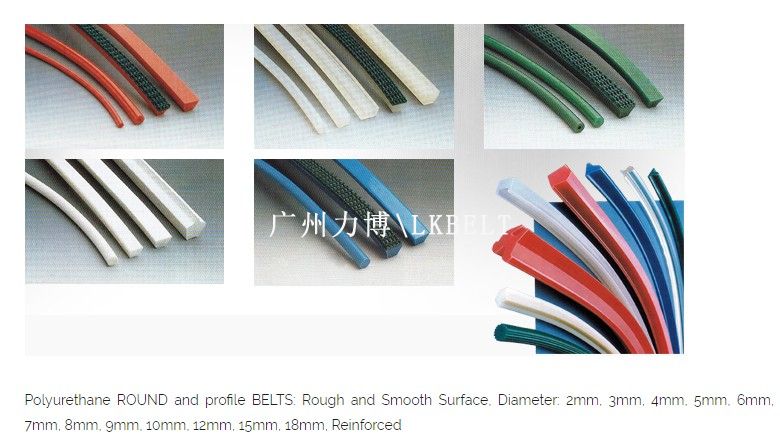
Polyurethane belts are offered in smooth and rough surface finishes. Specify the finish of the round belt required for your pulley or conveying contact. The product-range photograph also shows non-round profiles, which are separate shapes from the round belt on this page.
Measure the belt and pulley arrangement
| Detail | Information to provide |
|---|---|
| Cord size | Diameter and tolerance, measured on an unworn section |
| Required length | Finished endless-loop length or cord length, stating whether measured relaxed or installed |
| Pulley arrangement | Groove dimensions, pulley diameters, centre distance and installation access |
| Operating conditions | Machine type, speed, load, temperature and contact with liquids or cleaning chemicals |
| Surface and joint | Smooth or rough finish, joint requirements and required quantity |
Joining and installation
Butt-end welding allows the ends of the cord to form a continuous loop. Keep the diameter and joint aligned with the pulley groove, and use joining conditions suitable for the selected material. Send photographs of the existing joint and installation if you need a replacement belt.
For a belt that slips, wears unevenly or breaks at the joint, include the pulley layout and photographs of the affected area with your enquiry. This helps identify the size, finish and joining requirements for the replacement.


