
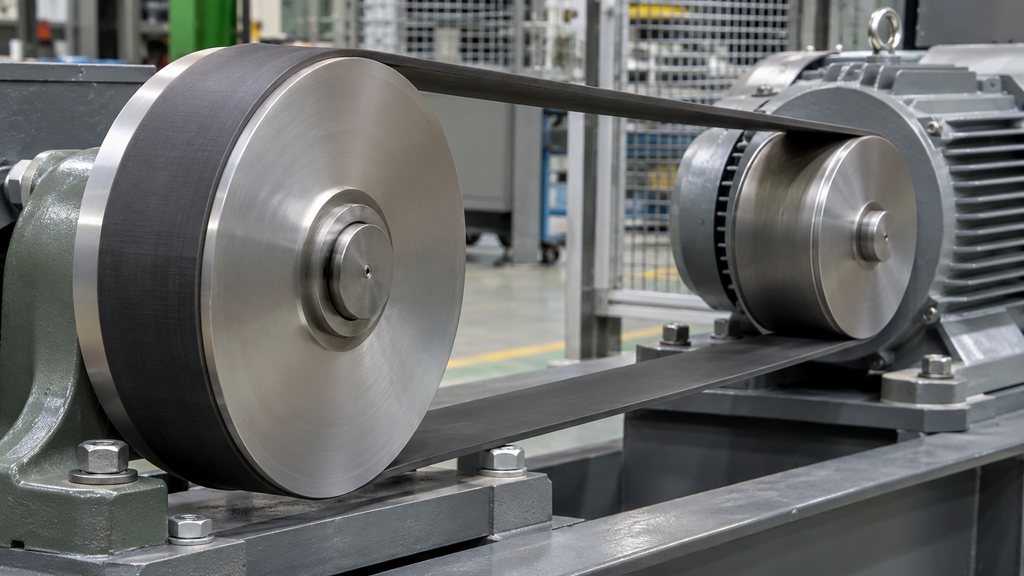
A speed reducer is fitted with a new belt drive. The belt engages correctly and transmits the required power, but the output-shaft bearing begins to run abnormally hot. The problem may lie outside the nominal belt rating: the sheave or toothed pulley can apply a radial load beyond the outermost bearing that the reducer was not designed to carry. Belt drive overhung load is a shaft-and-bearing design constraint, not simply a belt-strength question. Engineers must assess pulley pitch diameter, its distance from the nearest bearing, the tension forces and drive orientation, the operating duty and the reducer manufacturer’s permitted overhung-load rating. A belt that can transmit the required torque is not proof that the shaft or bearing arrangement is acceptable. This article helps industrial OEM and maintenance buyers understand why a changed belt-drive layout may require engineering approval before a belt is purchased. It does not provide a universal reducer-rating formula or claim that LKBELT supplies bearings, reducers or a complete designed drive.
What Is Overhung Load in a Belt Drive?
Overhung load (OHL) refers to the load applied to a shaft beyond the outermost support bearing. In a belt drive, the mounted sheave or timing pulley transmits radial forces associated with belt tension and operating conditions. The further the effective load acts beyond the bearing, the greater the bending moment for the same transverse force, other factors equal. A speed reducer output shaft experiences two different categories of loading. Torque produces torsional stress associated with transmitting power. Radial belt force produces bending and bearing reactions. They are related through the geometry and tension state of the drive but cannot be substituted for one another. A drive can have an acceptable belt power rating and still impose an unacceptable load on its output bearing. Gates’ engineering discussion, How Belt Drives Impact Overhung Load, explicitly treats reducer overhung-load ratings and the effects of pitch diameter and load position. Its numerical factors and branded performance statements are specific to the underlying methodology and products; they must not be copied into an LKBELT product specification.
Why Pulley Diameter Changes the Engineering Problem
For a simplified tangential drive-force relationship, torque at a pulley is related to the difference between the tight-side and slack-side belt tensions: Transmitted torque = (tight-side tension − slack-side tension) × effective pulley radius. The expression helps explain why a smaller pulley radius needs a larger tension difference to transmit the same torque. But it does not give the full resultant radial force on the shaft. Actual shaft loading depends on both span tensions, their directions, belt wrap, pretension, the mass of attached hardware and the specific drive condition. A reducer manufacturer may apply further factors or a model-dependent rating procedure. As a deliberately simplified arithmetic example, imagine a specified torque of 20 N·m acting at an effective pulley radius of 0.05 m. The implied tension difference is 20 / 0.05 = 400 N. This 400 N is not the overhung load, an allowable bearing load or an LKBELT belt rating. It cannot be compared directly to the reducer’s OHL limit. The designer must still determine the resultant shaft force with the real geometry and use the reducer supplier’s rating method. This distinction prevents a dangerous purchasing shortcut. A salesperson who knows the transmitted power and pulley diameter cannot independently approve bearing life by calculating one tangential force. The machine’s shaft load and rating basis must be reviewed by qualified engineering.
Worked screening example: torque force is not reducer OHL
Consider a hypothetical driven shaft carrying 40 N·m of transmitted torque and a pulley with an effective pitch radius of 0.05 m. The corresponding operating tangential force difference is 40 ÷ 0.05 = 800 N. That arithmetic tells the engineer about tight-side minus slack-side tension for the assumed operating condition. It does not establish either span’s absolute tension, their vector resultant on the pulley, the shaft bearing reactions, or whether any reducer OHL rating has been met.
If the pulley radius is reduced while torque remains the same, the required tension difference increases; in this example, a hypothetical 0.04 m radius would correspond to 1,000 N of tangential force difference. The drive must still be checked for actual belt tension, pulley wrap, line of action, shaft position and the reducer manufacturer’s load-location and duty factors. These example forces are not LKBELT belt capacity values, a complete design calculation or a safe operating recommendation.
Why Pulley Position Matters Even When Belt Force Is Unchanged
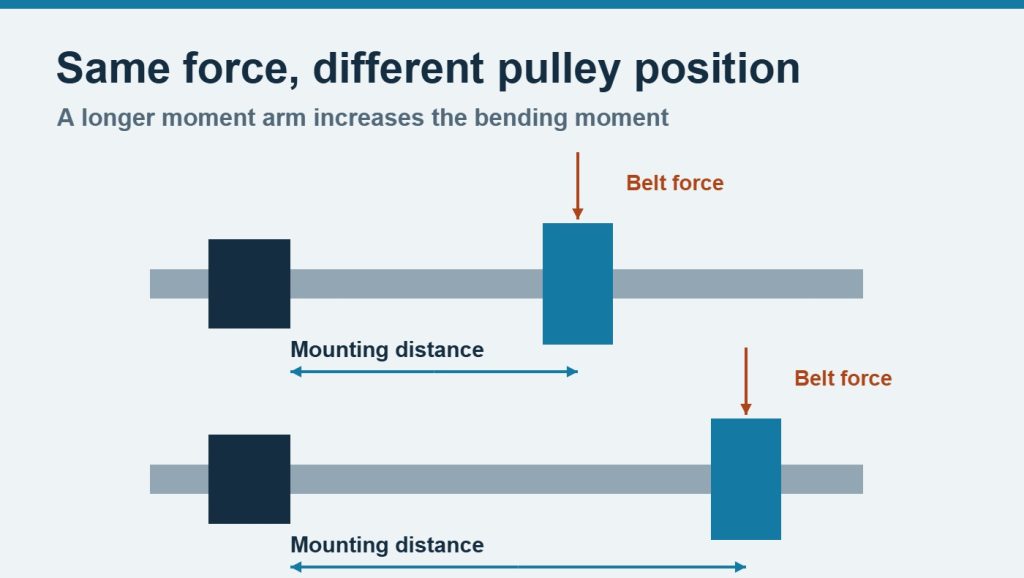
Imagine an overhung load applied at a shaft position beyond the outer bearing. The bending moment about that bearing, in a simple transverse loading model, is force multiplied by the perpendicular lever arm. Moving the same load farther from the bearing increases this moment. For example, in a hypothetical educational comparison, a 300 N transverse force applied 40 mm from the reference bearing produces a local moment of 300 × 0.040 = 12 N·m. At 80 mm, with the same force direction and magnitude, the corresponding moment is 24 N·m. These examples illustrate geometry only; they are not a gearbox calculation and do not provide actual reactions in a multi-bearing shaft. In practice, the pulley center may be offset by a wide hub, mounting collar, spacer or belt-guard constraint. The actual location needs to be measured from the reference specified by the reducer manufacturer. A revised drive with the same belt size may increase bearing demand if the pulley is installed farther outboard. Likewise, pulley position cannot be changed casually if doing so compromises key engagement, guarding or belt alignment. A useful procurement record therefore shows both the selected pulley diameter and the distance from the rated outer bearing to the effective load center. A belt quotation that ignores pulley mounting geometry can leave this important equipment risk unresolved.
Belt Pull, Installation Tension and OHL Are Different Values
Engineering teams often use the expressions belt tension, belt pull, tight-side tension and overhung load interchangeably in informal conversation. They describe different quantities and must be distinguished in formal approval.
- Installation tension / pretension: the initial tension set according to the drive manufacturer’s method to obtain the intended engagement and operating behavior.
- Tight-side and slack-side tension: operating span forces that depend on torque transmission and the actual drive state.
- Resultant shaft load: a vector combination of forces transmitted to the pulley and shaft, taking drive geometry and relevant component weight into account.
- Overhung load rating: a value or allowable-condition framework published by the reducer or motor manufacturer for the relevant shaft position and operating duty. One cannot use a generic belt pull value as the final reducer OHL check. Consult the applicable reducer datasheet and its specified calculation or configuration tool. The Tsubaki gearbox selection and overhung-load guidance provides an example of a manufacturer-specific method; it is not a formula for all reducer models. Tension should never be reduced below the belt manufacturer’s acceptable operating requirements simply to improve a bearing-load calculation. Under-tension can impair tooth engagement or cause slippage; excess tension may load bearings unnecessarily. The complete system must satisfy both criteria.
When Is an OHL Review Especially Important?
Retrofitting a chain drive to a timing belt
A conversion can change pulley or sprocket diameter, hub placement, tension requirements and load direction. A matched timing-belt drive can offer maintenance advantages in an appropriate application, but a replacement proposed solely on torque rating might cause new radial loads. The timing belt versus chain selection context helps identify the belt family; the reducer OHL limit and retrofit approval remain independent engineering checks. Avoid comparing a Gates branded carbon belt’s torque or life figures to a generic LKBELT T10 product. The materials, profiles and design ratings are not demonstrated to be interchangeable.
Changing to a smaller pulley
A smaller pulley may fit a constrained guard envelope but can increase required tangential force for the same torque. It also changes belt bending, speed relationship and tooth engagement. The proposed belt’s minimum permitted pulley and tooth-mesh requirements must be confirmed separately. A pulley that physically fits is not automatically a safe redesign.
Moving a pulley farther along the shaft
A spacer or replacement hub that shifts the pulley away from the outboard bearing increases the lever arm for the same transverse force. Engineering should compare the proposed location with the reducer manufacturer’s allowable mounting reference and examine the effects on shaft deflection, alignment, key engagement and bearing life.
Increasing startup, shock or reversing duty
A higher service demand can change peak torque, belt span tensions, structural movement and bearing load. A nominal operating power value may not represent transient conditions. The machine owner should provide the relevant duty and shock factors, and the reducer supplier should state the correct rating procedure for that operating profile.
What the Reducer Catalog Actually Needs
There is no universal conversion from an article’s computed belt tangential force to a pass/fail OHL value. The relevant reducer model must be checked using its own permissible radial-load reference point, operating duty, input/output-shaft designation and load application distance. The Tsubaki manufacturer selection guidance explicitly distinguishes load and location factors in its gearbox-specific selection procedure. A force that passes one reducer’s method is not automatically acceptable for another reducer family.
For engineering review, request a marked-up shaft sketch that identifies the outer bearing or catalog datum, pulley load line, force direction and distance. Record the mounting configuration, not just a guessed distance from the housing face. Include belt tension information and pulley mass when required by the applicable reducer method. If the catalog’s required data are unavailable, the correct outcome is engineering hold, not a calculated approval from a generic rule of thumb.
Overhung Load Review Matrix for Purchasing Teams
| Engineering input | What to obtain | Why the input matters | Who should approve it |
|---|---|---|---|
| Reducer / motor model | Exact manufacturer, output-shaft data, rating revision | Determines the permitted OHL basis | OEM or reducer supplier |
| Pulley or sprocket | Effective/pitch diameter, face, hub and mounting drawing | Changes belt force geometry and load location | Drive engineering |
| Shaft layout | Position relative to outermost bearing and other supports | Defines bending lever arms and reactions | OEM / reducer supplier |
| Belt and tension system | Belt type, tight/slack load data, specified pretension | Supports resultant shaft-force assessment | Drive engineer / supplier |
| Operating duty | Actual torque, speed, starts, reversals and load peaks | Rating may vary with duty and transient loads | Machine engineering |
| Approved construction | Tooth profile or V-section, width, length and pulley match | Determines belt fit, independent of OHL approval | Belt and pulley suppliers |
Two Practical Industrial Engineering Scenarios
Scenario A — A speed-reducer retrofit uses a smaller timing pulley
A factory replaces a belt-drive arrangement on a packaging machine, choosing a smaller toothed pulley to fit a redesigned guard. The proposed polyurethane belt matches the selected tooth form and appears adequate for the required motion. Engineering notices that the reducer manufacturer’s permitted load must still be checked at the new pulley diameter and position. The team obtains the original pulley drawing, reducer model, mounted position and duty. It then asks the reducer supplier to evaluate the actual load using the published rating procedure. The belt supplier confirms only the proposed belt’s tooth profile, width, bending requirement and finished length. Decision: Do not release the retrofit as an approved drive until both the belt design and shaft/bearing check are complete. This is a hypothetical case without invented equipment ratings or trial results.
Scenario B — Bearing trouble follows a pulley-hub replacement
After maintenance, a conveyor auxiliary drive experiences elevated reducer-bearing temperature. The belt appears correctly tensioned under the established procedure, and the new pulley has the same nominal tooth count as the previous assembly. However, the hub and spacer locate its effective belt load farther outboard. A qualified maintenance investigation reviews lubrication, alignment, bearing condition and other possible causes rather than assuming OHL is proven. Engineering also compares the new mounting location with the reducer’s approved overhung-load basis. Purchasing does not assume that a replacement belt can resolve a shaft-bearing issue. Decision: If an outboard load problem is established, repair the mounting or redesign the drive under OEM approval. Only then confirm whether the belt needs replacement and what construction is required.
How LKBELT Belt Products Relate to an OHL Review
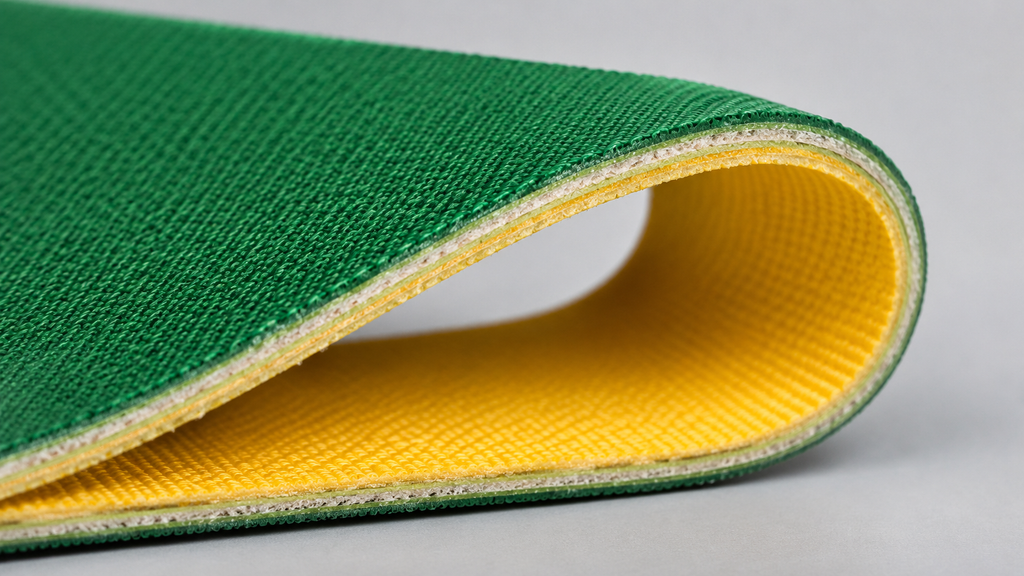
The LKBELT polyurethane T10 timing belt and TK10 PU timing-belt listing demonstrate identifiable toothed-belt product families. Their public references do not provide a universal torque capacity, reducer OHL allowance or shaft-design certification. Each finished belt must be reviewed against the pulley profile, effective diameter, tooth engagement, duty and actual machine constraints. For another technology family, LKBELT’s Types of Industrial V-Belts guide explains why V-section, belt construction and machine compatibility must be distinguished. A V-belt drive may have a different tension and load behavior from a synchronous drive, but there is no valid single multiplier that applies to every available belt and pulley arrangement. The PU versus rubber timing-belt comparison provides further material-selection context. Material choice does not override the reducer OHL requirement. LKBELT can review a belt quotation when a buyer supplies verified profile, dimensions and duty; it should not be represented as approving a reducer bearing design on the strength of a belt product page alone.
One Change, Two Independent Approvals
A revised timing-belt specification can be commercially quotable even when the reducer OHL question remains unresolved. Use two sign-off fields in the project record:
- Belt supplier fit review: tooth family, pitch, length/tooth count, width, backing, joint, bending requirements and proposed construction relative to the pulley drawing.
- Equipment/reducer engineering approval: actual shaft force calculation, pulley load position, duty and service factors, allowable OHL or bearing reaction, and any redesign required to satisfy the reducer maker’s rating.
Do not substitute one sign-off for the other. This separation enables purchasing to request a conditional quotation without representing an unapproved drive conversion as safe to operate.
An RFQ That Prevents Belt and Reducer Responsibilities From Getting Mixed
Send the belt supplier the original belt code, pulley tooth form or sheave groove reference, width, finished length, duty, drawing and required construction. In parallel, send the OEM or reducer supplier the reducer model, output-shaft arrangement, mounted pulley diameter and position, load conditions and proposed retrofit geometry. Ask each party to document what is inside and outside its scope. For a first article or replacement trial, retain the accepted belt specification, pulley drawing, reducer approval and the prescribed inspection results. A procurement approval should explicitly distinguish belt fit and performance from shaft and bearing load acceptance. A supplier’s belt quote is not a substitute for a signed system-design review.
Frequently Asked Questions
Does a belt rated for enough power guarantee acceptable overhung load?
No. Shaft loading and bearing reaction depend on drive geometry and tension as well as transmitted duty. Compare the appropriate calculated OHL to the exact reducer manufacturer’s rating method.
Does increasing pulley diameter always solve the problem?
Not automatically. It can change the force relationship for a given torque, but space, speed ratio, tooth engagement and the rest of the system must also be reviewed.
Is transmitted tangential force the same as bearing load?
No. The tension difference associated with torque is not the complete resultant force or the bearing reaction.
Does pulley distance from the bearing matter?
Yes. A transverse load acting farther beyond an outer bearing increases the corresponding bending lever arm, although actual bearing reactions require the complete shaft model.
Can LKBELT certify reducer overhung load from belt dimensions alone?
No such capability or rating is established by the public belt pages. Reducer OHL acceptance requires the reducer and machine engineering data and the applicable approval process.
Conclusion
A belt-drive redesign succeeds only when the belt, pulley, shaft and bearings work as an approved system. Treat pulley diameter, shaft mounting position, actual tensions and reducer OHL limits as connected engineering inputs—not as details to check after purchasing the belt. LKBELT can review a proposed belt specification while the equipment owner and reducer supplier confirm the associated shaft and bearing loads.