
An OEM receives two replacement quotes for the same indexing drive. Both belts have the quoted width and pitch, but one uses polyurethane and the other rubber. Before approving either, the engineer needs the original belt drawing and the mating pulley specification.
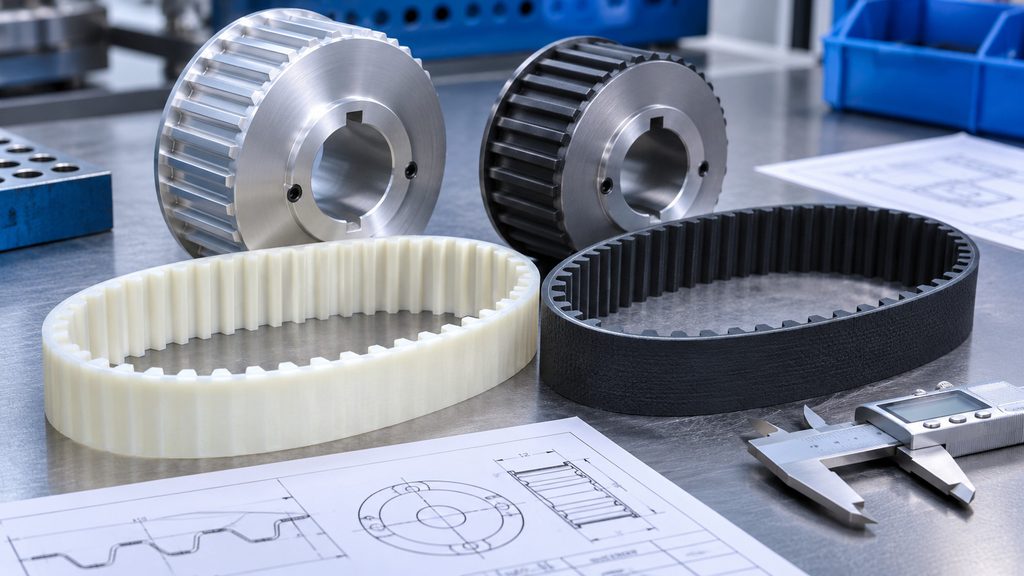
Compare PU vs rubber timing belts against the original drive. First verify the exact tooth profile, tooth count or pitch length, width and pulley grooves. Then compare the body compound, tensile cords, tooth facing, bending limits and supply form for the actual load and environment. A proposed substitute needs approval as a finished belt.
What Is the Difference Between PU and Rubber Timing Belts?
Both are synchronous belts. Their teeth engage mating pulley grooves to transmit motion. PU and rubber identify the body material family. The body forms and supports the teeth, the cords carry longitudinal tensile load, and any tooth facing changes the surface that meets the pulley. The finished belt can also include a backing, a joint or other features that affect fit or operation.
At a product-family level, PU timing belts are often considered where abrasion resistance and low belt dust are important. Many rubber timing belts use fabric tooth facings that can help reduce operating noise, while selected rubber compounds offer different heat and oil-resistance characteristics. PU formulations also differ in their response to moisture and hydrolysis. These are selection tendencies, not guarantees for every belt. Compare the exact grades, constructions and manufacturer ratings under the intended operating conditions.
Start the comparison with the original part number, drawing revision and reason for replacement. A routine replacement on a proven drive needs confirmation of the accepted construction. A substitution prompted by wear, dust or a change in duty needs a defined problem and an acceptance check. Ask suppliers to identify which parts of the original design their offers retain and which they propose to change.
Why Must Tooth Profile and Pulley Fit Be Checked First?
Pitch identifies tooth spacing. Full tooth geometry determines how the belt engages the pulley. An HTD 5M belt and an S5M belt share a nominal pitch, but their designations describe different tooth systems. Check the tooth shape, flank geometry and mating groove drawing. Confirm the pulley tooth count, usable face width and flanges, along with the belt tooth count or specified pitch length. Equal width and pitch alone give too little evidence to approve a substitute.
Optibelt documents compatible pairings by tooth system, including specific belt profiles that it lists for standard HTD pulleys. Use the corresponding compatibility data for the exact belt and pulley in your drive. Optibelt timing belt pulley compatibility
For a broader explanation of tooth profiles, pulley matching and belt construction, see our industrial timing belt guide.
LKBELT’s polyurethane T10 timing belt gives a concrete example. The listing names a T10 PU belt, and the T10 row gives a 10 mm pitch in a table that also lists other profiles. Use that row as a profile reference and request the drawing for the offered belt. The table describes several geometries and gives no drive approval for the particular replacement.
For a rubber replacement, use the catalogue designation Rubber Timing Belt HTD 240-5M from the LKBELT rubber timing belt range. Put that reference beside the original belt marking and ask the supplier to confirm the tooth profile, pitch length or tooth count, width and mating pulley on the offered drawing. Request a model-specific datasheet for the compound, cord, working load and exposure limits, and a sample if fit needs to be checked.
How Do Rubber Compounds and PU Formulations Differ?
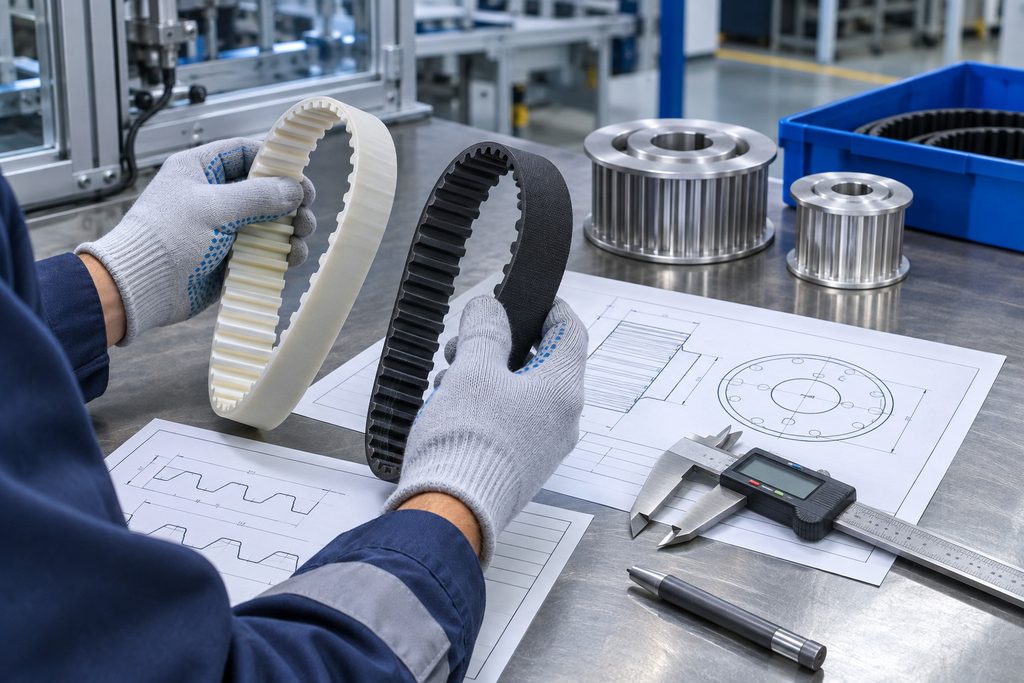
The terms PU and rubber each cover several formulations. Bando discusses chloroprene (CR), EPDM, NBR and HNBR in its synchronous belt selection guide. It also distinguishes ester-based and ether-based polyurethane and discusses differences in hydrolysis behavior. Its product examples show why oil and moisture resistance need a grade-specific check. Use the proposed belt’s data to confirm compatibility with the actual duty. Bando synchronous belt selection guide
Ask the supplier to identify the body grade on the quotation and document the properties relevant to the machine. If a formulation is proprietary, a supplier designation and written application limits give purchasing a reference for subsequent orders. Where the specification requires low particle generation or food-contact documentation, state the exact requirement and ask for evidence for the offered product. A general claim about the polymer family leaves that requirement open.
What Role Do Tensile Cords and Tooth Facings Play?
Record the actual tensile member if the supplier identifies it. Steel, aramid and fiberglass are examples encountered in timing belts. LKBELT’s T10 Kevlar-cord PU timing belt listing names one cord construction. Its broader profile table is a geometry reference. For the actual variant, request the cord specification, allowable working tension and finished-belt load–elongation data. State the expected peak and running loads so the supplier can confirm which ratings apply. Cord material alone gives too little information about working extension, tooth capacity or flex fatigue.
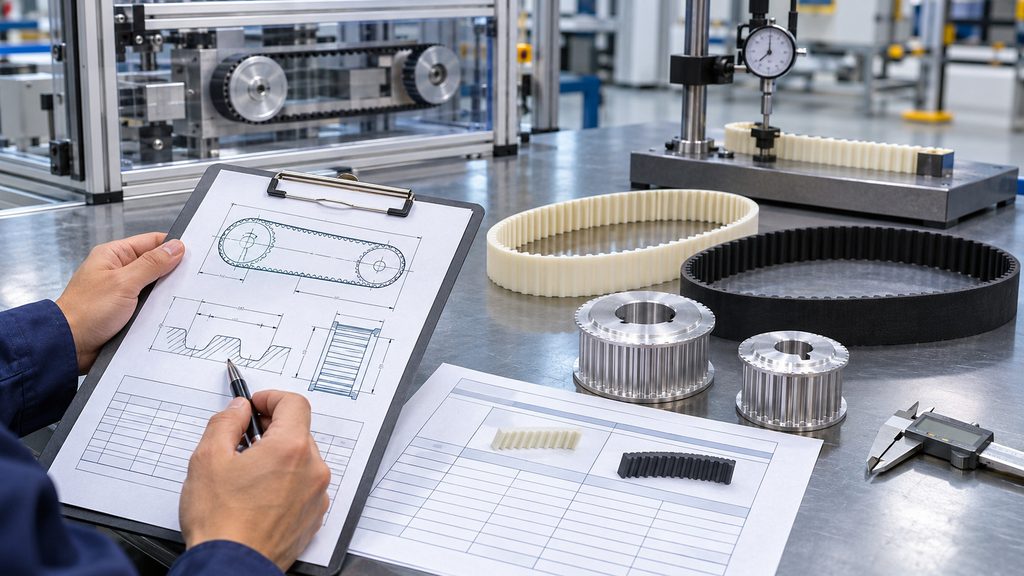
A tooth facing has a separate job at the pulley interface. Ask whether the proposed teeth are faced, what facing is specified and whether it is included in the drawing and performance data. Check the backing separately wherever it contacts an idler or supports the product. Changes on either face may affect clearance or engagement elsewhere in the drive.
How Should Buyers Compare Wear, Noise and Positioning?
Describe the original symptom at the operating point where it appears. Tooth wear, edge fray, debris and a change in sound can warrant different inspections. Look at pulley condition, alignment, engagement and installation tension under the OEM procedure before attributing a symptom to the belt compound. Bando discusses tooth fabric as a factor in running noise. For a comparable trial, keep the pulley, setup, speed and load documented and agree on the observation method.
For an indexing drive, define acceptable position error at the actual station. Tooth clearance and deflection, belt extension under load and the machine setup can all affect the result. If the axis reverses, include that direction change in the approved trial. Specify where and when to measure position. A quiet run at steady speed leaves the behavior during deceleration and restart untested.
What Changes With Temperature, Oil and Cleaning Exposure?
Record actual temperatures at the belt and product contact, and distinguish continuous exposure from peaks during a run or stop. Name the oil, lubricant or cleaning agent. State whether exposure is by splash, mist, wiping or repeated contact, and include concentration, duration, frequency and drying where relevant. If operating conditions recently changed, give the supplier both the old and new cycle.
Ask for limits for the finished assembly, including the body, cord bond, facing, backing and any joint. Confirm whether a stated limit applies while the belt carries the required load and bends at operating speed. Material compatibility and the allowable duty of the whole belt both enter the approval. Consider selecting a documented grade for the changed exposure before changing the material family.
What About Pulley Size, Reverse Bends and Supply Form?

Show each toothed pulley and idler on the routing drawing. Record the diameter basis, wrap and whether the teeth or back face contact each component. Include reverse bends and tensioner travel. Ask the supplier for minimum permitted pulley and idler diameters for the exact belt, and for confirmation of load and speed through the route. A belt that meshes during a static fit check may face different bending and tooth loads when the machine cycles.
State whether the drive takes a factory-made endless belt, a joined belt or open stock that is clamped in the machine. Confirm installation access and the intended load rating for that supply form. If the original has cleats, holes or a backing, submit their dimensions and position. Have the supplier review the modified belt as an assembly, including its clearance, bending and any joint requirements.
PU vs Rubber Timing Belt Selection Matrix
| Requirement | What to check in a PU offer | What to check in a rubber offer | Evidence or buyer decision |
|---|---|---|---|
| Teeth and pulleys | Exact profile and pitch, tooth count and width | Exact profile and pitch, tooth count and width | Confirm both against the original pulley and belt drawings |
| Reinforcement and load | Cord reference and finished-belt working limit | Cord reference and finished-belt working limit | Compare load–elongation and service ratings at equivalent duty |
| Bending and routing | Forward and reverse bend limits for the offered build | Permitted pulley and idler sizes for the offered build | Check every bend and face contact on the routing drawing |
| Wear, noise and indexing | Tooth facing, contact surfaces and test conditions | Tooth fabric or other facing, contact surfaces and test conditions | Agree baseline, operating cycle and acceptance checks |
| Heat, oil and cleaning | Exact formulation and approved exposure | Exact compound and approved exposure | Confirm the chemicals, temperatures and duration for the complete assembly |
| Finished construction | Endless, joined or open form and any modifications | Endless, joined or open form and any modifications | Confirm the drawing, installation access and finished rating |
Two Practical Industrial Selection Scenarios
Replacement for a rubber HTD-type drive
Suppose a packaging drive has a worn rubber HTD-type belt. One supplier offers rubber and another offers PU at the same nominal pitch. Confirm the OEM pulley drawing and correct profile first. Then send both suppliers the original tooth count, pulley route, installation tension, speed, peak load and any lubricant exposure. Ask them to show approved engagement, working duty and bend limits for the quoted construction. If the PU supplier proposes a different pulley, review that change as a drive modification. Approve a sample only against the agreed drawing and operating checks.
PU indexing drive after a change in duty
Suppose a PU belt on an indexing machine now sees more frequent starts and stops and a changed cleaning cycle. A supplier proposes rubber. Record the original belt, facing and pulley condition, then define the position tolerance and representative start–stop test. Compare working load and extension data at the relevant duty, verify the proposed facing and confirm compatibility with the cleaning cycle. Check tooth fit and the intended installation route before an authorized trial. Obtain OEM or responsible engineering approval for the substitution before buying repeat stock.
What Should Buyers Send With a Replacement RFQ?
Send every supplier the same drive drawing and ask for deviations in writing.
- Identify the original drive. Include machine ID, belt part number, drawing revision, tooth profile and pitch, tooth count or pitch length, width, body grade and cord where known.
- Show what the belt touches. Include pulley and idler details, groove drawing, wrap, forward and reverse bends, tensioning arrangement, tooth facing, backing and any attachments or holes.
- Describe duty and exposure. Provide speed, running and peak loads, starts, stops and reversals, installation tension where documented, actual contact temperature, moisture, oil and the cleaning cycle.
- Set delivery and acceptance requirements. State supply form, installation access, quantity, permitted substitutions, required drawings and data, and who approves the first article.
Review the datasheet and deviations before fitting a sample. Confirm identity, geometry and fit, then use the OEM or site’s approved test procedure for running behavior. Agree which checks matter to the machine, such as engagement, tracking, noise, wear observations and indexing under load. Record test conditions and retain the approved drawing and variant for repeat orders.
Frequently Asked Questions
Is PU always better than rubber?
Select the finished construction for the duty. Check body formulation, cord, tooth facing, bends and the operating limits of the offered belt.
Can PU and rubber timing belts with the same pitch share pulleys?
Confirm the exact tooth and groove geometry, profile designation and width. Matching pitch confirms spacing only.
Which timing belt has better oil resistance?
Ask for data on the proposed grade with the actual oil, exposure duration and temperature. Both material families include different formulations.
Is rubber always better for heat or small pulleys?
Check the finished-belt rating for the actual thermal duty and each pulley or idler, including back bends.
Can I replace a rubber timing belt with PU directly?
Use the original drive drawing. Obtain supplier confirmation for fit and operating duty and get the substitution approved through the machine’s engineering and sample review.
Conclusion
Start with the original tooth system and pulley route, then compare the offered compounds, cords, facings and finished belt forms. The approved drawing, operating limits and first-belt checks give purchasing a basis for deciding whether a material change suits the machine.