
An automated packaging line begins making a high-pitched sound after a belt change. The operator reports “timing belt noise,” but the drive also contains flanged pulleys, idlers, shaft bearings and a gearbox. Replacing the new belt again without identifying the source may leave the problem untouched. Treat unusual timing belt noise as diagnostic evidence, not a diagnosis. Record when the sound occurs and how it changes with speed and load; isolate the machine before inspecting belt edges, tooth engagement, tension, pulley alignment and nearby bearings. Confirm the mechanism responsible before adjusting a drive or ordering replacement stock. A whine, chirp or periodic knock can have more than one cause. This guide addresses industrial synchronous-belt drives, not automobile timing-chain repairs. Its purpose is to help maintenance teams recognize which observations matter to engineering and which belt and pulley details a B2B purchaser needs for a correct replacement. Sound-based observations are preliminary; the equipment manufacturer’s service procedure controls all inspection and acceptance decisions.
First, Capture the Operating Pattern Safely
The safest useful evidence often comes from the machine’s normal operating records rather than a mechanic approaching a moving drive. Log the equipment ID, affected drive position, recent service, motor speed, direction, production load and whether the noise appears only at startup, during acceleration, continuously or on shutdown. If the system has remote or guarded condition-monitoring points, qualified personnel may use the approved test procedure to capture changes across operating conditions. Do not remove guards or touch the drive while it is running to locate a sound. For any physical examination, isolate energy, control stored motion and follow the site’s lockout and OEM access requirements. A hearing-only diagnosis should never be used to authorize extra tension or a pulley modification. The competitor article Timing Belt Noise: Types, Causes, and Solutions by BRECOflex distinguishes whine, chirp, slap, click/grind, rattle and hum. That is a useful vocabulary. But similar sounds may originate in a bearing, guard, frame or auxiliary motor coupling, so a sound label alone cannot confirm a failed timing belt.
Decide Whether the Drive Can Be Evaluated or Must Be Escalated
A troubleshooting sequence should begin with machine risk, not with the sound category. If operators report abnormal impact, new heavy vibration, damaged teeth, severe edge cutting, overheating or guarding contact, follow the site and OEM stop-and-escalate procedure; do not continue operating solely to collect a better recording. For stable, guarded operating conditions that the OEM permits, capture the speed, load and timing of the symptom through approved monitoring or machine logs. Physical inspection, alignment and tension measurements require the machine’s isolation and stored-energy procedure.
Use this four-stage decision path: record symptom → identify the affected machine component → check OEM tolerances → only then decide on belt, pulley, bearing or structural corrective action. This prevents a second belt purchase from masking a gearbox or guard fault.
What Different Timing Belt Noises May Indicate
Whining that rises with drive speed
A relatively continuous whine may reflect normal tooth engagement and air displacement or an unfavorable combination of pulley size, speed, belt tooth geometry and tension. It can also originate from another rotating component. Document whether the sound existed before the belt change, whether it rises smoothly with shaft speed, and whether a specific pulley or operating state is involved. Do not assume that “whine” always means excess tension or that loosening the belt is safe. If the belt or pulley profile has changed, confirm the exact tooth family. A T10 and an AT10 share a nominal 10 mm pitch but use different tooth forms. Tooth interference from an unsuitable profile is a much more important compatibility question than the label printed on the replacement order. The LKBELT T10 PU timing belt is an example of a named product family; its reference table is not proof of compatibility with every 10 mm pulley.
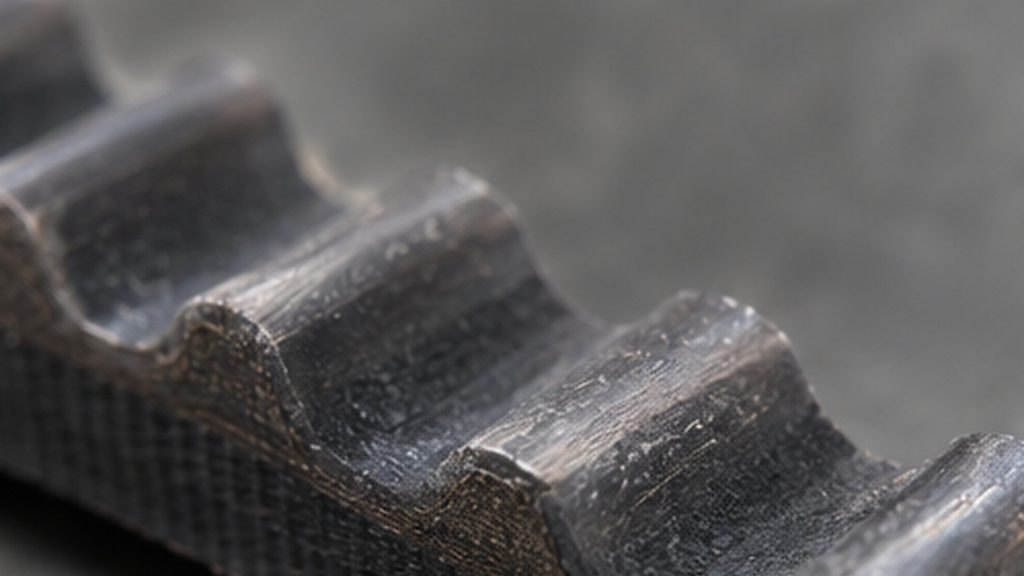
Chirping, squeaking or repeated edge rubbing
A sharp chirp can accompany contact between a tracking belt edge and a pulley flange or another stationary part. Examine the belt edge and flange for matching scuff marks only after safe isolation. Record pulley shaft parallelism, belt width, flange clearance, idler position and any change in load. A polished belt edge or a single heavily worn flange may support a tracking hypothesis, but it does not by itself prove why the tracking force arose. Industrial synchronous belts can drift laterally even with properly meshing teeth. The synchronous-belt tracking and flange overview discusses tensile-cord twist, pulley alignment and belt geometry as possible influences. A flange restrains lateral travel; it does not correct a bent shaft or incorrect pulley mounting. Do not add a flange or narrow the available belt width without engineering confirmation.
Slapping or a periodic impact
Slap may occur when a span oscillates or when the belt experiences inadequate tension for the applicable duty. An impact can also come from loose components, a moving guard, a joint, an idler or a tooth-engagement problem. Record whether the impact is tied to starting torque, reversal, abrupt stops or a particular load. Check the original tension specification, pulley centers and machine rigidity before touching an adjustment. The general industrial timing-belt failure guide covers common damage mechanisms. This article serves a different need: deciding whether a sound merits checking tension, pulley geometry, structural vibration or a component other than the belt. An arbitrary tension increase can overload bearings and worsen wear.
Clicking, grinding and rattling
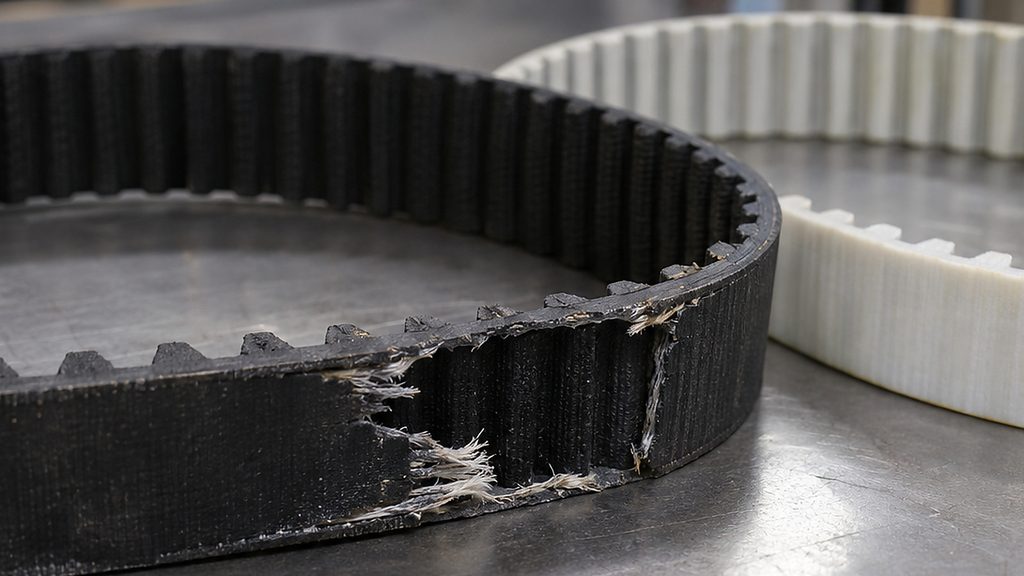
A recurring click may coincide with debris caught in grooves, damaged teeth or periodic contact with a frame component. Grinding may originate from a damaged rolling bearing rather than the timing belt. Rattling can reflect fasteners, supports or guard movement. Inspect tooth roots, pulley grooves, guards and adjacent rotating parts under the approved shutdown procedure. Escalate suspected bearing or severe mechanical damage to qualified service personnel instead of recommending a fresh belt as the universal cure. Where teeth are missing, the replacement question includes the failure cause. Reinstalling an identical belt on a pulley with damaged grooves or a contaminated drive may repeat the damage. Record the old part designation and the drive condition before submitting the belt quote.
Humming or resonance under one operating condition
A tonal hum at a narrow speed range may be related to dynamic excitation or structural resonance. It can involve the belt span but also the mounting frame, pulleys, reducer, motor or process equipment. Have engineering review the machine’s natural and forcing frequencies; do not assume that changing belt material alone can resolve a resonance condition. The presence of one tonal peak does not prove a belt defect.
A Practical Noise-to-Evidence Matrix
| Observation | First evidence to document | Possible non-belt source | Purchasing consequence | |—|—|—|—| | Whine with rising speed | Speed range, before/after replacement, pulley/profile reference | Bearing, motor, airflow | Verify profile and pulley data before changing grade | | Repeated chirp at one side | Belt edge and flange contact marks, shaft alignment | Guard or bracket contact | Confirm belt width and lateral-clearance requirement | | Slap under starts or stops | Start/stop condition, tension history, center distance | Loose mount or idler | Do not change length or pretension without OEM review | | Click at a repeating interval | Tooth condition, pulley groove debris, related component period | Loose fastener or joint | Inspect belt and pulley before ordering belt-only repair | | Grinding or harsh rattling | Shutdown findings, bearing condition, debris | Bearing or gearbox defect | Prioritize qualified drive diagnosis | | Hum limited to certain speeds | Load and speed range, machine support condition | Structural resonance | Engineering review, not automatic belt substitution | Use the table as a triage framework, not as a test that assigns a unique root cause to a sound. A complete repair decision requires additional evidence and the applicable OEM limits.
Distinguish Belt Tooth Frequency From the Actual Noise Source
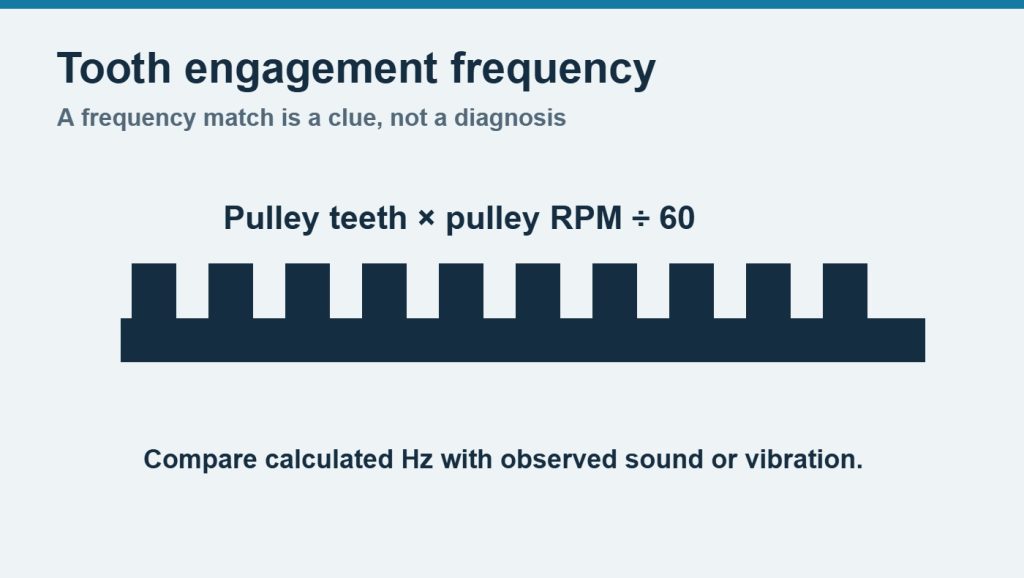
On a synchronous drive, a convenient reference is the nominal tooth-passing rate at a pulley: Tooth-passing frequency (Hz) = pulley tooth count × pulley speed (rpm) ÷ 60. For example, a hypothetical 20-tooth pulley turning at 600 rpm has a nominal tooth-passing rate of 20 × 600 ÷ 60 = 200 Hz. The number is a kinematic reference, not a measured sound level, resonance prediction or LKBELT product rating. A sound at or near this frequency or one of its harmonics may motivate further inspection, but it does not establish the belt as the source. Bearing signatures, electrical harmonics, structural responses and other periodic contacts can overlap. This distinction matters to a maintenance team handing evidence to engineering. Record the actual pulley tooth count and measured shaft rpm instead of substituting motor nameplate rpm when gearing is present. If a frequency check is useful, it belongs in a qualified condition-monitoring process, not a consumer “phone microphone proves the fault” instruction.
Verify the Repair, Not Just the New Belt
After a cause has been confirmed and corrected, an OEM-approved commissioning record should show the installed belt designation and tooth profile, the specified tension method and measured result, pulley alignment, guard clearance, drive load and direction, and the before/after symptom at comparable conditions. If the machine was altered, identify who approved the new condition. A quieter run by itself is not proof that tooth engagement, shaft load or expected service life is acceptable.
For a repeat purchasing decision, preserve the accepted sample or drawing revision. If the next replacement arrives with a different profile, width or facing, the maintenance team should be able to identify the deviation before installation.
Five Replacement Details That Matter After the Root Cause Is Found
1. Tooth pitch and profile. Match to the pulley drawing rather than assuming similar visual shape or identical pitch guarantees interchangeability. LKBELT’s RPP5M-PAZ PU timing belt specifically requests marking or pulley reference, width, length and the required surface construction. 2. Belt width and flange spacing. Record both the finished belt width and available pulley face/guide clearance. A replacement that scrubs a flange can make noise and lose edge material even if it engages correctly. 3. Belt length, tooth count and centers. Record the original designation and approved center-distance adjustment range. Do not order based only on the outside circumference of a worn belt. The LKBELT timing-belt selection guide provides the broader context of toothed belt drives. 4. Backing, facing and attachments. A new outer cover can change clearance, mass and contact behavior. On an SFAT10-PAZ PU timing-belt inquiry, the actual tooth-facing or backing requirement and drawing must be supplied; model suffixes should not be treated as universal design approvals. 5. Tension and duty. Include speed, acceleration, reversing, load history and the manufacturer-specified tension method. A supplier can review the offered belt construction, but setting a machine’s final pretension or diagnosing an unrelated failed bearing is not automatically included in belt supply.
Two Industrial Diagnostic Scenarios
Case A — New belt chirps after installation
A carton-feed mechanism begins chirping after replacement. The old belt is unavailable, but the maintenance record shows a recent change in width and a new pulley. Under an approved service shutdown, the technician finds matching contact marks on one belt edge and a flange. Engineering reviews shaft alignment and the belt-to-pulley designation, then discovers the new assembly was ordered from nominal pitch and width without the original profile drawing. What changes in procurement? The buyer should not simply order a harder belt or more of the same part. The RFQ needs a corrected profile reference, true installed width, pulley and flange data, and confirmation of the approved geometry. This is an illustrative case, not an actual LKBELT installation or proven diagnosis.
Case B — Whine appears only at high production rate
A positioning machine is quiet at low speed but noisy near its upper approved operating range. The belt and pulleys have no obvious damage. Maintenance records the sound’s speed dependence without bypassing guards. Engineering evaluates tooth engagement, shaft bearings, idlers, belt tension and structural behavior. Depending on the outcome, the correct action could be an equipment repair, an operating-limit adjustment or a matched drive redesign rather than a same-size replacement belt. What changes in procurement? Only an approved decision to change the belt should trigger a new belt specification. If approved, provide the actual drive profile, tooth count, pulley sizes, belt construction and duty—not just the complaint “high-pitched noise.”
What Buyers Should Include in a Noise-Related RFQ
Include the machine model and revision; original belt and pulley codes; photographs of both belt faces, tooth condition and edges; documented noise circumstances; shutdown inspection results; pulley alignment and flange data; belt width, tooth count and length convention; idlers; installation access; normal and exceptional operating duty; and any special facing or backing. Note whether a qualified diagnosis confirmed belt failure or whether the cause remains unresolved. Request written identification of the proposed belt and any deviations from the original construction. The first-belt acceptance plan should follow the equipment manufacturer’s approved method for fit, tooth engagement, tracking, tension and operation under representative duty. If the fault is not yet isolated, label the quote conditional pending drive diagnosis. That prevents a supplier’s acknowledgement from being mistaken for a diagnosis of the complete machine.
What should the quote request actually say?
A concise RFQ for a noise-related replacement may read: "Machine / drive position; existing belt code and pulley tooth form; belt width and nominal pitch length; photographs of both belt faces and both edges; observed chirp/whine/slap, operating load and speed; root-cause finding; intended correction; approved tension/alignment procedure; replacement quantity." Attach the OEM approval if the drive geometry or material is changing. This is more actionable than "please send a quieter timing belt," which implies an unverified acoustic performance target.
Frequently Asked Questions
Can a timing belt make noise even when it is not damaged?
Yes. Tooth engagement, air movement or drive-system behavior may produce sound. Determine whether the sound is normal for the approved machine and whether other evidence shows a problem.
Does chirping always mean pulley misalignment?
No. Misalignment and flange rubbing are possibilities, but adjacent components or other contact points may also chirp. Use the inspection findings, not the sound alone.
Should I tighten a noisy timing belt?
Not without checking the OEM’s method and required operating condition. Incorrect tension can overload shafts and bearings or affect tracking.
Can a different timing-belt tooth profile reduce noise?
A drive redesign may change acoustic behavior, but an unapproved profile substitution can cause poor engagement. Evaluate the complete belt-and-pulley system with engineering.
Is the industrial timing-belt noise guide useful for car engines?
This guide is written for industrial machinery and does not replace automotive service instructions for enclosed engine timing systems.
Conclusion
The useful output of a timing-belt noise investigation is a documented cause and an appropriate repair decision—not merely a list of sounds. Once qualified maintenance has separated belt, pulley, bearing and machine issues, buyers can send LKBELT the actual matched drive specifications for review of a replacement timing-belt construction. Keep the diagnostic findings and approved belt identity together for reliable repeat orders.