
An incline conveyor begins losing cartons after a belt replacement. The new material has the expected width and thickness, but the raised surface is shallower and its pattern faces a different direction. More belt tension may not solve that product-handling problem, because the key difference is how the load contacts and releases from the carrying face. Choose a conveyor belt surface pattern by testing the actual product-to-belt interaction and verifying the entire finished belt. Smooth, diamond, fishbone/herringbone and other embossed finishes solve different grip, release, positioning and cleaning problems. No pattern name or nominal incline angle alone guarantees suitability. The underside, reinforcement, pulley geometry and joint still determine whether the complete belt fits the machine.
Belt Surface Pattern Is Not the Same as Belt Material
PVC and PU describe material families or coatings; smooth, matte, diamond, fishbone, golf and sawtooth describe surface geometry. A blue PVC belt may have a flat gloss cover or a raised textured cover. Two PVC belts with the same nominal thickness may behave differently because the top texture, hardness and underside construction differ. A surface code also does not define every performance property. Friction depends on the conveyed product, its underside, contamination, contact pressure, belt speed and whether the load accelerates, stops or accumulates. A ribbed pattern may hold a corrugated carton on an incline but mark a soft package or interfere with a clean side transfer. For general material families, see LKBELT’s types of conveyor belts and PVC vs PU comparison. This guide is deliberately narrower: which carrying-surface texture is appropriate for a particular handling requirement and how the replacement surface should be specified. Forbo’s official Transilon technical Q&A on surface-pattern selection says to consider product slip behavior, release characteristics and incline angle. Those are application tests, not universal interchange rules. Forbo-specific finishes and model codes must not be attributed to LKBELT without matching product evidence.
Smooth and Lightly Textured Conveyor Belts
A smooth or lightly textured carrying face may be useful when cartons, totes or packages must move consistently on a horizontal conveyor, transfer laterally or stop and accumulate against a controlled mechanism. It can also be easier to inspect visually than a deep relief surface in some environments. But a smooth face does not mean low friction under every load, and it does not automatically satisfy a food-cleaning requirement. LKBELT’s blue PVC flat conveyor belt shows a glossy blue carrying surface and fabric underside. That published example can help buyers distinguish the top from the running face; it does not provide a measured coefficient of friction or a verified maximum incline. Request the exact model, surface condition and representative product trial when product grip is decisive. For accumulation, a surface with very high product grip can be undesirable. It may resist the controlled slip that the handling system expects and increase product scuffing or back pressure. The separate accumulation conveyor belt guide addresses stop-and-release behavior; here the important lesson is to avoid equating more grip with better conveying in every system.
Diamond-Pattern Conveyor Belts: What Must Match?
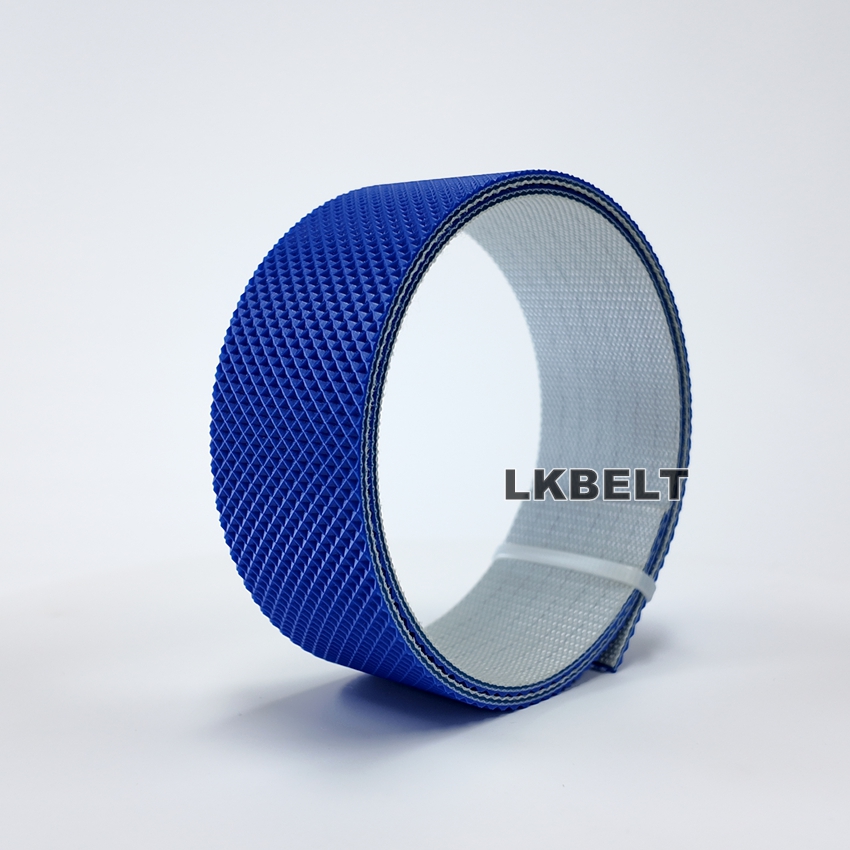
A diamond-pattern belt has raised shapes that alter product contact compared with a flat surface. The pattern can support traction with particular products, but its behavior depends on relief height, spacing, compound, loading and contamination. Raised geometry also changes the effective contact interface and can affect transfers, small product stability and contact marking. LKBELT publishes PB22-TA18-B, a black diamond-pattern PVC belt with a fabric underside. Its product page asks for finished width, length, total thickness and pattern height, and includes photographs of surface, underside and edge. These are useful dimensions to transfer into a replacement drawing rather than ordering by “black diamond belt” alone. A separate PB22N-TA18-FDA blue diamond-pattern PVC model is also shown publicly. Its suffix and colour do not independently establish food-contact approval. The supplier must provide the relevant food-contact declaration and supporting documentation covering the actual belt construction and intended temperature, food and use conditions, if applicable; do not infer compliance from the model suffix. Do not copy specifications from a generic pattern-belt range table onto a separately photographed sample. LKBELT’s product pages distinguish model references from adjacent range rows. Confirm the named model and finished build for the order.
Fishbone or Herringbone Belt Patterns
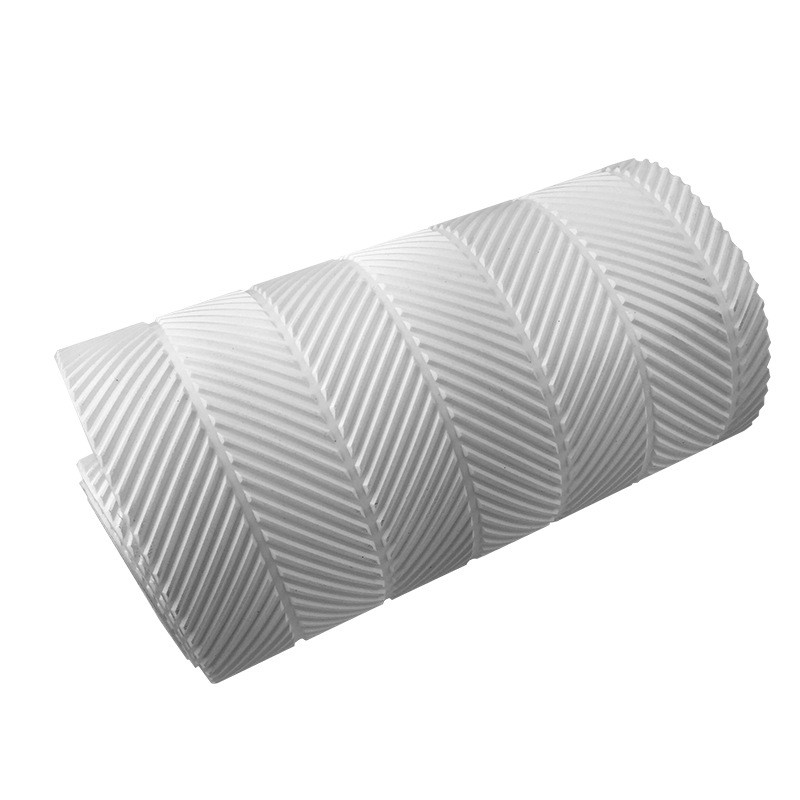
A fishbone or herringbone pattern typically uses diagonal ribs that repeat across the carrying face. Its shape and orientation can matter when a belt conveys flexible packages, soft goods or other products that may interact differently with longitudinal and diagonal relief. A direction-sensitive pattern should be specified with an unambiguous running-direction reference. LKBELT’s PVC fishbone-pattern conveyor belt shows white PVC with raised diagonal ribs. Its public replacement guidance calls for rib height, spacing, angle and pattern direction, plus the finished size and machine arrangement. A purchase request that says only “white fishbone belt” therefore leaves several material dimensions unresolved. Pattern direction and production orientation are especially important if a conveyor reverses. A layout that works in one direction may not release the product the same way on reversal. This does not mean every herringbone belt is one-directional; it means the actual profile and duty must be checked rather than assumed.
Sawtooth and Other Embossed Profiles
LKBELT’s PVC sawtooth-pattern belt uses a raised repeating pattern. The published product guidance emphasizes profile height, spacing, direction and belt edge. An aggressive pattern may help a particular item remain engaged during starts or incline motion, but that does not establish suitability for every gradient, product or cleaning process. Deep textures can create other constraints. A small package might contact only a few raised peaks, wobble or leave marks. Product residues may lodge in recesses and require different cleaning validation. The joint may interrupt pattern continuity and create a local contact change at each revolution. A rough-top label itself is not a precise material specification. Industrial technical guides differentiate rough, lattice, diagonal, rhomboid and other designs. Do not assign a universal coefficient of friction, slope rating or lifetime advantage to a named pattern without product-specific data.

When Pattern Selection Should Be Tested, Not Guessed
A replacement proposal is ready for approval only when the buyer and supplier agree how it will be evaluated. A simple comparison can use the existing belt as the control, with the candidate tested on representative products and identical machine conditions. Record the following in the trial report:
| Trial item | Comparable observation | Acceptance belongs to |
|---|---|---|
| Grip during acceleration/incline | Product stays positioned or shifts relative to the moving belt | Equipment owner’s actual line requirement |
| Release at discharge | Product transfers without unplanned carryback or snagging | OEM/maintenance test plan |
| Product quality | Surface marks, deformation, damage or unwanted rotation | Buyer’s product-quality limits |
| Line integration | Belt/roller clearance, splice passage and tracking | OEM-approved assembly geometry |
| Cleanability where relevant | Residue accumulation and ability to complete the approved cleaning procedure | Site sanitation and compliance requirements |
Do not invent a maximum conveyor incline, coefficient of friction or pass percentage to fill the table. The selected pattern should be the one that passes the application’s agreed trial without creating new release, quality or machine-fit problems.
Conveyor Belt Surface Selection Matrix
| Handling condition | Surface to assess | Why it might help | Critical check before approval | |—|—|—|—| | Horizontal cartons with controlled accumulation | Smooth or suitable light texture | May permit predictable stop-and-release | Actual package scuffing and back pressure | | Cartons sliding on a modest incline | Tested textured/diamond pattern | Raised geometry may improve grip | Package stability, incline, start/stop and contamination | | Flexible or soft packages | Smooth or carefully selected ribbed surface | Contact and release may differ | Product impressions, snagging, discharge behavior | | Direction-sensitive processing | Herringbone or other oriented pattern | Rib orientation interacts with movement | Running direction and reverse-duty approval | | Repetitive slip under acceleration | Appropriate grip surface | Increased engagement may address slip | Diagnose whether the issue is belt-to-product or belt-to-drive | | Frequent washdown or residue | Cleanable verified construction | Reduce hard-to-reach surface features where needed | Surface, joint and complete cleaning documentation | | Small transfer or tight return route | Thin, flexible compatible construction | May permit required bending | Pattern height, splice thickness and minimum pulley | This matrix establishes candidate testing logic. It is not a manufacturer’s universal application chart.
Do Not Confuse Product Slip With Drive Slip
A conveyor may display two quite different kinds of slip. Product slip occurs when a carton or other load moves relative to the top carrying face. Drive slip occurs when the conveying belt does not move correctly with its driven pulley. Changing the top surface may influence product grip but might do nothing for a drive traction problem underneath. Maintenance should identify the event before choosing a pattern. Note whether the belt moves at the commanded speed, whether only the load slides, and whether the symptom occurs at startup, during incline operation or at discharge. The conveyor belt drive types guide explains why the belt-to-drive contact surface depends on the installed layout. The chosen texture must then be checked with the belt’s underside and actual pulley route. A thicker raised carrying face can change clearance around narrow transfers; the splice may be locally thicker than the belt body. A surface pattern alone does not resolve the finished assembly’s flexibility or tracking requirements.
How to Specify Pattern Geometry in a Replacement Order
Provide a dimensioned cross section or clear sample photographs. Record the base-belt thickness separately from the total thickness including raised features, and define exactly where each measurement is taken. State the pattern height, rib or peak pitch, spacing, orientation and required coverage across the belt width. If there is a plain-edge margin, show that in the drawing. The width and finished circumference must use the supplier’s agreed measurement basis. Record the original joint type, local thickness, whether pattern continuity at the splice matters, and any plain sections needed for attached profiles or tracking guides. Add the smallest contacted pulley diameter, support arrangement, installed transfer gap and take-up position. A product sample is often the best way to verify grip and release. If testing is required, agree what products, speeds, inclines, clean/dirty states, starts and stops represent the actual line. Document the pass/fail criteria rather than relying on a subjective statement that one belt “feels grippier.”
Two Practical Industrial Examples
Scenario A — Cartons sliding on an incline
A parcel-handling conveyor uses a smooth PVC belt and sometimes loses lightweight cartons during acceleration. Purchasing receives a quote for a raised diamond-pattern replacement. Before selecting the alternate, maintenance checks that the conveying belt itself is moving correctly and that the load is sliding on its top face. The engineering team then trials representative cartons, including the lightest, most flexible and most heavily loaded. It checks grip during startup, holding during travel, discharge behavior and whether the new pattern introduces marking. The alternate must also meet the existing pulley and joint specifications. If it passes the agreed trial, the chosen model and profile dimensions become part of the repeat-order record.
Scenario B — Replacing a herringbone belt on packaging equipment
A packaging plant needs an urgent replacement for a white fishbone-pattern belt. The supplier is given width and overall thickness, but not the rib direction or original joint photograph. The purchasing team obtains an existing-sample photo with a machine-side arrow and records rib height, pitch and orientation. It also provides a view of the running side and available installation access. The supplier can now quote a documented finished construction. If it proposes a different surface orientation or pattern, that difference remains subject to approval rather than being silently accepted as “same white belt.” Both are hypothetical examples, not LKBELT customer performance claims.
A Practical Surface-Pattern RFQ
Ask buyers to send the belt’s original code and sample photographs; finished loop length, width and tolerances; face/underside construction; pattern name, height, spacing and direction; joint; smallest roller; product size and packaging material; incline; speed and acceleration; accumulation or transfer conditions; exposure, cleaning and test requirements; quantity and approved deviations. If several candidate patterns are available, label them by their actual model and documented surface geometry, not an unqualified marketing description. Keep the approved first sample and its drawing revision for repeat purchasing. The LKBELT PVC pattern-belt product range demonstrates why named models and other range references must remain distinct.
Frequently Asked Questions
Is rough-top always better than smooth top on a conveyor?
No. It can improve engagement for some products but hinder accumulation, release, cleaning or gentle handling in others. Test the actual application.
Does diamond-pattern PVC have a standard incline rating?
Not a universal one. Actual load, pattern geometry, contamination, drive and machine operating conditions determine performance.
Can I replace a fishbone belt with a diamond belt of the same dimensions?
Only after reviewing product behavior, orientation, underside, joint, equipment geometry and an approved trial where needed.
Does belt colour establish its material or food compliance?
No. Verify the named construction and documentation for the intended market and use. A product code suffix alone is insufficient.
What measurements matter besides width and length?
Total thickness, base thickness, pattern height and pitch, direction, joint profile, underside and pulley constraints are common critical details.
Conclusion
A conveyor belt surface pattern is a functional specification, not just a cosmetic choice. Smooth, diamond, fishbone and sawtooth finishes should be compared against real product grip, release, handling damage, cleaning and belt-path constraints. Share the original sample, pattern geometry, machine drawing and operating duty with LKBELT so a proposed finished belt can be assessed and its approved replacement specification retained for future orders.