
An obsolete V-belt part number can stop a packaging line even when another supplier lists a seemingly identical belt. Cross-reference tables make searching easier, but an equivalent designation is not automatically an approved substitute. Two candidates may share a nominal section and still differ in length convention, sidewall construction or the duty for which the drive was designed. A V-belt cross reference is a starting point, not a fit or power-rating certificate: verify section and groove geometry, the exact length reference, construction, duty and approval status before ordering. The safest comparison begins with the original part number and machine record, checks the proposed belt against the sheave system, and records any deviation for approval. This guide focuses on the purchasing decision after a possible cross-reference has been found—not on reproducing another V-belt size chart.
What Does a V-Belt Cross Reference Actually Prove?
A cross-reference maps a manufacturer’s designation to one or more potentially corresponding designations. Depending on the source, the match may reflect a nominal section, catalogue length or an advertised aftermarket equivalent. It may not certify that the belt has the same cord construction, tolerances, installation tension, matched-set classification or duty limits. For example, a maintenance file may name a particular wrapped classical belt, while a supplier offers a raw-edge cogged belt with a similar letter-and-number code. The two constructions can require different tensioning and drive review even when the nominal section appears similar. The question is not whether the alternate marking looks plausible; it is which characteristics the cross-reference verified and which remain unverified. A seller may publish an unconditional-looking fit claim; the purchasing file still needs to distinguish a catalogue match from a tested drive-specific approval. Texas Belting publishes a Bando-focused belt cross-reference guide, and its V-belt product pages discuss family-based matching. These are brand-oriented reference aids, not universal fit approvals. Treat such supplier mappings as useful leads rather than universal compatibility approvals. For background on section dimensions and inside, outside, datum and effective length, see LKBELT’s separate industrial V-belt size chart. This article addresses the next stage: accepting or rejecting a proposed replacement.
Start With the Original Drive, Not the Substitute Catalogue
Recover the strongest available identifier: OEM drawing, maintenance bill of materials, original purchase invoice, complete belt marking, pulley details or approved replacement history. Photograph the old belt before cleaning the markings, and preserve the exact spaces, slashes and suffixes rather than rewriting them into a guessed code. If a designation is partly missing, mark its uncertainty. A measured, worn belt is secondary evidence. Sidewalls lose material; a belt removed after overheating or stretching may no longer represent its catalogue dimensions. LKBELT’s guide on identifying V-belt families explains the construction categories, while the proposed cross-brand match must remain tied to the actual drive. For each replacement inquiry, state whether the machine requires an exact designated replacement, a supplier-suggested equivalent subject to approval, or a redesign of the drive. Those are different procurement instructions. A seller may be able to quote an alternate belt, but the responsible equipment party must approve a change that affects system performance.
Check the Four Layers of Equivalence
1. Section family and sheave groove
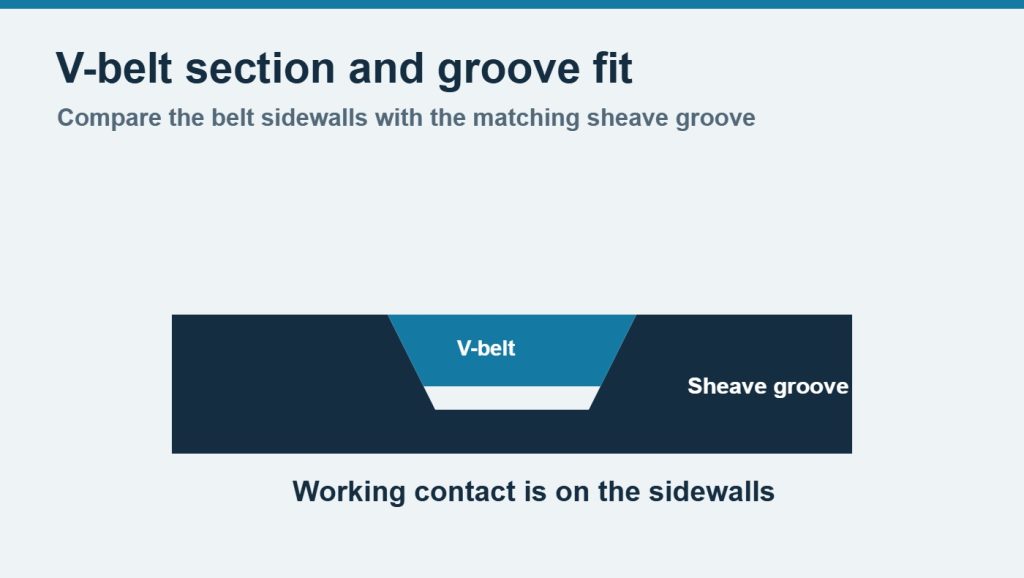
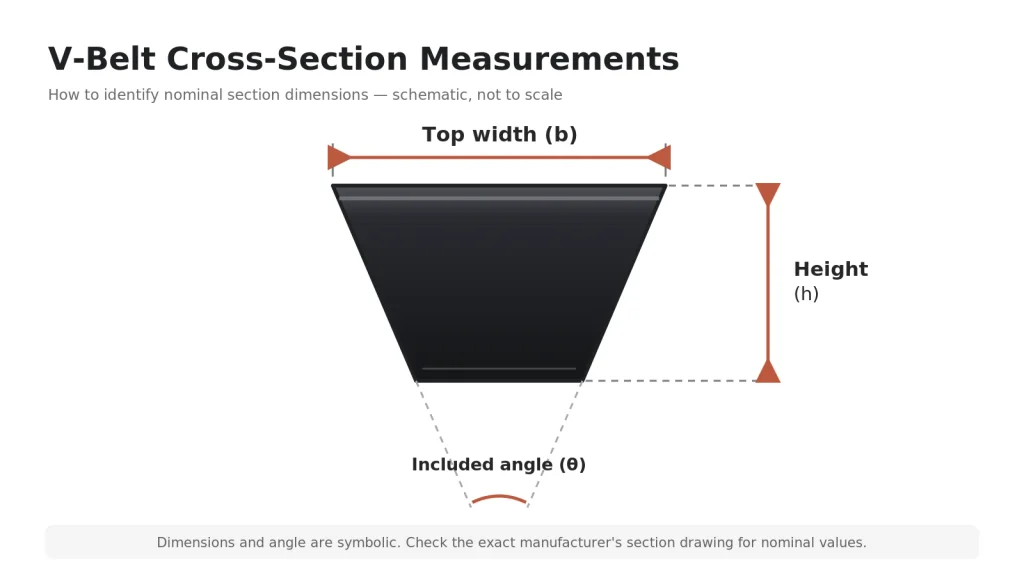
A classical A/B/C profile, a narrow wedge profile such as SPA/SPB, and a US 3V/5V profile are not interchangeable label systems. Similar nominal top widths do not prove an identical working geometry or groove fit. Verify the manufacturer-specific section drawing, pulley groove dimensions and wear condition, particularly when the original machine uses an older standard. The belt should contact the intended flanks of the sheave rather than bottoming in the groove or riding at an abnormal height. Qualified maintenance personnel should inspect the sheaves and confirm the applicable equipment limits; no conclusion about fit should be based on photographs of loose belts alone.
2. Length value and reference system
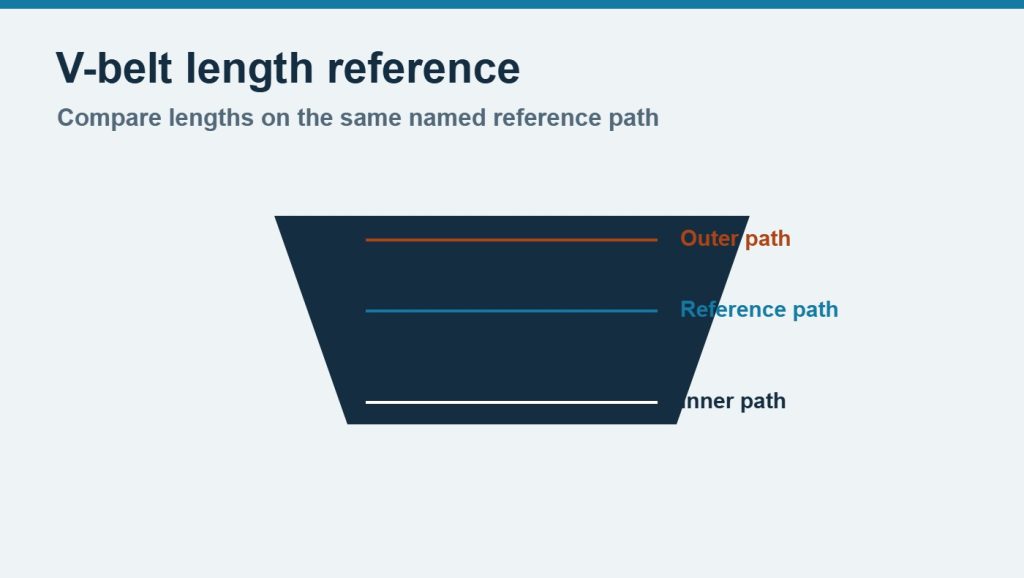
The length field may express inside circumference, outside circumference, pitch/datum length or effective length. Never subtract a universal correction from one number to invent another. A conversion that is documented for one named family may not work for another. Ask the supplier to show the original and proposed lengths on the same defined measurement basis. An apparently near-matching length may create an installation problem when the motor adjustment is already at one end of its travel. Record center distance, available take-up and the OEM installation allowance. Those details can rule out a replacement before any performance calculation is attempted.
3. Construction and working surfaces
Wrapped and raw-edge constructions, molded-notched versions, banded belts, link belts and other configurations need separate attention. The driving surfaces, tensile member and flexibility may differ even where section dimensions overlap. A raw-edge cogged alternative is not just a wrapped belt with the same printed number. LKBELT’s published V-belt profile information distinguishes its HM, AX, BX, CX, DX and EX raw-edge section references. For instance, AX is listed at 13 × 8 mm and BX at 17 × 11 mm; these are dimensions of named LKBELT sections, not a declaration that every third-party A or B belt is a drop-in equivalent. Confirm the actual LKBELT product, finished length and supply availability with the team.
4. Duty, matching and installation
Record motor rating, driver/driven speeds, pulley diameters, starts per hour, shock loading, ambient conditions and contamination. Multiple-belt drives add the question of length matching and load sharing. An alternate may be acceptable for a lightly loaded intermittent drive and unsuitable for a drive near its operating limit. Manufacturer-specific belt catalogues may use different symbols to denote construction, nominal length and matched-set status. Read the decoding notes for the exact named series rather than transferring a third-party numbering rule onto LKBELT or a different product family.
Three Evidence Levels Before You Approve an Equivalent
A brand-to-brand mapping may help narrow the search, but it should not jump directly into a purchase order. Assign each proposal to one of three levels:
- Catalogue candidate: a distributor or manufacturer associates two series or part numbers. Section, dimension basis and duty remain to be checked.
- Documented dimensional and construction match: the buyer has compared series drawings, length references, sidewall/cord construction and the target sheaves. Fit and operating approval still require review.
- Drive-approved substitute: the equipment owner or authorized engineer has accepted the differences against the actual drive duty and installation limits, with a recorded revision or supervised trial when necessary.
A supplier can quote a level-one candidate, but the customer should not label it a level-three approved alternative. A useful cross-reference worksheet keeps a separate evidence/source column and flags every blank as pending, rather than copying a competitor’s equivalence claim without context.
V-Belt Cross-Reference Approval Matrix
| Cross-reference claim | Evidence to request | Why a nominal match can fail | Decision owner | |—|—|—|—| | Same letter/section | Original and proposed section drawings; sheave inspection | Classical and narrow sections may differ | OEM or drive engineer | | Same printed length number | Both reference conventions and tolerances | The number may refer to Li, La, Ld or Le | Supplier plus equipment owner | | Same material description | Construction and cord/sidewall data | “Rubber” does not define the belt build | Supplier technical team | | Same belt count | Individual versus banded configuration; matching requirement | Several belts may not share load equally | Maintenance and engineer | | Fits the pulley | Groove geometry and usable adjustment | Worn or wrong sheaves defeat nominal fit | Maintenance | | Approved equivalent | Documented differences and controlled acceptance | Catalogue substitution is not an OEM authorization | Authorized approver | A useful procurement record lists a verified match, an unresolved question and the person responsible for each one. “Equivalent—confirmed” should not appear merely because two web listings share a number.
How to Evaluate a Supplier’s Proposed Equivalent
Request a side-by-side specification sheet identifying the original designation, proposed designation, manufacturer and product family, construction, section, measurement reference and recommended installation method. Require the supplier to mark every deviation explicitly—including changed material or treatment, tooth/notch form, banding, operating environment or compliance attributes. Separate fit verification from duty approval. A belt that enters the sheave groove is not necessarily rated to transmit the required power over the intended service cycle. Conversely, a belt that can transmit sufficient power on paper may be impossible to install within the available take-up range. A complete replacement decision addresses both. If original product documentation is unavailable, do not turn the cross-reference into an engineering certainty. Ask whether the equipment manufacturer can supply a drawing, whether the original supplier has a historical record, or whether a supervised sample trial is permitted. The unknowns should remain in the purchasing file rather than disappearing into an email exchange.
Two Practical Industrial Scenarios
Scenario A — Cross-brand replacement for a packaging drive
A packaging plant has the OEM designation and an old invoice for a wrapped V-belt. A new supplier proposes a raw-edge cogged alternative with a matching nominal section and a similar length number. Maintenance confirms that the motor has limited adjustment remaining. The purchasing team first asks which length basis each catalogue uses. The technical team checks the sheave profile, condition and remaining take-up. It then examines the change of construction, tensioning instructions and drive duty. If the documents and equipment limits support the change, an approved controlled replacement can proceed. Otherwise the offer remains a candidate rather than a verified substitute. The crucial result is preventing a plausible catalogue match from becoming an unauthorized machine change.
Scenario B — Four-belt fan drive with mixed replacements
A maintenance crew finds two damaged belts on a multi-groove fan drive. Purchasing has an equivalent belt code but proposes ordering only two new belts and keeping the two older ones. The equipment team must check the drive maker’s rules on matched sets, pulley wear and replacement practice. Mixing belts with different wear histories or nominal matching classes can lead to uneven load sharing. The cross-reference must therefore specify the number of individual belts, matched-set requirement and whether a banded design is involved. A supplier quotation for a single equivalent part number is not enough to approve the repair strategy. Both examples are hypothetical, not customer case studies or claims about a particular LKBELT installation.
What Should an Industrial V-Belt Cross-Reference RFQ Include?
Send the supplier a concise, traceable package:
- Original identification: exact manufacturer code, complete belt marking, machine reference and document revision.
- Candidate mapping: proposed manufacturer’s code, product family, source of the cross-reference and any claimed equivalence.
- Geometry: section, length and reference convention, pulley-groove information, center distance and adjustment range.
- Construction: wrapped/raw-edge, cogged or smooth, banded or individual, reinforcement where documented.
- Service conditions: driver and driven speeds, load pattern, starts/stops, environment, belt count and maintenance history.
- Approval status: original part, proposed alternate, whether each equivalence claim is catalogue-only or verified, trial requirement, authorized sign-off and quotation quantity.
- Quote comparison: ask suppliers to state which dimensions/ratings are documented, which remain unknown, and whether any pulley or installation change is required. Where the original or proposed belt is not fully defined, ask the supplier to identify what cannot yet be confirmed. Good purchasing information reduces avoidable re-quoting and supports repeat orders without confusing an unapproved substitute with the original design.
Frequently Asked Questions
Does a cross-reference chart guarantee interchangeability?
No. It identifies possible corresponding designations. Verify section, length convention, construction and drive duty before approval.
Can an AX belt replace every A-section belt?
No. Profile similarity alone does not authorize a construction change. Confirm pulley geometry, operating conditions and the manufacturer-specific replacement guidance.
Do SPB and B represent the same V-belt?
No. They are labels from different profile systems. Compare defined section and groove geometry rather than the letter or approximate width.
Why does a belt with the same length number not fit?
The numbers may use different length references, or the machine may have insufficient take-up. The nominal belt family may also differ.
Should all belts in a multiple-belt drive be replaced together?
Follow the OEM and belt manufacturer’s matching and service instructions. The correct decision depends on the installed design and approved practice.
Conclusion
A V-belt cross reference is a search tool, not a substitute for a verified engineering specification. Keep the original part code intact, compare length references and construction, inspect the sheaves and make deviations explicit. Buyers seeking an LKBELT alternative can submit the complete belt marking, sheave details, service duty and quantity for a documented technical review before repeat ordering.