
A replacement round belt can match the old cord diameter and still sit poorly in the groove, slip under load or strike a guide each time the weld passes. Before ordering another belt, compare the original cord, finished loop and pulley path with the proposed replacement.
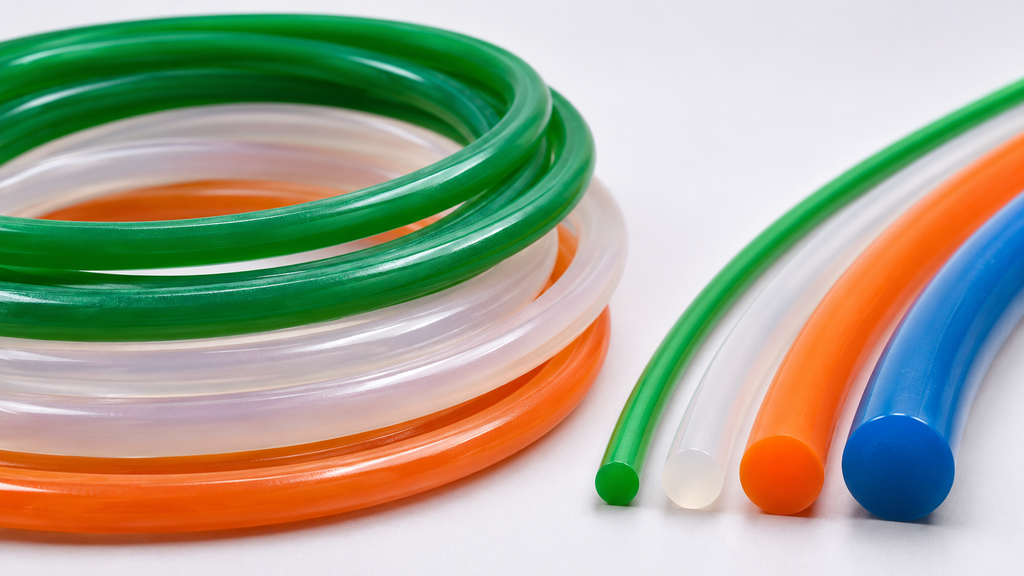
A PU round belt is a circular polyurethane cord used in a friction drive. For a replacement, verify the cord diameter and tolerance, material grade, hardness, surface finish and finished loop length. Check the pulley grooves, bending path and required installation conditions, then confirm the joining method for that exact cord.
What Is a PU Round Belt?
PU is short for polyurethane, a family of materials. TPU is thermoplastic polyurethane, one part of that family. A belt sold as a PU round belt can therefore also be a TPU round belt. The grade and construction are the details that help determine whether the cord can be welded and how it behaves on the machine.
The pulley moves the cord through friction at the groove contact. The driven pulley receives motion through the same principle. This differs from a synchronous drive, which transfers motion through tooth engagement. A V-belt also relies on friction, but its profile is designed to engage a compatible V-groove. Confirm the original profile before treating another friction belt as a substitute. Types of industrial V-belts
Round belts can serve packaging transfers, light roller drives and selected paper, textile or automation mechanisms. Check the actual duty. For example, a paper transfer may require stable contact through starts and stops, while a textile machine may expose the cord and groove to lint. A round belt can also drive rollers beneath a separate conveying surface. Identify which function the belt performs before specifying its replacement. BEHAbelt round belt range
Which PU Round Belt Diameters Are Available?
LKBELT round-belt sizes
Our TPU round-belt range covers 2–20 mm diameters. Select the diameter and hardness together.
| Diameter (mm) | Hardness (Shore A) |
|---|---|
| 2, 2.5 | 95 |
| 3, 3.5, 4, 5, 6, 7, 8, 9, 10, 12, 15, 18, 20 | 90 |
State the required surface finish, diameter tolerance and finished loop length with your enquiry.
View round-belt specifications ›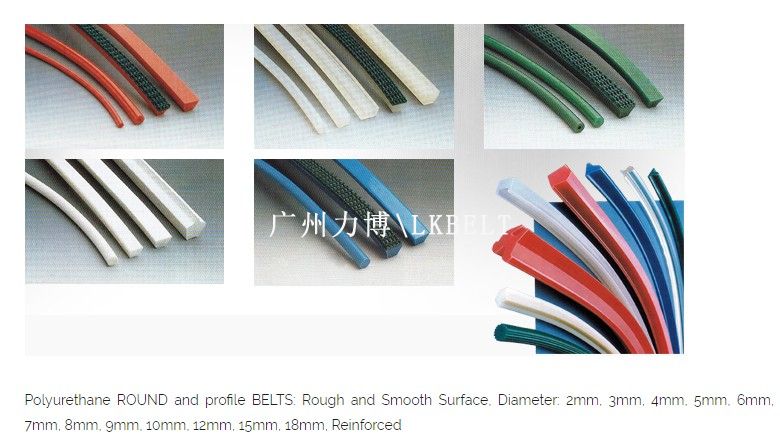
Start with the machine drawing or original part reference. If you have a removed sample, take readings across the circular section at several representative points away from the joint and any flattened areas. Use light measuring pressure to avoid compressing the cord. Record the range of readings and the sample condition. A worn section or an enlarged weld can give a misleading impression of the original size.
The groove also needs its own specification. Use the pulley drawing or an identified sample to show the groove profile and dimensions. Confirm where the cord should sit, which surfaces provide contact and whether there is clearance at groove transitions. Similar groove openings can have different depths and contact shapes. Matching the nominal cord diameter is the first check in a fit review.
How Do Hardness and Surface Finish Affect Selection?
Shore A describes indentation hardness. It gives the buyer one way to distinguish grades. Extension under load, friction at the pulley and repeated bending depend on the complete material and cord construction. A higher Shore A number provides no ranking for those outcomes by itself.
LKBELT’s published range describes smooth and rough finishes. Specify the finish the machine requires and ask for evidence relevant to the contact pair. On a roller drive, the cord meets the groove. Where the cord also touches conveyed material, check that second contact for grip, release or marking. Color and texture can help identify a sample for discussion. Confirm the grade from its marking or documentation.
A manufacturer may list different pulley and installation recommendations for different profiles in a single grade. BEHAbelt’s transparent smooth PU80A product page illustrates this by separating hardness, profile dimensions, recommended pulley diameters and pretension. Use the same fields to evaluate a proposed replacement against its own supplier data. BEHAbelt PU80A round belt technical data
How Should You Measure a PU Round Belt?
Write the length reference beside the number. A relaxed endless-loop measurement describes the completed loop off the machine. An installed measurement describes the belt in a tensioned state. The straight cord cut for fabrication is another dimension. The joining process and the supplier’s finishing method determine how the cut length relates to the completed loop.
If the original loop is available, identify whether it is new, used or damaged. Record the supplier’s required measuring reference, including the circumference basis and the condition under which it was measured. A used loop can retain changes from service. Preserve its reading as an observation and compare it with the original part specification. A broken or partly missing belt calls for more reliance on the drawing and machine geometry.
Send the center distance separately. It locates pulley axes and does not describe the route around the pulleys. Include all pulleys and idlers, the route and any take-up position that affects the path. If ordering cord by length for fabrication, state the quantity of straight cord. If ordering a welded loop, state the required finished length and reference. Ask the fabricator to determine the cut length under the approved joining process.
How Are PU Round Belts Joined?
Butt-end welding joins the prepared ends of a suitable thermoplastic cord face to face. For the LKBELT range described above, it is the listed method of making an endless loop. Select the joining method for the exact cord construction, the manufacturer-approved procedure and the application. BEHAbelt describes butt welding for its unreinforced profiles and overlap welding for its reinforced profiles. This distinction applies to the profiles covered by its guidance. For the cord you are ordering, confirm the approved method, equipment, preparation and handling with its supplier. BEHAbelt round belt joining guidance
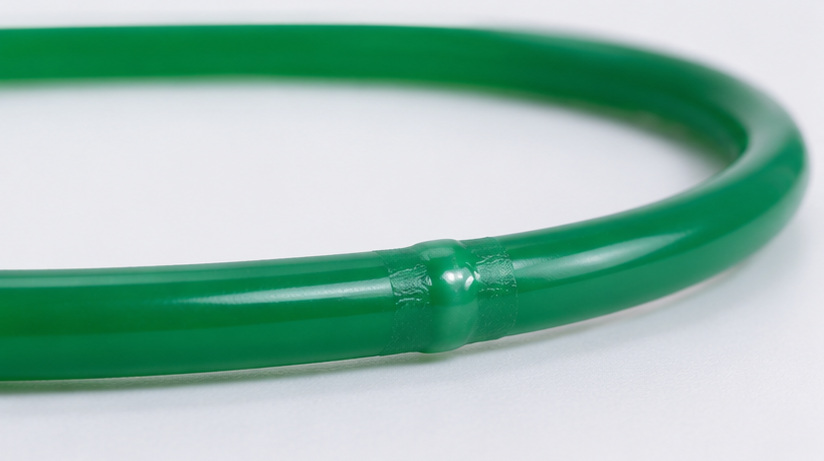
The ends must meet in alignment so the loop retains a consistent circular profile. An offset, abrupt step or oversized weld bead can interfere with a groove or guide. Let the joint cool and handle and finish it according to the approved process. Inspect the finished loop length, joint alignment and profile before installation. Confirm whether the joint is approved for the load and repeated bends in the route.
Appearance can reveal a mismatch at the joint. Mechanical acceptance depends on the approved process and the application’s requirements. If a used belt opens at the weld, retain the failed section. Compare its length reference and bend path, and note whether it failed during installation, after repeated cycles or following a change in load. That evidence gives the supplier a starting point for assessing both the joint and the drive.
What Pulley and Tension Details Matter?
Check groove shape and pulley diameter separately. The groove governs seating and contact. The route determines how tightly and how often the belt bends. Include the smallest pulley that the belt wraps, any reverse bend, the wrap arrangement and installation access. Ask for the limits that apply to the finished loop, including the joint. A cord may sit correctly in a groove and still face an unsuitable bend elsewhere. Conveyor components and belt compatibility
Initial installation stretch helps establish tension and frictional contact. LKBELT’s table lists a 1.5–3% stretching reference. Use the machine’s installation requirements and the supplier’s approved belt specification to establish the required loop length and setting. Shortening an existing order by a guessed percentage can create a new fit or load problem.
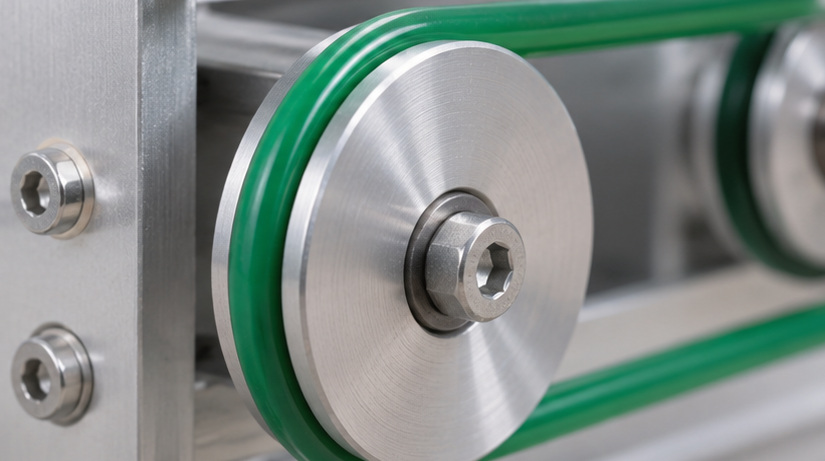
When a replacement slips, review the seated profile, contamination, pulley condition and alignment, installed tension and peak duty. A belt that slips at startup can have a different problem from one that slips after the groove becomes contaminated. Use the equipment’s approved safeguards for overload protection. Where several rollers share a drive, verify each contact and bend before approving the replacement.
PU Round Belt Selection Matrix
| Selection factor | What buyers should identify | Why it matters | What to verify |
|---|---|---|---|
| Diameter | Original nominal size and sample readings | Affects how the cord sits in the groove | Profile drawing, tolerance and wear at the measuring point |
| Grade and hardness | Exact formulation or model and Shore A value | Separates similar-looking cords with different properties | Offered grade and applicable bending and extension data |
| Surface finish | Smooth or rough and each contact surface | Affects groove contact and any product interaction | Representative duty, contamination and release requirements |
| Length | Relaxed finished loop or straight cord quantity | Defines what will be delivered and how it will fit | Circumference reference, measurement condition and tolerance |
| Pulley path | Groove, pulley diameters, centers and idlers | Governs seating, wrap and repeated bending | Complete route and approved limits for the finished loop |
| Joint | Cord construction and proposed joining process | Determines fit at the splice and suitability for repeated flexing | Alignment, finished profile and joint acceptance criteria |
| Operating duty | Speed, starts, peak load and exposure | Establishes the conditions the belt must handle | Machine requirements and supplier evidence for the exact grade |
Two Practical Industrial Selection Scenarios
Packaging machine replacement
Suppose a packaging transfer uses an unreinforced PU round loop between grooved pulleys. Two quotations show the same nominal diameter. One proposes a different hardness and surface, while the other gives a length without saying whether it is measured relaxed or installed.
Have both suppliers quote against the original pulley drawing and the same finished length reference. Ask the first supplier to document the proposed grade and finish for the groove contact and startup duty. Ask the second to confirm the delivered loop length and measurement condition. If the previous loop marked a guide at the weld, include the guide clearance and joint profile in the acceptance checks.
Multi-roller textile equipment
Suppose a textile machine has several round-belt-driven rollers. The route includes a small wrapped pulley and an idler that bends the belt in the opposite direction. The maintenance team has also recorded lint collecting at one groove.
Send the routing drawing and identify the affected groove, speed, loads and operating cycle. Check whether the proposed grade and joint are approved for the tightest bend and reversal. Inspect the contamination and contact conditions under the machine’s service procedure. An equivalent diameter gives purchasing a starting point. The route and duty determine which candidate needs further evidence before approval.
What Should Buyers Provide Before Ordering?
Use the original part number or sample to anchor the inquiry. Record observations separately from the specifications the replacement must meet.
- Machine model, installation position and application.
- Original belt reference, cord diameter and tolerance, grade and Shore A hardness if known, and surface finish.
- Required relaxed finished-loop length and reference, or the required quantity and length of straight cord.
- Pulley groove profile and dimensions, pulley diameters, center distances, routing and installation access.
- Speed, load, starts and stops, temperature, contamination and chemical exposure.
- Supply form, approved joining requirements, joint clearance and quantity of finished loops where applicable.
- Photographs of the cord, joint and pulley, plus available drawings and the machine’s installation specification.
When a supplier proposes a substitution, ask for the changed fields and the data that support the offered construction. Check the documented size and hardness pairings before specifying an LKBELT cord.
Frequently Asked Questions
What is the difference between a PU round belt and a TPU round belt?
PU names the polyurethane family. TPU identifies its thermoplastic subset. Ask for the exact grade and profile when ordering.
How do I choose the correct round-belt diameter?
Use the original specification and pulley groove drawing. Compare measurements from a removed sample and account for wear or distortion.
Can polyurethane round belts be welded?
Suitable thermoplastic grades can be joined with an approved process. Confirm the construction and joining method for the exact belt.
Does a rough PU round belt always provide better grip?
Grip depends on both contact surfaces, the material, loading and contamination. Evaluate the finish for the actual groove and product contact.
Why does a replacement round belt slip or fail at the joint?
Review groove fit, the length reference, installed tension, duty and bending path. Inspect joint alignment and retain the failed section for assessment.
Conclusion
Approve the diameter, grade and finish together with the groove fit, finished loop length and joining requirements. Confirm the installed conditions against the machine documentation before releasing the replacement specification.
For an LKBELT quotation, send the cord diameter, finished length and reference, pulley arrangement, joint requirements and operating details. Contact LKBELT for a round belt quotation