
A torn belt can stop production while leaving maintenance teams with an uncertain choice: repair the damage, make a new joint, or order a replacement. Acting on appearance alone can overlook damaged reinforcement or create another shutdown.
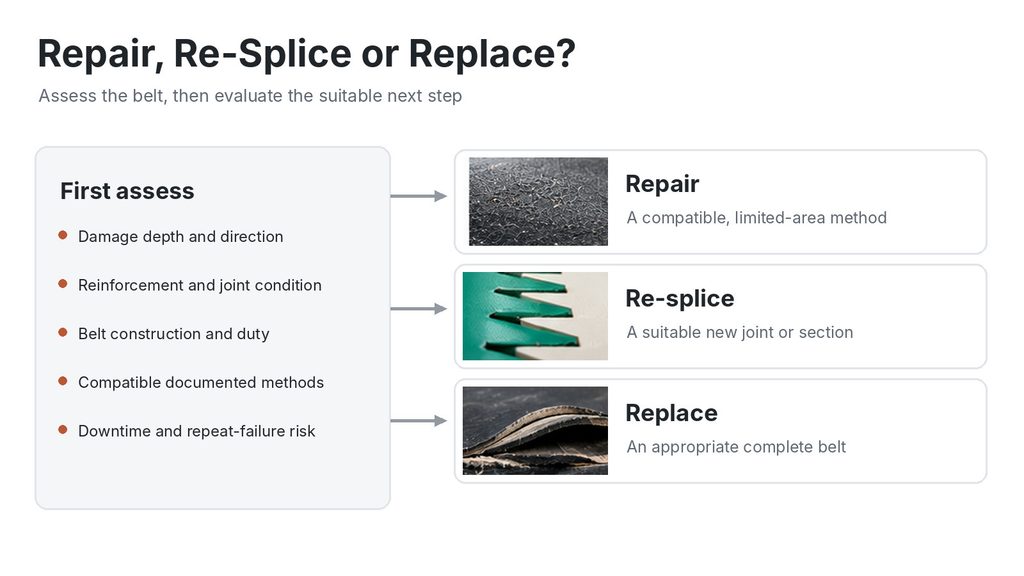
Conveyor belt repair suitability depends on damage depth, direction, location, belt construction, reinforcement condition, and joint integrity. A compatible local repair may address limited damage, while a failed splice or damaged section may require re-splicing. Extensive structural deterioration, unsuitable repair options, or unacceptable operating risk can make replacement the better decision.
First identify what carries the belt tension and whether that structure remains serviceable. Then compare suitable methods, downtime, and the consequences of another failure.
What Types of Conveyor Belt Damage Need Attention?
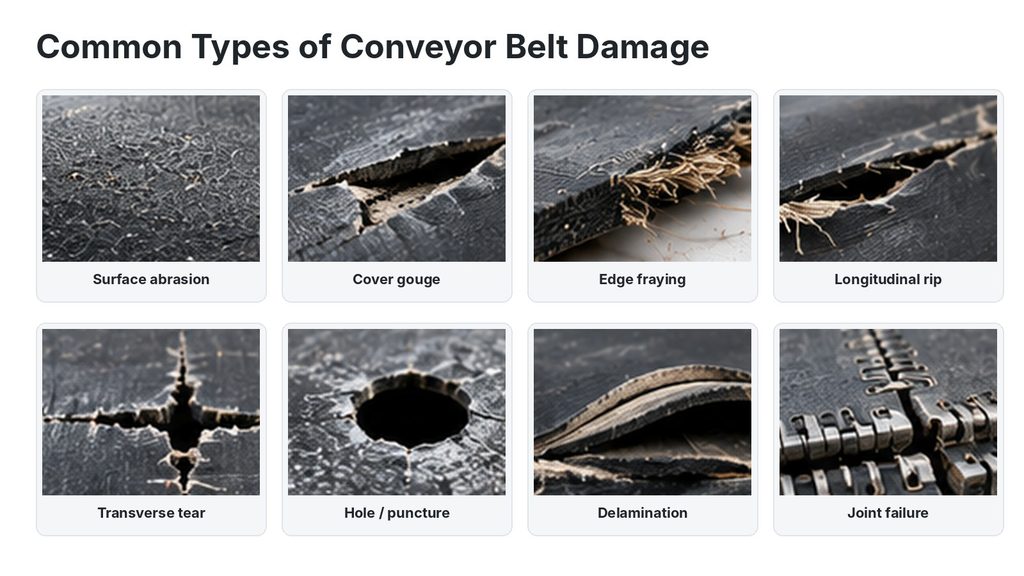
Surface abrasion and cover gouges affect the product-contact or running surface. Their significance depends on depth and location: a shallow mark and a cut exposing reinforcement are different findings. Even limited cover damage can matter where cleaning or product contact is critical.
Edge fraying may involve loose coating, exposed fabric, or damage extending into the tension member. Record which edge is affected, how far the damage extends, and whether it repeats along the belt. Do not assume cutting away visible frays resolves the underlying cause.
Longitudinal rips run mainly along the belt; transverse tears run across it. Crosswise damage can interrupt the tensile load path, while lengthwise damage can still spread or snag. A hole or puncture may affect both cover and reinforcement, so diameter alone cannot determine repairability.
Delamination is separation between bonded layers. Look for lifting, blisters, or separation near edges and joints, without treating those appearances as a complete diagnosis. Joint failure can include separating fingers, lifting overlaps, or damaged mechanical lacing.
Record dimensions, direction, position, visible depth, exposed fabric or cords, and proximity to the splice or attachments. Photograph both faces and the edges with a scale. Hidden reinforcement damage cannot be ruled out from photographs alone.
Before close inspection, isolate hazardous energy and follow the equipment’s procedures. OSHA 29 CFR 1910.147 addresses covered servicing in US workplaces; other jurisdictions have their own requirements. A stopped control switch alone is not an energy-isolation procedure.
When Can a Damaged Conveyor Belt Be Repaired?
A repair is a candidate when the damage is understood, sound surrounding material can support the proposed repair, and a documented method suits the belt and its application. The assessment must consider how the repaired area will carry tension, bend, track, and contact the product.
Establish the belt’s exact construction before choosing consumables or equipment; the guide to conveyor belt materials and constructions explains those distinctions. A rubber cover, thermoplastic coating, textile reinforcement, and steel cords create different repair requirements. “Conveyor belt glue” is not a specification for a compatible repair system.
The NIBA Conveyor Belt Repair Options technical note discusses a 25%-of-width rule of thumb for transverse or diagonal injuries in bulk-materials conveying. It is not a universal repair threshold or permission to keep running. A smaller damaged area in a light-duty PVC/PU belt can still compromise reinforcement, a critical joint, or hygienic suitability.
Repairability also differs from permission to restart. The responsible maintenance personnel need to assess the finished repair and the conveyor before release, using applicable belt, equipment, and repair-system guidance.
Three Observed Conditions: What to Check Next
For limited surface wear with no visible reinforcement exposure, consider a hypothetical belt with a shallow worn patch. Record its extent, remaining cover condition, location, and product-contact requirements. Further inspection must establish whether the wear is confined to the surface; the absence of exposed fabric does not prove an intact tension member.
For a failed joint or visible reinforcement damage, assess a hypothetical separating splice or cut with exposed fibers. Competent personnel need to determine the extent of damage, available sound material, and whether an approved structural repair or re-splice is feasible. Reclosing the visible gap alone does not settle that assessment.
For widespread delamination or repeated repair failure, consider separation at several positions or a repeatedly reopening repair. Review the whole loop and failure cause with the belt manufacturer or a suitable specialist. Replacement deserves evaluation alongside any supported repair option. These examples identify inspection priorities, not repair approvals or permission to restart.
Which Conveyor Belt Repair Methods Are Available?
Local repair treats a limited area. Re-splicing prepares and joins belt ends, sometimes after removing damage or inserting a replacement section. Complete replacement renews the loop. These actions solve different problems and should not be priced as equivalent work.
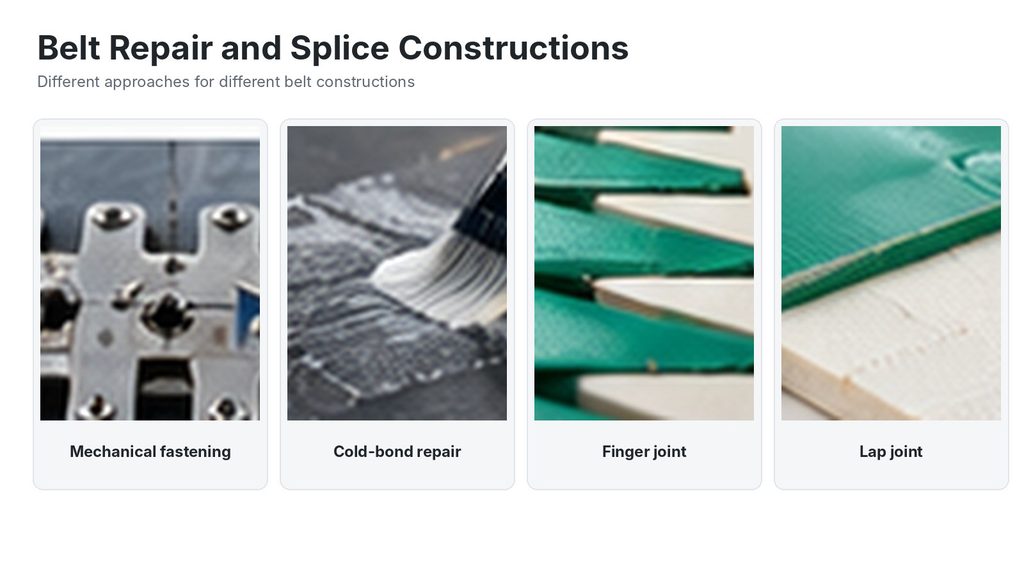
Flexco’s rubber-belt repair overview describes mechanical systems, rubber repair strips, vulcanized repair, cold bonding, and cutting out damage. Its proprietary systems illustrate available approaches; their instructions and suitability must remain tied to the specified belts and products.
| Repair approach | Typical purpose | Applicable belt considerations | Main limitations | What must be verified |
|---|---|---|---|---|
| Local patch or cover repair | Restore a limited surface area | Compatible cover, substrate and repair material | Does not by itself restore severed reinforcement | Depth, bond compatibility, bending and contact requirements |
| Mechanical repair or fastening | Bridge suitable damage or join prepared ends | Fastener design, belt thickness and reinforcement | May introduce a raised or discontinuous area | System rating, pulley diameter, clearance and product contact |
| Hot vulcanized repair | Repair suitable rubber constructions | Compound, carcass or cords and repair design | Needs appropriate equipment, preparation and controlled conditions | Manufacturer procedure, structural extent and qualified personnel |
| Hot-press joining | Form an endless splice in suitable constructions | Belt layers, end preparation and joining system | Not interchangeable with a rubber repair recipe | Belt-specific procedure, joint flexibility and finished geometry |
| Cold-bond repair | Bond compatible repair material to local damage | Repair compound, cover and substrate | Bonding and cure are system-specific; not a universal structural repair | Approved repair system, preparation, cure and service conditions |
| Cold-press splicing | Join prepared belt ends using a specified cold-press method | Compatible belt and splice design | Forbo identifies strength and flexibility limitations for its cold-pressed wedge/overlap splices | Belt-specific instructions, end preparation, joint geometry and duty |
| Remove damage and re-splice | Eliminate a failed joint or damaged section | Sound remaining belt and compatible joining method | Changes length or adds joints when inserting a section | Finished length, take-up travel, section compatibility and splice layout |
Cold-bond repair and cold-press splicing describe different work. Flexco discusses cold bonding for rubber cover gouges and surface damage; Forbo describes cold-pressed wedge or overlap joints between prepared ends in relevant Transilon constructions. Neither term defines a universal adhesive or makes the methods interchangeable.
The table identifies questions for technical assessment, not installation instructions. Heat, pressure, adhesive choice, and curing conditions require the exact product procedure.
How Does Repair Differ Between Rubber and PVC/PU Conveyor Belts?
Heavy Rubber and Steel-Cord Belts
In a textile-reinforced rubber belt, distinguish cover loss from damage to the load-carrying carcass. A repair suitable for a cover gouge does not automatically address cut plies. In a steel-cord belt, cord condition and the repair’s ability to transfer load require specialist assessment; closing the visible opening is insufficient.
Heavy-duty mechanical repair systems and rubber patches are designed around particular thicknesses, constructions, and service conditions. They should not be selected for a thin coated-fabric belt merely because the visible tear looks similar.
Light-Duty Coated-Fabric Belts
For PVC or PU fabric belts, coating, reinforcement, underside, and splice all contribute to operation. A repair can alter local thickness or flexibility and interfere with a small transfer, slider bed, scraper, or product-contact surface.
Forbo Transilon Technical Information 1, printed pages 8–9, relates joining choices to belt type, application, and flexibility. It also requires consideration of both belt and fastener minimum pulley diameters. These are Transilon references, not repair approvals for every LKBELT belt.
Hot pressing a compatible thermoplastic joint is not the same process as vulcanizing a rubber repair. Likewise, PVC conveyor belt repair and PU conveyor belt repair need the actual construction and approved joining materials, not a shared generic temperature or adhesive.
Food-contact duties add another decision: can the damaged or repaired area meet the required cleanability and product-contact conditions? A structurally plausible patch may still be unacceptable for that use. Obtain application-specific confirmation rather than assume a polymer name establishes hygienic suitability.
For modular plastic belts, replacement of damaged modules or sections is a different structural operation from patching a continuous belt. Check the exact module series, rods, adjacent damage, and manufacturer’s replacement instructions.
When Should a Conveyor Belt Be Re-Spliced or Replaced?
Re-splicing may be considered when the failure is concentrated at a joint or removable section and sufficient sound belt remains for the proposed preparation. Cutting out damage and reconnecting the ends shortens the loop; confirm that the finished length and available take-up still work.
Inserting a compatible section retains or restores length differently, but creates additional joints. The inserted material and each splice need suitable construction, geometry, and operating compatibility. Section replacement is not the same decision as installing a new complete belt.
Replacement deserves stronger consideration with extensive reinforcement damage, widespread delamination, repeated repair failures, or damage that prevents reliable tracking or acceptable product contact. It may also be appropriate when no supported repair method is available for the construction.
Assess the remaining belt, not only the proposed repair location. Renewing one joint cannot resolve deterioration distributed throughout the loop. Repeated edge damage also calls for checking alignment, loading, clearances, and the cause of contact before installing another belt. The conveyor component compatibility guide explains the relevant machine-to-belt relationships.
Finger Joints, Lap Joints and Replacement Compatibility
LKBELT’s joining information includes finger joints, with interlocking finger-cut ends, and lap joints, with prepared overlapping ends. These describe joint constructions; neither is a universal treatment for damaged belting.
For re-splicing, the selected method must suit the base belt, sound material available for preparation, finished thickness, and bending path. A joint that survives on a large pulley may not be suitable for a small transfer. The underside must also remain compatible with the conveyor support.
Provide the existing joint type and photographs, finished belt thickness, and pulley arrangement when requesting a replacement. Also explain installation access: can a complete endless loop be fitted, or must the ends be joined after the belt is routed through the machine? These details help define the required supply form and joint construction.
The Forbo technical FAQ similarly treats strength, flexibility, and installation access as joining considerations for its own range. Use such distinctions to frame the questions, then obtain the procedure for the exact belt.
Conveyor Belt Repair vs Replacement: What Should Buyers Compare?
First establish technical feasibility with competent maintenance personnel and the relevant manufacturer or repair specialist. A low repair price is irrelevant if the method cannot meet the belt’s structural and application requirements.
Then compare total interruption: access and preparation, personnel and equipment availability, repair processing, inspection, and return to service. Compare that with replacement delivery, installation, and joining. Confirm actual availability rather than assume either option is faster.
Consider the likely consequences of another stoppage, contamination, product loss, or damage spreading into otherwise repairable material. Include repeat-failure risk and the condition of the remaining loop alongside material and labor costs. No single age or repair-cost percentage settles every case.
A temporary repair may bridge a planned shutdown only when a suitable method and operating limits have been established. Record its intended service period, inspection arrangements, and permanent next step. Temporary operation is not evidence of long-term suitability.
In a hypothetical short packaging conveyor, an available replacement may be quicker to fit than a complex repair. On a different conveyor with a serviceable belt and a documented local repair, that repair may be worth evaluating. The deciding facts are construction, damage, access, availability, and risk—not the label “repairable.”
What Information Should Buyers Send When Ordering a Replacement?
Prepare an enquiry that describes the existing belt and its failure:
- Identity: original model, manufacturer, material, reinforcement, and available datasheet or order reference.
- Damage: location, direction, visible depth and extent, affected joint or attachments, previous repairs, and when the problem appeared.
- Finished dimensions: width, thickness, endless length, measurement basis, and required tolerances.
- Construction: carrying surface, underside, joint, guides, cleats, sidewalls, and their positions.
- Conveyor and duty: pulley sizes, support arrangement, take-up travel, speed, loading, temperature, contamination, and cleaning conditions.
- Supply: quantity, destination, required installation window, photographs of both faces, edges and joint, plus available drawings.
A stretched or damaged sample may not represent the original length. State whether measurements come from the old belt, a drawing, or equipment geometry, and identify any proposed construction change.
LKBELT’s conveyor belt range includes PVC belt options and PU belt options for relevant replacement discussions. Specify the complete finished belt; material alone does not establish fit or supply availability.
Frequently Asked Questions
Can a Torn Conveyor Belt Be Repaired?
Sometimes. The decision depends on the construction, direction and depth of the tear, reinforcement condition, and a supported repair method. A small visible tear is not automatically minor structural damage.
Can a Conveyor Belt with a Hole Keep Operating?
There is no universal safe hole size. Assess reinforcement, snagging, product loss or contamination, and the risk of enlargement before deciding whether operation can resume.
When Is Re-Splicing Necessary?
It may be considered for a failed joint or after removing damage, provided sound belt remains and the resulting length, joint, and duty are compatible. Extensive deterioration may favor complete replacement.
Can PVC and PU Belts Use the Same Repair Method?
Not simply because both are coated-fabric belts. The exact coating, reinforcement, joining materials, and manufacturer instructions determine suitability.
Are Mechanical Fasteners Always Temporary?
No. Some specified belt systems use them as the intended joint. An emergency damage repair and a designed mechanical splice are different cases; verify the fastener, belt, pulley, and application requirements.
Conclusion
An effective conveyor belt repair decision starts with the complete construction and damage assessment. Separate local surface work, structural repair, re-splicing, and full replacement, then compare feasible options against downtime and repeat-failure risk.
For replacement-belt sourcing, send LKBELT the existing belt specification and operating requirements. Include damage and joint photographs so the quotation can address the finished belt needed by the machine.