
A replacement V-belt can look correct yet fail to fit the drive. Worn markings, unfamiliar profile names, and competing length conventions make selecting a belt from dimensions alone surprisingly uncertain.
Read a V-belt size chart by identifying the belt family, checking its nominal top width and height, and confirming what the length designation measures. The same nominal cross-section does not necessarily mean the same construction or a compatible replacement. Compare the full belt marking with the original machine and pulley requirements before ordering.
What Does a V-Belt Size Chart Show?
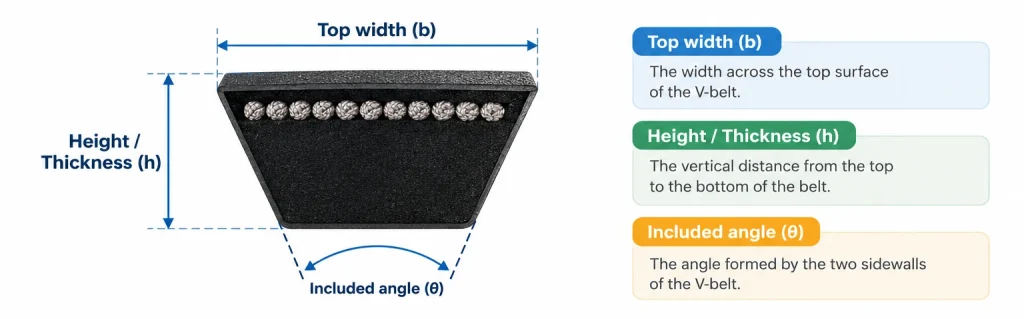
A V-belt transfers power through contact between its angled sides and a compatible pulley groove. Its section is commonly described by top width (across the broad top) and height or thickness (from top to bottom). These measurements help narrow down the profile but cannot describe the entire belt.
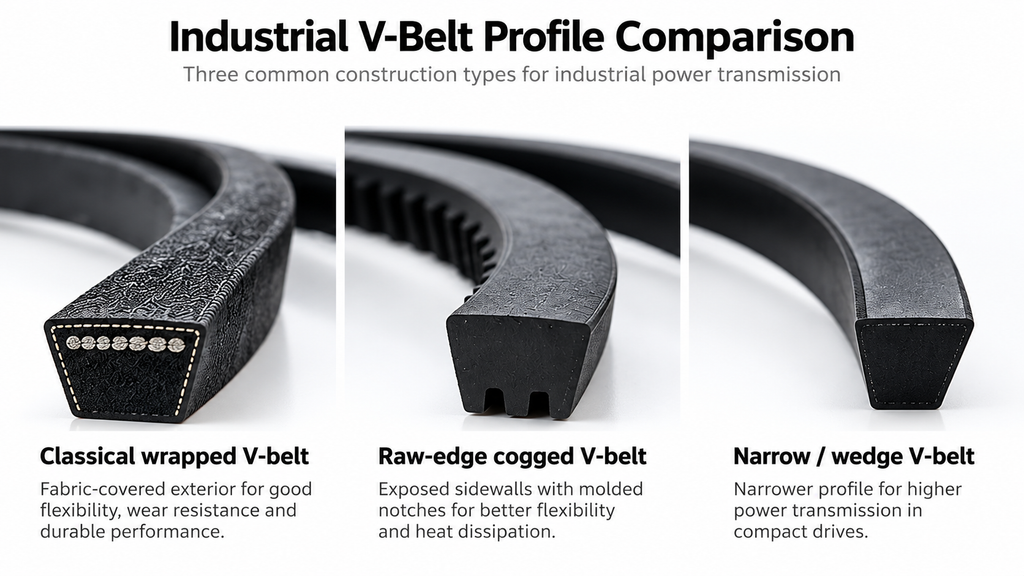
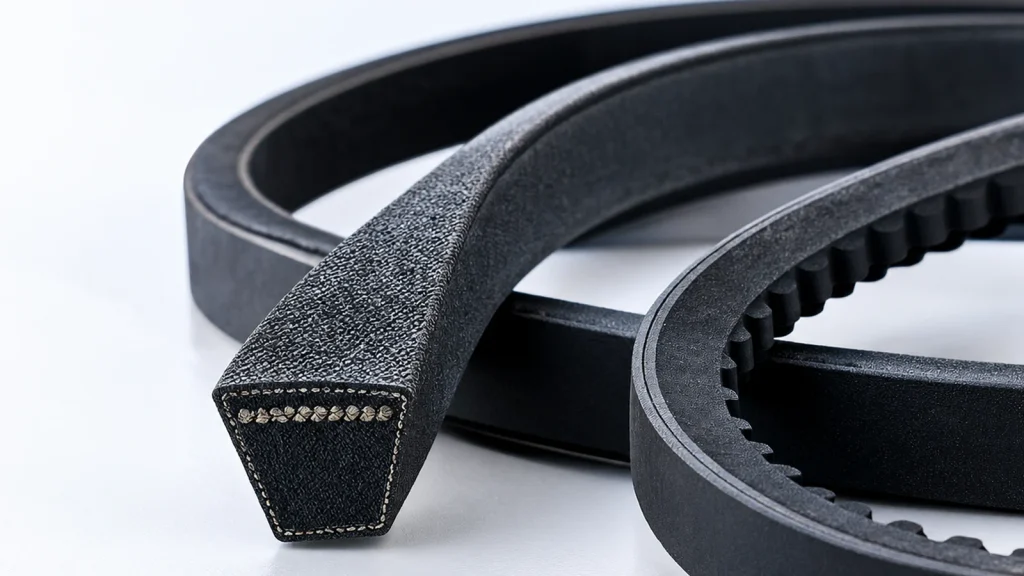
A useful chart also identifies the belt family and construction. Wrapped belts have a fabric-covered exterior; raw-edge belts expose the working sidewalls, and cogged or molded-notch versions have transverse notches on the underside.
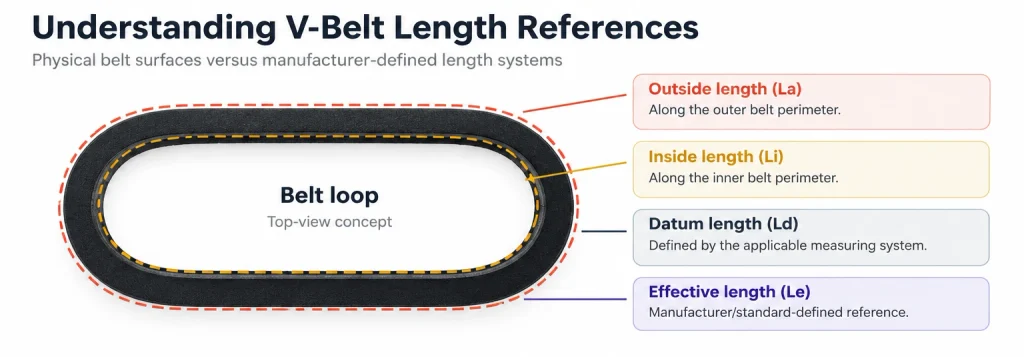
Length is a separate specification. Depending on the series, the printed number may refer to inside circumference, outside circumference, datum length, or effective length. Never infer the measurement reference from a bare number without identifying its product series.
What Are the Main Types of Industrial V-Belt Profiles?
Classical V-belts commonly use Z, A, B, C, D, and E section names. They appear in conventional pulley drives, and manufacturer documentation distinguishes wrapped classical constructions from raw-edge classical versions.
Raw-edge cogged classical belts may carry AX, BX, or CX markings. The X commonly identifies molded notches in the relevant manufacturer’s nomenclature, but construction and naming must still be checked by series. For example, an A and an AX profile can share nominal top width and height without necessarily sharing all installation or duty requirements.
Narrow or wedge V-belts include SPZ, SPA, SPB, and SPC families, together with 3V, 5V, and 8V designations in other product systems. These sections are designed around different profiles and pulley arrangements from classical belts. A B and an SPB belt should not be treated as equivalent merely because their top widths are similar.
V-Belt Size Chart: Common Profiles and Dimensions
The following reference combines nominal dimensions reported for specific Gates belt series with published LKBELT raw-edge section dimensions. It is not a universal dimensional standard. Metric values are retained as published; approximate inch equivalents have been calculated and rounded for quick US reference, not as exact manufacturer design specifications.
| Published product family | Profile | Top width mm (≈ in) | Height mm (≈ in) | Published angle |
|---|---|---|---|---|
| Gates Hi-Power wrapped classical (2019) | Z | 10 (0.39) | 6 (0.24) | — |
| Gates Hi-Power wrapped classical (2019) | A | 13 (0.51) | 8 (0.31) | — |
| Gates Hi-Power wrapped classical (2019) | B | 17 (0.67) | 11 (0.43) | — |
| Gates Hi-Power wrapped classical (2019) | C | 22 (0.87) | 14 (0.55) | — |
| Gates Hi-Power wrapped classical (2019) | D | 32 (1.26) | 19 (0.75) | — |
| Gates Hi-Power wrapped classical (2019) | E | 38 (1.50) | 23 (0.91) | — |
| Gates Delta Classic wrapped (2024) | E | 38 (1.50) | 25 (0.98) | — |
| Gates Super HC wrapped narrow (2019) | SPZ / 3V | 10 (0.39) | 8 (0.31) | — |
| Gates Super HC wrapped narrow (2019) | SPA | 13 (0.51) | 10 (0.39) | — |
| Gates Super HC wrapped narrow (2019) | SPB / 5V | 16 (0.63) | 13 (0.51) | — |
| Gates Super HC wrapped narrow (2019) | SPC | 22 (0.87) | 18 (0.71) | — |
| LKBELT industrial raw-edge | HM | 10.5 (0.41) | 8.0 (0.31) | 38° |
| LKBELT industrial raw-edge | AX | 13 (0.51) | 8.0 (0.31) | 38° |
| LKBELT industrial raw-edge | BX | 17 (0.67) | 11 (0.43) | 38° |
| LKBELT industrial raw-edge | CX | 22 (0.87) | 14 (0.55) | 38° |
| LKBELT industrial raw-edge | DX | 32 (1.26) | 19 (0.75) | 38° |
| LKBELT industrial raw-edge | EX | 38 (1.50) | 23 (0.91) | 38° |
The Hi-Power and Super HC figures are from the Gates Preventive Maintenance Manual, page 17; the alternative E-section row comes from the Gates Delta range brochure, page 4. The six LKBELT rows reproduce supplier-published figures from the LKBELT rubber V-belt product page.
The E-section difference deserves attention: Gates publishes 38 × 23 mm for the Hi-Power E section in its 2019 manual, but 38 × 25 mm for Delta Classic E in its 2024 brochure. Continental also identifies a classical 40/E profile. These references describe named product families, not a single interchangeable specification. LKBELT’s 38 × 23 mm EX row concerns a raw-edge profile, not a verified substitute for either wrapped E belt. Its listed 38° is a supplier-published value, not an independently measured angle or a universal pulley-groove specification.
How Do You Measure a V-Belt?
Begin with the complete marking if it survives. Photograph the belt’s top, sidewalls, and underside before cleaning or handling it further. If the belt is installed, follow the equipment manufacturer’s shutdown and lockout procedures before inspection; never measure or touch a moving drive.
For a removed belt, use calipers to estimate the top width at a relatively unworn location. Measure the vertical height across its cross-section rather than following the sloping sidewall. Inspect whether the exterior is fabric-wrapped, whether there are molded notches, and whether separate ribs are joined by a common backing.
To estimate outside circumference, a flexible tape can follow the belt’s outer surface, or the removed belt can be rolled carefully along a straight measuring surface for one complete revolution. Record the result specifically as an estimated outside circumference, not simply “belt length.”
Inside-length measurement uses a different reference. Gates describes a dedicated belt-length finder that reads inside length with the belt seated over measuring fixtures; its maintenance manual also warns that this reading is indicative rather than suitable for precision length or tolerance determination.
A used belt can be worn, damaged, elongated, or deformed. Its measured width and length are therefore evidence for identification, not proof of the original nominal size. Manufacturer documentation, an old order record, or equipment parts information can be more reliable than attempting to reverse-engineer a part number from a worn sample.
Inside Length vs Outside Length vs Datum Length
This is the most important distinction in V-belt size conversion. Four length terms describe different references, not four interchangeable names for one measurement.
Inside length (Li or I.C.) refers to the circumference measured along the belt’s inner surface. Outside length (La or O.C.) refers to the outer surface. Datum length (Ld) is defined using a specified reference position associated with the belt and pulley measurement system, rather than either visible belt surface. Effective length (Le or EL) is another manufacturer- or standard-defined reference and must be interpreted under the relevant specification.
The numbering convention depends on the belt family. In the official Gates Belt I.D. Chart, 5VX800 identifies a 5VX belt in the Gates Super HC / Super HC XP identification group with an 80-inch outside circumference. The “X” indicates a molded-notch construction in this chart, while “800” encodes the 80-inch O.C. under that specific naming rule. It does not mean that every V-belt number ending in 800 uses outside length. By contrast, Gates’ Hi-Power II A–E numbering convention refers to inside circumference.
Other Gates product families use different conventions. Its maintenance manual distinguishes ISO-labelled classical profiles designated by datum length from corresponding DIN-labelled metric profiles designated by inside length. For several narrow SPZ/SPB-type families it documents datum-length conventions; certain RMA-series products use effective-length conventions. Continental likewise publishes Li ranges for classical Conti V profiles and Ld / Le ranges for narrow profiles in its Conti V product information.
A useful second example is XPB2990/5VX1180. The Gates Preventive Maintenance Manual, page 13, identifies this narrow raw-edge molded-notch belt by a 2990 mm datum length or a 118-inch outside circumference. That is a documented dual designation for this manufacturer and series, not a universal formula for XPB-to-5VX conversion.
Do not add or subtract a fixed amount from a measured circumference until the exact belt family and manufacturer conversion method are known. Even a conversion published for one classical series may include size-dependent exceptions. If replacement information gives only “1,200 mm,” ask whether it means inside, outside, datum, or effective length.
LKBELT V-Belt Length Conversion Chart: Li, La, and Lp
LKBELT provides dimensional specifications for selected standard and cogged V-belt profiles, including cross-section sizes and length relationships.
For the belt profiles listed below, inside length (Li) is used as the ordering-length reference. Outside length (La) and pitch length (Lp) can be determined using the corresponding values.
| V-Belt Profile | W × H (mm) | Bottom Width S (mm) | Outside Length (La) | Pitch Length (Lp) |
|---|---|---|---|---|
| M | 10 × 6 | 5.9 | Li + 38 mm | Li + 22 mm |
| A / AX | 13 × 8 | 7.5 | Li + 50 mm | Li + 36 mm |
| B / BX | 17 × 11 | 9.4 | Li + 69 mm | Li + 43 mm |
| C / CX | 22 × 14 | 12.3 | Li + 88 mm | Li + 56 mm |
| D / DX | 32 × 19 | 18.2 | Li + 119 mm | Li + 79 mm |
These length relationships apply to the specified V-belt profiles. Other belt families may use different measurement conventions, so the exact profile and length reference should be confirmed before ordering a replacement.
The M profile in this table, measuring 10 × 6 mm, should not be confused with LKBELT’s separately listed HM raw-edge profile, measuring 10.5 × 8 mm. Similar designations do not establish identical belt sections or replacement compatibility.
Worked Example: A/AX V-Belt with a 1,000 mm Inside Length
Consider an A/AX belt with a specified inside length of 1,000 mm.
Using the length relationships above:
- Inside Length (Li): 1,000 mm
- Outside Length (La): 1,000 + 50 = 1,050 mm
- Pitch Length (Lp): 1,000 + 36 = 1,036 mm
This example shows how the length references relate to one another for the specified profile.
The three values represent different measurement references for the same assumed belt. They should not be used as interchangeable ordering dimensions.
For instance, if an equipment drawing specifies 1,000 mm Lp, ordering a belt with Li = 1,000 mm would describe a different requirement under this conversion table.
Before ordering, confirm the exact belt construction, pulley requirements, and original equipment specifications. The example does not establish availability or compatibility with a particular drive.
A length conversion helps identify a candidate replacement, but it does not prove that the belt will fit or operate correctly.
What Should Buyers Check Before Converting V-Belt Lengths?
A reliable replacement inquiry should identify the original belt profile, manufacturer or series, belt construction, and the length reference being used.
If a purchasing record specifies only “1,200 mm,” the measurement is incomplete unless it identifies Li, La, Lp, Ld, Le, or another applicable reference.
Similarly, a worn belt’s measured outside circumference should not automatically be treated as its original nominal length.
For the LKBELT profiles listed in the conversion table, use the corresponding relationships. For other belt families, consult the relevant manufacturer documentation.
Identify the belt profile first, confirm the length convention second, and verify drive compatibility before ordering.
How Can You Identify a V-Belt Without a Readable Part Number?
Work from the strongest clues toward the least reliable. First check the machine manual, purchase history, packaging, and any remaining characters on the old belt. Next identify the belt construction and estimate its top width, thickness, and outside circumference.
Inspect the pulley information as well. A pulley marking, machine model, original drive drawing, or belt supplier’s technical record may reveal a profile or length family that the worn belt alone cannot confirm. For multi-groove drives, record the number of belts and whether they are separate or joined.
If the old belt has worn sides or missing material, avoid treating a single caliper reading as an exact catalogue dimension.
Can V-Belts with Similar Dimensions Be Interchanged?
Matching top width and thickness is useful identification evidence, but not a complete compatibility test. The belt’s profile must seat correctly in the pulley groove, and the pulley geometry and condition must suit its intended construction. A belt that rides incorrectly can cause slippage, wear, or unreliable power transmission.
Also compare length on the same reference basis, belt construction, duty requirements, number of belts, and any matching requirements for multiple-belt drives. Wrapped, raw-edge cogged, joined, and reinforced constructions should not be swapped solely on visual similarity.
Likewise, a 17 mm-wide classical B belt is not automatically equivalent to every narrow-profile option with a similar width.
Confirm the actual pulley groove, working speed, loads, tensioning arrangement, and equipment maker’s requirements.
What Should Buyers Provide When Ordering Replacement V-Belts?
Useful details include:
- Belt identification: complete original marking, brand if known, and proposed profile.
- Dimensions: top width, thickness, length value, units, and whether the length is Li, La, catalog Lp, Ld, Le, or only an approximate measurement.
- Construction: wrapped or raw-edge; cogged or smooth; single or joined; any known reinforcement.
- Drive details: machine make and model, pulley groove information, pulley sizes, belt count, and relevant drawings.
- Operating requirements: speed, load, starts and stops, temperature, and significant oil, dust, or chemical exposure.
- Ordering details: required quantity, destination, and clear photographs of the old belt and drive.
You can compare industrial V-belt products at LKBELT and contact the LKBELT team with your replacement specifications. Supply confirmation should follow a review of the complete profile, construction, and operating information; a size-chart match alone is not a product-availability or fitment guarantee.
Frequently Asked Questions
What is the difference between an A belt and an AX belt?
They belong to related classical profile families. In the cited Gates product terminology, AX identifies a raw-edge, molded-notch construction; A identifies a classical section. Similar nominal dimensions do not, by themselves, prove replacement compatibility.
Does a V-belt part number always indicate inside length?
No. Some named product lines use inside circumference, others outside circumference, datum length, or effective length. Check the manufacturer and series before interpreting the digits.
Can I measure a worn V-belt to find the replacement size?
You can estimate its section and circumference, but wear and distortion introduce uncertainty. Use measured values alongside machine records, pulley details, and a manufacturer-specific identification guide.
Are SPB and B V-belts the same size?
No. They belong to different profile families. Nominal dimensions, groove requirements, and length designations should be confirmed individually rather than inferred from a similar name or width.
Should I replace all belts in a multi-belt drive?
Follow the drive and belt manufacturer’s instructions for matched sets and replacement practice. Mixing different wear conditions or constructions can create uneven load sharing; inspect the complete drive before ordering.
Conclusion
A reliable V-belt size chart helps identify candidate profiles; it cannot confirm a replacement on its own. Start with the complete marking, distinguish wrapped and raw-edge constructions, and establish precisely what the stated length measures. Then verify pulley fit and operating requirements.
For uncertain replacements, provide the original marking, measured dimensions, photographs, and machine information when requesting technical confirmation. That is more dependable than guessing from top width or applying a universal length conversion.