
Timing Belts for Tobacco Machinery
For a tobacco-machine replacement, match the original tooth profile and every cleat position to the equipment drawing. Review the base belt and its attachments as one finished assembly.
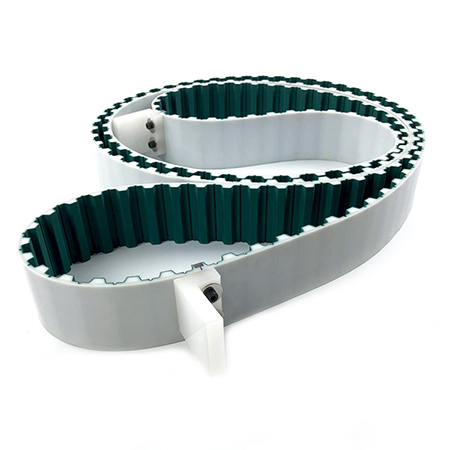
Start from the OEM part and working position
A belt with attached cleats needs to fit the pulleys and the machine’s working layout. Identify the machine model, original part number and belt position before discussing a replacement.
A photograph shows the general construction, but does not supply cleat spacing, fixing dimensions or the finished belt length. Use the original drawing or a labelled sample for those details.
Locate the belt
Record the tobacco-machine model, station and original part number.
Identify the base
Provide tooth profile, pitch length or tooth count, width and joint requirement.
Map the cleats
Show shape, height, spacing, orientation and alignment to belt teeth.
Review fit
Check fixing method, hole positions and clearance around adjacent machine parts.
Specify both motion and handling features
| Machine position | Belt duty | Information to confirm |
|---|---|---|
| Toothed drive | Engages the pulley for synchronized motion. | Original tooth profile, pulley drawing, width and finished length. |
| Cleat/contact position | Presents projecting features at defined intervals. | Number, shape, height, spacing, orientation and contact-face detail. |
| Attachment point | Connects cleats to the base belt. | Hole positions, fasteners or other original fixing method; clearance in operation. |
Connect the application to the exact belt
The linked supplier product pages show a PU timing belt with cleats and a tobacco-machine listing. Final dimensions and attachment layout are made from the machine reference or approved sample.
Include the machine conditions with the drawing
Original reference
Send the machine label, part number and belt marking, if available.
Contact and load
Describe the item handled, contact face, load and speed at the belt position.
Environment
State temperature, dust, deposits and the actual cleaning method.
Access and joint
Show installation space and whether the machine needs an open, joined or endless finished belt.
Record the finished reference and its environment
| Detail | Information to provide |
|---|---|
| Base belt | Tooth profile, width, finished length or tooth count |
| Cleats | Shape, height, width, count, spacing and tooth alignment |
| Attachment | Fastener or joining detail, hole positions and clearance |
| Machine | Model, original part number, belt position and pulley drawing |
| Order | Quantity, destination and required drawing or sample approval |
Approve the full assembled geometry
Check the base belt
Confirm pulley engagement and finished width and length against the drawing.
Check each attachment
Confirm cleat shape, count, intervals and fixing positions before production.
Check on equipment
Review clearance and movement using the machine’s established acceptance method.
Tobacco processing machinery belt questions
Can a cleated belt be ordered from a photograph alone?
The photograph helps identify construction. A drawing or sample is needed for cleat geometry and attachment positions.
Which timing profile is suitable?
Start with the original belt and mating pulley; the industry name does not determine tooth profile.
Is this a food-contact belt?
The tobacco-machine product listing does not establish food-contact compliance. State any documentation requirement for the exact finished belt.
Share the belt and cleat drawing
Send the tobacco-machine model, original belt reference, tooth profile, cleat layout, attachment detail and finished dimensions. Include the quantity and operating conditions so the complete assembly can be reviewed.
Send your drawing or original belt reference
Include the quantity, delivery destination and any sample approval requirements. Photographs of the belt and installed position help our team review the construction.
Get a Quote