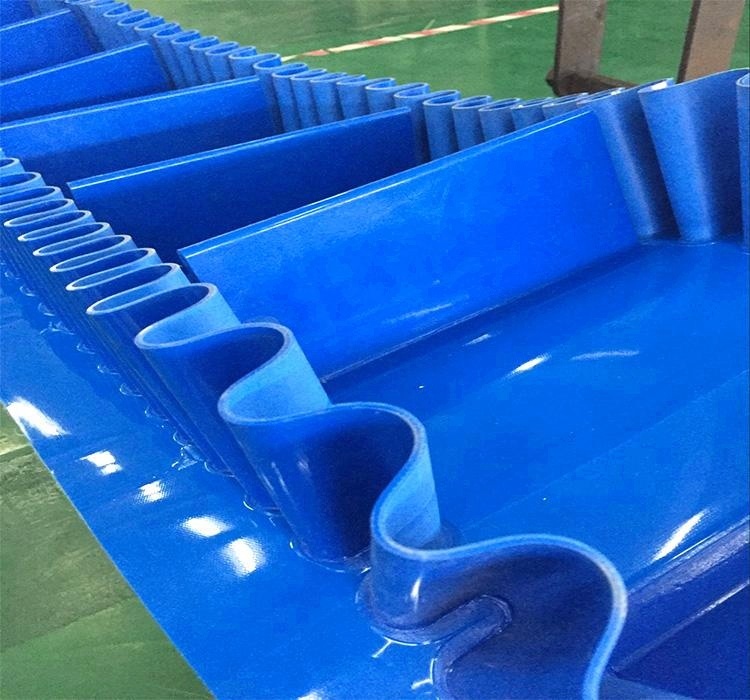
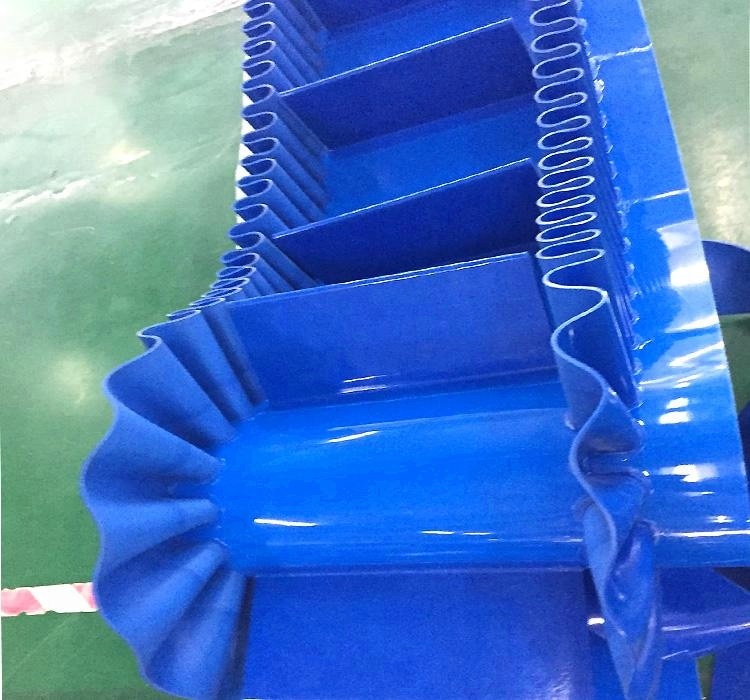
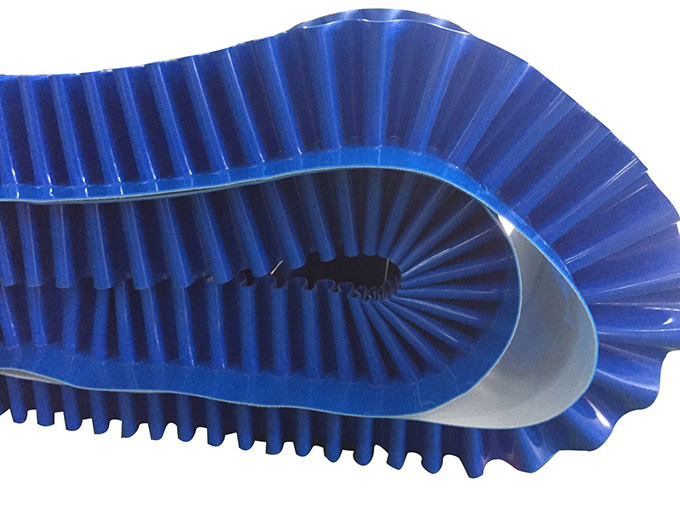
Conveyor belt with sidewalls and cleats
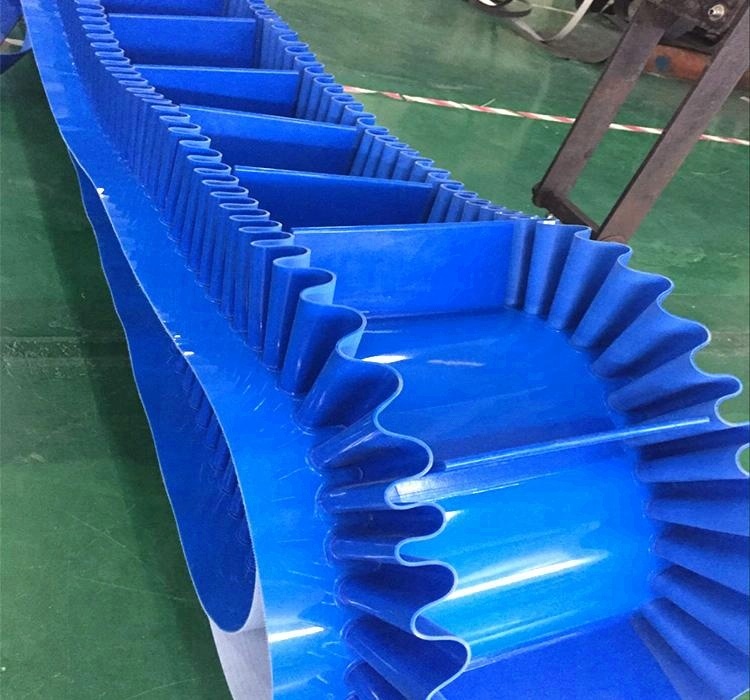
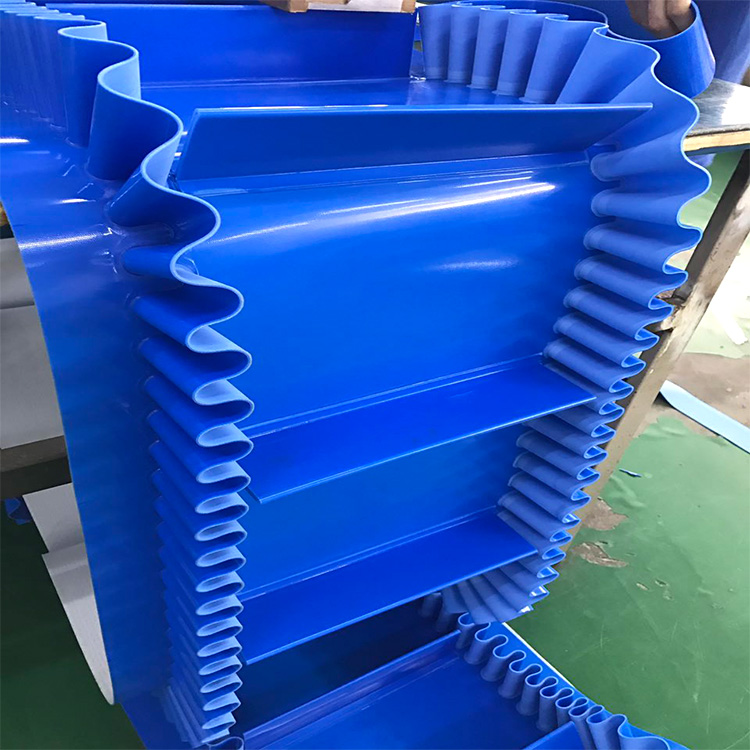
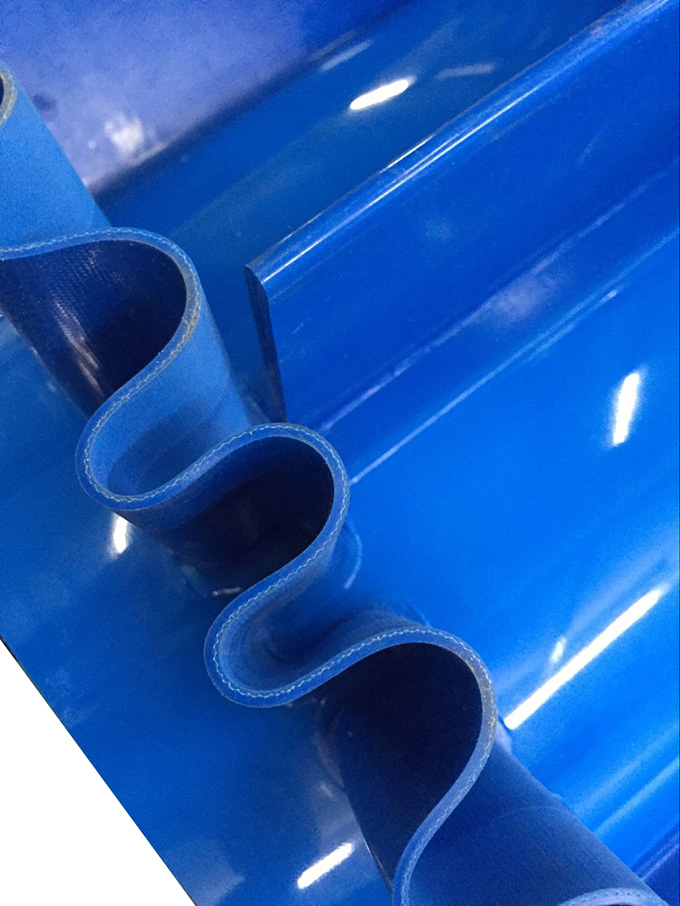
Sidewalls and cleats divide the carrying surface into pockets for the material being conveyed. The blue belt shown combines corrugated sidewalls with transverse cleats. Specify the base belt, pocket dimensions and conveyor arrangement together when requesting a replacement or custom assembly.
| Item | Product details |
|---|---|
| Product | Conveyor belt with sidewalls and cleats |
| Base-belt range | PVC; specify the required material grade |
| Colour shown | Blue |
| Assembly dimensions | Width, length, sidewall height and cleat spacing |
| Guiding | Underside guide bars to suit the conveyor |
Send a conveyor drawing, product details and quantity to request a quote.
Sidewall and cleat details
Dimensions for your conveyor
| Detail | Information to specify |
|---|---|
| Base belt | Material grade, total width, finished length, thickness and fabric construction |
| Sidewalls | Height, corrugation shape, width and offset from each belt edge |
| Cleats and pockets | Cleat height, shape, spacing and usable pocket width |
| Guides and return path | Guide profile and position, pulley diameters, supports and clearance for sidewalls and cleats |
| Duty and handling | Incline, speed, load, product size, temperature and cleaning method |
Base-belt construction and operating conditions
The PVC base-belt range includes thicknesses of 1, 2, 3, 4, 5 and 6 mm, with colours and surface patterns selected for the application. Choose the finished construction together with the sidewalls, cleats and joint.
Specify the conveyed material, incline, loading conditions, belt speed and cleaning method. Include the pulley diameters and return-side supports so the sidewalls, cleats and joint can be selected as one assembly. State the operating temperature and any exposure to oils or chemicals when requesting the belt.
Joint and guiding options
A single-layer finger joint uses fingers cut into the ends and joined under heat and pressure. An overlapped finger joint uses a stepped, layered joint arrangement. Select the joint for the actual belt construction and installation; include any requirement for an openable mechanical fastener.
Guide bars can be positioned on the underside to suit the conveyor. Show their profile, location and matching pulley or support grooves on the drawing.
PVC pattern-belt range reference
These are base-belt range examples, not the dimensions of the complete sidewall assembly shown above. The grade code containing FDA is a product identifier; request the applicable documentation for your selected grade. On smaller screens, scroll the table sideways to view all columns.
| Type / range | Thickness (mm) | Colour | Layers | Pattern |
|---|---|---|---|---|
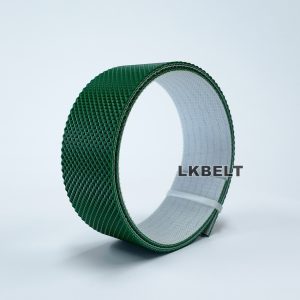
| PB22-A18 | 2.2 | Green | 2 | Diamond |
| PB50-A35 | 5.0 | Grey / white | 2 | Fishbone |
| PB60-3M-H | 6.0 | Dark green | 3 | Seaweed |
| PB52-A40 | 5.2 | Green | 2 | Grass |
| PB35-A32 | 3.5 | Green | 2 | Pinstriped |
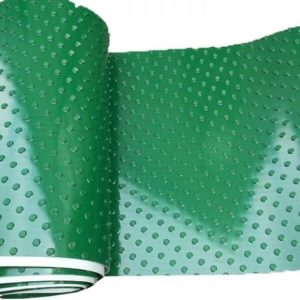
| PB6-YDG | 6.0 | Green / white | 2 | Embossed dot |
| Golf-pattern range | 2.5 | Dark green | 2 | Golf |
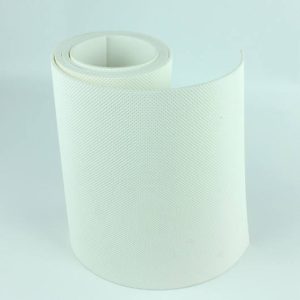
| PB22-A18-W-FDA | 2.2 | White | 2 | Diamond |
Request a matched belt assembly
Send the conveyor drawing or existing belt sample, pocket dimensions, pulley arrangement and required quantity. Include photographs of the carrying surface, underside, joint and return path so the assembly can be matched to your equipment.